This website or its third-party tools use cookies which are necessary to its functioning and required to improve your experience. By clicking the consent button, you agree to allow the site to use, collect and/or store cookies.
Please click the consent button to view this website.
I accept
Deny cookies Go Back
  • Skip to primary navigation
  • Skip to main content

ABTI | Joseph Riggio International

  • Home
  • Meet Joseph
    • To Sicily And Back … A Love Story
    • JSR Short Bio & CV
    • Abbreviated CV Timeline
  • BLOG :: “Blognostra”
  • Contact
You are here: Home / Archives for Joseph Riggio

Joseph Riggio

Life Is Movement

Life Is Movement

by Joseph Riggio · Apr 20, 2018

  The Magic of Movement

  Do you recognize the magic in movement … or like most people do you take it for granted that humans move?

Think about that comment for a moment.

We typically don’t even notice we have the capacity for or access to movement, despite being in movement virtually in a constant way, 24 hours a day, 7 days a week, 357 days a year, year after year … even when we sleep (except for very brief periods of REM sleep paralysis, and even then breathing and eye movement is happening). The exception to this ignorance of familiarity seems to be when we are in pain or unable to move in the ways we want.

There’s a second factor as well that falls within the scope of the magic of movement … i.e.: how our physical bodily movement is reflected in and by our thoughts, and how in mirror form our thoughts are reflected in and by our movement. There are many sources that document this at a very precise level, for example the work of Dr. Paul Ekman on micro expressions (https://www.paulekman.com/).

What I’d like to share with you is the power of becoming conscious of your movement to improve the quality of your PERFORMANCE and by virtue of that improvement the quality of your LIFE.

Let’s call PERFORMANCE the ability to willfully enact behaviors that create the outcomes you desire, including your cognitive behaviors that determine the way you experience yourself and the world around you as well as others with whom you share it. Then let’s say that the quality of  your life is determined by the quality of the way you perform, where your performance is a function of the following algorithm:

PERCEPTION/SENSATION ➡︎ SENSE-MAKING ➡︎ MEANING-MAKING ➡︎ DECISION-MAKING ➡︎ ACTION!

Where each of these steps in the algorithm have the potential to be willful and intentional, and most significantly aligned with the outcome of how you desire to have the experience of your life, i.e.: who you are being in any given moment.

To improve your performance in the way I suggest is possible above you’d need to attend to it in a way that is beyond how most people will ever will. In particular this means attending to very precise and distinct actions that are part of how you move, in relation to the thought process that is simultaneous to your movement, even and especially your micro-muscular responses.

[NOTE: Here’s a link to an article I wrote in 2000 as an example of what I mean by that: Utilising Soma-Semantic Modeling.]

Soma-Semantic Modeling is a process that we use within Soma-Semantics℠ as a part or the MythoSelf℠ Process model to lead people to uncover how they create their own thoughts and responses, so that they can willfully choose the outcomes they create. The essence of the model is a function of tracking the movements that are simultaneous to the cognitive processing. Within the model movement is considered part and parcel of cognitive processing, i.e.: how and what you think.

It’s really that simple, it’s impossible to separate these two aspects of being human, i.e.: thinking and moving!

Or, we could say that movement is thinking, and that thinking is virtually impossible without movement (even if the movement is outside of the scope or ordinary awareness and perception, i.e.: micro-muscular movement such as changes in breathing or eye accessing).

However, the magic is that we have much more willful and intentional control over our movement in most cases than over our thoughts, or our emotions for that matter (and “Yes, Virginia, emotions are based in movement as well … in fact, inextricably so).

But, let’s leap to a very critical point:

  • “Somatic Education” or “Somatic Intervention/Therapy” mostly, if not entirely, is done to alleviate discomfort, pain or some limitation of physical mobility. What I am pointing to here is NOT that.

Another critical point to consider would be:

  • Most “Embodiment Training” or “Embodiment Facilitation” means attending to being present, or mindful, about what is immediate to the experience that is happening and unfolding. Again, I am NOT pointing to that either.

What I am pointing to is the function of movement:

  • I am point to “Vitality” and “The Felt Sense of Self” … two essential qualities of being human, and the uniqueness of “humanness” in movement (as humans enact and experience it).


The Essential Quality of Human Movement:

Humans move in particular ways that only humans move. I get it, that that seems obvious, yet we so often refer to exquisite human movement in non-human similes and metaphors, e.g.: “he/she moves like a panther,” “strike like a tiger, ” “run like the wind” or “Become flexible and surrender yourself as the willow surrenders itself , bend without breaking.” We use these forms of speech especially when we intend to offer someone a high compliment or dramatize a point about movement.

Human movement is a function of our innate structure, i.e.: how we are built physically, the laws of physics and how they act upon our structure, e.g.: gravity, and our learning about how we use ourselves physically. 

We could drill down and make the list of how human movement functions more specific and detailed, but the simple outline above should be enough to make the point that movement has limitations that are inherent in what it is to be human, as well as in how we have learned what it means to be human and use ourselves well.

The great challenge actually is that not only don’t we typically learn to use ourselves well physically, we are actually taught to use ourselves poorly!

Most people who have been educated in a Western school system, or work in an office type environment have been taught to become very still for long periods of time in positions that weaken and distort the body. Primarily this means sitting for long periods of time, often hunched forward with your head pitched forward over the body, like a bird waiting to peck at something in front of it … the problem for humans is that they are birds or built like them either.

Another great insult to how we move and damage our bodies (and our minds in the process) is through sustained repetitious movement that often happens in factory or assembly type work, where the same movement pattern is repeated over and over, sometimes for hours on end, with minimal breaks in-between. This kind of continuous repetition over time begins to limit the body to perform that movement more efficiently by altering the basic structure, shortening some tendons and ligaments, while lengthening others, and making alternative movement more challenging, difficult or impossible.

Now we could get into the physical ramifications of this poor learning about body awareness and use, like pain and injury, but that’s not what I want to share with you (nor am I an expert in that aspect of movement). Instead, I want to point out again that movement is thinking, and thinking is virtually impossible without movement, especially when you are referring to micro-muscular movement as part of the larger fine and gross motor movement. So all of this poor learning about body awareness and use limits and distorts your thinking and ability to perform as well.

Start at the simplest level. In order to train children to be still from a very young age they are trained to ignore the signals and demands of their body to move, to adjust, to be free of a constantly held position … like sitting. So little by little, and within a very short period of time, say just a year or two, children are trained to sit still and pay attention from a sitting still position, and have shut down their internal awareness of their bodily process. These children are now primarily or exclusively externally aware, and minimally or completely unaware of their internal responses. Like this they have lost their ability to adjust in the ways that are best suited to them unique to perform well.

Even when we observe most physical education classes we see children trained to perform movement organized to some ideal, and not to explore or use their own bodies in ways that are uniquely suited to them as individuals. Then we can take this same idea to physical training or exercise for adults and watch them in yoga classes trying to emulate the “perfect form” of the teacher, or in martial arts classes doing the same, attempting to throw the perfect punch or kick. In organized sports there are also “perfect forms” that are stressed by coaches for the athletes to attempt to achieve, the perfect bat, tennis, golf or cricket swing … the ideal pitch or throw … the best swimming stroke or running gait … all based on some idea of what that means on a universal level and imposed on the individual.

Of course when we see fantastic performers do these things they are beautiful to watch and experience, in part because these individuals have learned to either adapt themselves to the ideal, or more likely found the ideal for themselves that transcends the illusion of a universal ideal. Once you recognize and accept the uniqueness of every body this becomes glaringly obvious … that no universal ideal exists for any particular human body.

So in the course of learning all of this “perfection” you learn to shut down your natural brilliance, how you uniquely and specifically are designed to move and perform and excel. 

This of course carries over as well into how you think about how you think, or “should” think, i.e.: how you use your mind for things other than how you move. When you accept that the teacher or society knows better about how you should use your body than you or nature do, then it’s easy to get you to accept they also know more about how you should use your mind as well.

However, despite all the bad learning, your body remembers …

If you give yourself a change you can return to natural movement, essential human movement, in a way that is uniquely suited to you and your body. However, this normally takes some re-training to learn how to forget what you have come to think is correct movement, and re-discover what natural movement is for you.

When you remember, and realize, what natural movement feels like and the freedom of moving naturally again it liberates you in a way that virtually nothing on earth can … even when that movement is a simple as effortlessly raising your arm or lightly flexing your wrist in the way your body is designed, and not in the corrupted way that you’ve been taught to do it “perfectly” to suit the design and needs of others.


Remembering Yourself

So here the good news … you can re-access at the very least some aspects of your natural movement as long as you can move, regardless of age, injury or poor learning. 

The beginning of remembering yourself starts with a focus on noticing what’s happening right now, even as your reading this … where are you in your body?

If you are sitting how is your weight distributed, are you sitting over your hips with your spine mostly erect and well supported? Or, are you sitting leaning forward or leaning back? Is your head over your spine, resting lightly on your neck and shoulders, free to move in any direction effortlessly? Or, is your head pitched forward, back to one side or the other, feeling tight and difficult to rotate smoothly and with pleasure? Are your shoulders relaxed and slightly dropped from their own weight and the weight of your arms towards the side of your body, rotated ever so slightly back so you feel a natural lengthening in them and your neck? Or, are your shoulders hunched and bunched, holding tension and pressing up against your neck, making movement all but impossible until your relax and release them and your upper back muscles too?

While the specific way you are put together is unique to you and your body in particular, the general structure of the human body is designed to be free of excessive tension at all times, even in hyper-performance mode. In fact the best performers are typically the least tense in terms of the movement they are enacting at any given moment.

If you’re unsure what it looks like to have a natural body in motion, or at rest, find a small child under the age of five and just observe how they are when they are still and relaxed, or in active motion. Some children retain this natural state of being and how they use themselves much longer, even up to the age of ten or twelve. But most children are beginning to show the signs of corruption in the ways they use their bodies by the time they enter school, and within a few years of schooling lose the ability to move naturally almost completely.

So starting with just noticing how you are in your body at random moments during the day, doing typical daily things you can begin to reshape your sense of self. You’ll begin to inhabit your body again in the way you did as a small child. You’ll find along the way that your creatively likely increases exponentially as you do, and your tolerance for insult of any kind … physical, mental, emotional, even spiritual … decreases in an equally exponential way, whether the insult is imposed upon you externally, or by yourself.

When you begin to re-inhabit yourself, and re-discover freedom in movement, you’re on a path to remarkable self liberation that will increase for as long as you choose to continue pursuing this way of being within yourself.

By the way, this way of being is not the way of the monk or yogi striving to become still for hours on end in meditation. This is more like the way of the hunter or warrior alert and intent in relation to the signals in the system, as well as to the subtle signals within themselves. Rather than shutting down or shutting off the urges to move, the hunter or warrior gives into them with precision and willful intention. The hunter or warrior moves stealthily and silently if they need or want to, or they can explode in a fury of motion instantaneously from a perfect still position without hesitation or preparation.

Think about this as mental movement as well, to be alert and intent to the signals around you, and to be able to keep your mind as quiet and still as you like or need, while being able to instantly respond in whatever way best suits you without hesitation or preparation. This way of being resides in how you use yourself at all times. Take back your innate gift of movement and all the rest will follow.

In the MythoSelf Process training we lead with Soma-Semantic modeling, starting with evoking from you how you are at your best, and then teasing out the minute details of how this shows up on you, feeding it back with precision until you can replicate it at will.

Then together we work to refine this way of being, and your access to it … connecting it to the things you do day to day as part and parcel of your daily routine, so it all becomes second nature. When you’ve begun to reform to the essential way you are within yourself, before any corruption was imposed or occurred, we can extend it to the most challenging aspects of life … work, relationships, self-care, care of others, care of the world-at-large … until you move through the world in a primal, resourceful manner that emanates effortless grace and power.

In addition to the original training that covered all of the above ways of accessing yourself, we’ve added new layers to the MythoSelf Professional Training Certification program as well that take this learning to a level, that was not present before. Now we train everyone who joins the program in how to access their slow and fast brains, for slow thinking and fast response, always emphasizing how to perform effortlessly. Then we take this further by exposing the layering of socio-cultural conditioning, making it obvious, and a choice, instead of an imposition to be carried out unconsciously.

Along the way you’ll also begin to notice how all of this is showing up on others around you, how to identify the ways in which they limit themselves, and limit what is possible on their own or with others, including with you. We’ll also begin the process of developing the expertise and skills to intervene masterfully if you so choose, either as a gift or in a professional capacity. This level of training is rare and powerful, and we delight in sharing it after decades of our own immersion and learning.

Like this you’ll find yourself ready for anything at anytime, and knowing in an intuitive way what the best “right action” is for you uniquely despite the challenges, or even chaos, that might arise in your life.

And, think … it all began with a simple noticing how you are at any given moment within the body you already have today.

As always let me know what you think … I love reading and responding to your comments.

All the best,

Joseph Riggio, Ph.D.
Architect & Designer of the MythoSelf Process and SomaSemantics


P.S. – The MythoSelf Professional Training Certification program is and intensive learning experience designed to create a new level of access to yourself at your best at all times, as well as the skills to incorporate the learning professionally as a coach or consultant, or in a sales or leadership role in business.

Folks who want to develop deep expertise and skills at the intersection of body-mind awareness, as well as the ability to use this expertise and skills professionally attend MythoSelf Professional Training Certification programs from around the world. MythoSelf Professional Training Certification training programs are presented and delivered by myself and my team of Master Trainers and trainers in multiple international locations, and are open to anyone with a background in coaching, consulting, training, counseling, sales, leadership, or without any specific previous training or professional experience at all … everyone is welcome and your experience will be unique to you.

There are new programs about to begin in the next few months. If you’d like to know more about how you can participate in a MythoSelf Professional Training Certification program just click this link: YES, PLEASE I WANT TO KNOW MORE!




Filed Under: Uncategorized

L’Chaim …

L’Chaim …

by Joseph Riggio · Mar 22, 2018

“To Life …”


This morning I was inexplicably brought back to a memory of sitting on a small bench overlooking the bridge that crossed the pond at the Blue Dell Farm in Pemberton, NJ during a break, while at an NLP training with Roye Fraser. I’d gone there to study NLP with him, and discovered he was weaving a magical score with something he called “The Generative Imprint” using NLP to deliver and train in this model of transformational change he’d been developing for about a decade at that time.

This was an unusual way to teach NLP, not by a series of exercises to teach either concepts or techniques, like representational systems or swish patterns, but in what he called “wholeform” (something I’d come to appreciate more as I delved into the work of the quantum physicist David Bohm).

We’d all sit in the “Hypnotorium” Roye’s name for the room we worked in with him, that was a converted mechanics garage on the property he owned there in Pemberton. Roye would begin talking about something, then he’d ask us all “What do you want?” and someone would say or do something that would catch his attention and he’d “bring them up” … meaning he’d bring them to the front of the room and begin working with them. Not demonstrating a concept or technique, but using concepts and techniques to create profound transformational change with whomever he’d brought up tot he front.

Then we’d be instructed to “Go do the exercise.” … and, everyone in the room would be like, “What exercise?!!???” (even though the exercise was clearly spelled out on a flip chart with steps to take to do whatever it was that we’d be working on at that moment) … because, we’d just seen a seamless flow of concept and technique customized to the exacting needs of an individual that no one there at the time could hope to replicate. So we’d walk off, spellbound, to do our best to “Do the exercise.”

It was in the Hypnotorium with Roye that the phrase, “L’Chaim” uttered in a deep, resonant, voice with a ting of a South African accent, usually proceeded or followed by a deep, roaring burst of laughter, became etched in my mind.

“L’Chaim!” … TO LIFE!

The work Roye did was about “LIFE!” … discovering the wonder and joy of being alive … fully, completely and with abandon.

I took this on in my years of apprenticing with Roye, dedicating myself to helping others find for themselves “the wonder and joy of being alive … fully, completely and with abandon.”

“L’Chaim!”

Many times since those early years I myself uttered that phrase after completing a piece of work with someone … often to Jewish clients I’ve had who I hoped would recognize my toasting their new awakening to themselves, sometimes to gentiles like myself who I hoped would recognize the intention if not the literary meaning of the phrase.

A way I’ll often end a piece of work, or a training session, or even many of my posts is with the bastardized Italian-American, “Buona Fortuna and Abundanza!” … which I state as a prayer and a blessing, i.e.: “May you have good fortune and abundance in your life.” (there is no word “abundanza” in Italian, the Italian word is “abbondanza” meaning “plenty”).

Another phrase I picked up from Roye was his colorful way of sending folks off, “Go forth and fructify.” … said with a glint in his eye and a conspiratorial tone to his voice.

fruc·ti·fy

ˈfrəktəˌfī/

verbformal

verb: fructify; 3rd person present: fructifies; past tense: fructified; past participle: fructified; gerund or present participle: fructifying

1. make (something) fruitful or productive.

◦ bear fruit or become productive.

Origin:

Middle English: from Old French fructifier, from Latin fructificare, from fructus ‘fruit.’

You may think, “Ahhh, this Roye fellow was a very playful sort!” … and you my friend would be correct. But, you’d be missing the deadly serious side of him. He was playful only in respect to achieving the outcome, i.e.: to lead his clients to living their lives … fully, completely and with abandon.

More than anything that’s what I got from my years with Roye, first to, “ live my life fully, completely and with abandon” and then to commit to this as the first principal of the work I learned with him as I share it with others.

After some years I began to bring my own approach to this work to life, the MythoSelf Process. This model was born from drawing on some distinctions that came from my own personal history and the study of other intellectual and transformational giants … folks like the renowned mythologist Joseph Campbell, and the masterful somatic practitioner Moshe Feldenkrais, and seeing how our life stories are carried within us in word and deed.

I began to develop a unique way of working with folks using both transformational stories and subtle somatic interventions to shift the fundamental position of perception and decision making of the clients I work with today. This way of approaching transformational change that leads to breakthrough performance emerged from that early work I began learning with Roye in the Hypnotorium.

Roye taught me to attend to gross and subtle “idiosyncratic movement” aligned with “ideomatic phrases” … individualized ways people express something that is not easily captured in language and is highly unique to them personally. From this early training I began to notice something more about what I today refer to as “micro-muscular response” and “dynamic patterns of movement” … the basis of the Soma-Semantics model I’ve been developing and refining for the past thirty years.

In my observations with clients over tens of thousands of hours of doing work with them in training rooms, groups and one-to-one private work, I’ve noticed how deep values that guide perception, decision making and behavioral responses are reflected in the way the body configuration adjusts to reflect the mind of the individuals I’m working with irrefutably and absolutely.

As a person accesses these values, that are the basis of their personal identity, i.e.: what’s most meaningful to them before any conscious awareness or processing take place, they automatically and irrevocably make somatic adjustments that are the physical manifestations of what they are accessing.

The resulting somatic pattern generates a state change, or a way of being, that is consistent with the values and identity position they have been accessing.

This is a physical declaration of themselves, like a bold pronouncement, “I AM THIS!” … or at a more fundamental level of awareness that is barely conscious for them most of the time, “I AM!”

This then becomes the basis, or the ground, from which all the work that proceeds is built upon.

From this most fundamental, unspoken declaration of “I AM!” we work to extract the narrative form in story and in idiom, often expressed in paradoxical form, e.g.: “supple steel” … “calm intensity” … this is the semantic expression of the Soma-Semantic pair.

When these are firmly inhabited they individual who possesses them has the basis for accessing how they know themselves to be alive in the most fundamental and primal way possible (NOTE: to get here takes a bit of expertise and tradecraft).

This has now become the starting point … beginning the journey that follows, remaining always grounded in and tethered to the fundamental distinction of being alive …
fully, completely and with abandon …
—
“L’Chaim!”
.

It’s not always so easy for clients who haven’t yet experienced the wholeform way of learning that is the basis for the MythoSelf Process and the Soma-Semantics model to see the value of investing in getting to this fundamental position from which to live their life.

Far too often folks are consumed with the urgency of the immediate …

– resolving some crisis that has arisen

– paying the bills

– sending the children off to school

– getting the next promotion, contract or client

– growing their business or practice

– caring for an elderly parent

– insuring their own future or legacy …

whatever is staring them in the face in the moment.

Yet, doing all these things, even extraordinarily well, will not bring you peace or peace of mind. These things will not satisfy the deep existential and ontological longings you have to know and live your purpose, and to fully manifest and express all you are capable of being.

And, despite the deep, compelling call of the adventure Jospeh Campbell speaks of in the Hero’s Journey … i.e.: to become fully human and realize yourself in all your magnificent splendor … most folks will pursue the urgent and trivial at the cost of the significant and substantial.

But, I persist because I have seen the difference that establishing the fundamental awareness and access to this way of being makes in every other moment of one’s life.

Instead of trying to “get somewhere” the basis of the work I do with clients is to have them stop where they are and experience themselves in this moment … fully, completely and with abandon.

This is difficult, I know.

To simply slow down enough to face yourself and come to the complex realization of where you are, how you and who you are in this moment … before rushing off to the next thing, or just proceeding to get on with your life.

However, all the accomplishments, achievements and accumulation of wealth and material success in your life will never satisfy you if you are missing this fundamental grounding in being fully , completely and with abandon present to yourself and your life as it is … right here, right now.

Then you can make the essential and substantive decisions you need to that will both satisfy your existential and ontological longings, giving your life meaning, purpose and direction … and, also ”get on with it”, knowing that where you are aiming yourself is a destination worth arriving at in the end.

Not having this one distinction in place keeps virtually everyone stuck without the hesitation, concern, worry, anxiety or fear that stops them from being able to “get on with it” … and create the life they desire and dream of for themselves, and those they care about and love.

Even when all the other pieces are seemingly in place, ignoring this crucial foundation for everything else will leave you at the top of having climbed the wrong ladder, and possibly with no way of getting back down to start over or the time left to do it if you could.

In fact, the greatest challenge is having enough success to dig in and fortify the position you’ve established, even when you sense that the peak you’re standing on isn’t one that serves you or those you truly care about and love.

Here’s the good news …

I’ve worked with enough folks, from 5 – 95, to know that remembering the deep call to life … your source code to living fully, completely and with abandon … is available to you regardless of where you find yourself standing today.

You may have to give up some of what you have, to get what you truly and deeply want, but the reward is worth the sacrifice every time.

The realization of yourself, and the potency of action that comes with that release, will allow you to build the significance and substance you desire in your life, both on your own and with others.

If you are ready there is a way …

“L’Chaim!” … it’s still ringing in my ears after all this time.

With grace and humility,

Joseph Riggio, Ph.D.
Architect & Designer of the MythoSelf Process and SomaSemantics

(On a snowy morning from) Parsippany, NJ

P.S.: If you’re interested in exploring experience Foolish Wisdom with me live in Lambertville, NJ, 2-days Live, Saturday & Sunday, 31 March/1 April (or join me for just one day on Saturday, 31 March).

Find out more: Foolish Wisdom
Let me know what you think otherwise in the comments below or by sending me a private message …

BUONA FORTUNA AND ABUNDAZA!

Filed Under: Blog, General, Human Systems, Life, Mentoring, Story, Transformational Change & Performance, Uncategorized

Thinking Small

Thinking Small

by Joseph Riggio · Mar 16, 2018

“I bury the bone so deep that the dogs have to scratch for it.”*

I admit it, I’ve always had a hard time thinking small. Some folks are great at it though. They use small words and a just a few of them to express magnificent and expansive ideas. Not me.

I tend to be wordy. My sentences run on … and, sometimes on. And, if there’s not a big word to express what I’m thinking and trying to say, I just make one up on the fly. I’m like that. I think that “free speech” means what it says, and I should be free to speak even that which hasn’t existed before I spake it.

In fact that’s the heart of the matter. As fish swim in water, we, i.e.: humans, homo sapiens sapiens, swim in language. Words. And, more words. Life is filled with wordiness for humans.

All that so far is okay. It’s okay to think small. It’s okay to be wordy. It’s okay that humans swim in language.

It’s the “belief” thing that gets us every time though. The idea that the words we read, and the words we hear, and the words we write, and the words we speak are “true” … or, represent what’s “real” … when in fact words are words and nothing more.

The words aren’t the thing they point to at all. The word “love” isn’t “love” any more than it’s a fish. But, that doesn’t mean that words aren’t powerful, they are indeed. Words bring worlds into being.

G. Spencer Brown, in his book, ”Laws of Form” speaks of universes coming into being when “… a space is severed or taken apart.”

The theme of this book is that a universe comes into being when a space is severed or taken apart. The skin of a living organism cuts off an outside from an inside. So does the circumference of a circle in a plane. By tracing the way we represent such a severance, we can begin to reconstruct, with an accuracy and coverage that appear almost uncanny, the basic forms underlying linguistic, mathematical, physical, and biological science, and can begin to see how the familiar laws of our own experience follow inexorably from the original act of severance. The act is itself already remembered, even if unconsciously, as our first attempt to distinguish different things in a world where, in the first place, the boundaries can be drawn anywhere we please. (page v)

Now, imagine if you will, that language severs the wholeform of reality by imagining it’s “parts” as independent and distinguishable by virtue of the idea that they can be labeled, i.e.: named, bringing into being a new universe each time a new word, specifically a noun, is uttered or written, contained within the universe that remains unnamed and residing next to all the universes that have been named, including all those things named, and labeled by the names given them, which don’t exist.

Which brings us to the point of my rambling.

For many years I’ve striven to present what I do as simply and naively as possible. Alas, as I’ve said though, I am not a man of small thinking, or for that matter small words.

I believe my fault lies in thinking in wholeform, i.e.: I have trouble perceiving the boundaries that sever spaces into separate universes. This leads to expansiveness in all ways, including the wordiness of which I am at fault. For what it’s worth I think the British polymath I’ve quoted above, G. Spencer Brown got this idea stuck in his head (or at least his writing) too, despite his writing about the opposite.

”In this sense, in respect to its own information, the universe must expand to escape the telescopes through which we, who are it, are trying to capture it, which is us.” – G. Spencer Brown, Laws of Form

Stay just a little bit longer

(Musical Interlude)

Oh, won’t you stay just a little bit longer

Please, please, please, say you will

Say you will

(Jackson Browne – “The Load Out – Stay” from the album Running on Empty)

Okay, back to the main point or as Professor Rodríguez from my first doctoral program was found of saying, “Keep the main thing, the main thing!”

As simply put as I can put it, what I do is lead people back to a wholeform consideration of the universe to help them get their heads right.

Literally for years I’ve been trying to simplify what I do, in terms of form, i.e.: how I do what I do … or the pragmatics of it. This led me down many paths and alleys.

As a result of this journeying I’ve developed many programs, and mini-programs, and models, and techniques … all in the service of this one thing, looking for the holy grail of transformational change, the philosopher’s stone or alchemist’s prima materia of the Change Artist.

(AUTHOR’S NOTE: For what it’s worth I think I may have stumbled upon it, but as Lao-Tau says in the Tao Te Ching,

Tao (The Way) that can be spoken of is not the Constant Tao’ The name that can be named is not a Constant Name.

Nameless, is the origin of Heaven and Earth;

The named is the Mother of all things.

Thus, the constant void enables one to observe the true essence. The constant being enables one to see the outward manifestations.

These two come paired from the same origin. But when the essence is manifested, It has a different name.

This same origin is called “The Profound Mystery.”

As profound the mystery as It can be, It is the Gate to the essence of all life.

http://www.with.org/tao_te_ching_en.pdf)

However, as a result, I’ve become as the ouroboros, swallowing whole the circle of infinity, and realizing in the process neither an end or a beginning. And, so I come back to the start of all things.

The beginning and the end are the wholeform, from which all separate universes are cleaved, but despite the severing remain whole nonetheless.

This was always the essence of the MythoSelf Process model and work.

BUT … to do this, as the sacred work I perceive it to be, i.e. leading a person back to themselves uncorrupted and complete, requires losing all other intentions or distortions along the way.

There can be no intention beyond arriving at the wholeform, having removed all the distinctions that create separate universes, and in turn separating ourselves from ourself.

So, “mea culpa, mea culpa, mea máxima culpa” I got both distracted and became disingenuous about the nature of the work at hand.

The MythoSelf Process work was never “about” something other than itself, i.e.: encountering the wholeform that is the *all and everything.

So my apologies for any suggesting otherwise. In other words that I may have misled you to think this was “about” something, e.g.: being happy, or getting wealthy, or having great relationships, or any other damn thing beyond the main thing, which of course is everything.

But, for whatever it’s worth, I’m back at the core of the work, but with a vengeance, having spent far to much time searching in vain for what it was not.

I guess I said it long ago, but had not the ears to hear myself …

“This is NOT that!”

With a few folks who have stuck around and become trainers and master trainers of the work, as well as some folks who are otherwise masterful in their own ways within the scope of the work, I will be offering both “MythoSelf Experience” 3-day programs and a full year-long MythoSelf Professional Training presented over three four-day modules in a few places in the upcoming months.

If you’d like to get on my list about these opportunities either drop me a note in the comments below, send me an email at joseph-AT-josephriggio.com, or PM me on Facebook (https://www.facebook.com/josephriggio) if you prefer.

I’d love to read your comments about where you are with my unfortunate wordiness below …

Best,

Joseph Riggio, Ph.D.
Architect & Designer of the MythoSelf Process and SomaSemantics

P.S. – In the meantime if you’d like to experience the MythoSelf work with me directly in a small group setting I’m offering a “Foolish Wisdom” workshop this month in Lambertville, NJ, you can find the information here:

Foolish Wisdom in Lambertville, NJ – MARCH 2018


Filed Under: Blog, Coaching, General, Life, Mentoring, Mythology, Transformational Change & Performance, Uncategorized, Upcoming Events, Workshops

The Skeleton Key To Transformational Performance

The Skeleton Key To Transformational Performance

by Joseph Riggio · Jan 17, 2018

Why We Focus On Neurocognitive Developmental Training As The Basis Of Instigating Transformational Change And Peformance Breakthrough

At each stage of human existence the adult is off on his quest to his Holy Grail, the way of life he sees by which to live.
– Clare W. Graves


Because people get stuck when the worldview they are using doesn’t accommodate the outcomes they intend … they need a way to get out of their “stuck state.”

Neurocognitive Developmental Training provides the skeleton key that unlocks the mystery of success.

This is the essential and most rewarding reason “WHY” it makes sense to get Neurocognitive Developmental Training (NDT) … but, once you dive down the rabbit hole you’ll find so much more that will be valuable to you too.

Neurocognitive Developmental Training is all about building “(Human) Adaptive Intelligence” – i.e.: the ability to adapt your thinking to the situations and contexts you encounter and are engaged in at any given time.

When you put your attention on it, you’ll likely recognize that what I’m calling (Human) Adaptive Intelligence, or (H)AI, is an innate trait of almost everyone you’ve met and know, including yourself. However, you may also simultaneously recognize how most folks avoid “adapting” their way of thinking, or probably more frequently reach the limits of their capacity to adapt rather quickly.

So, why is it, if we all seem to possess the ability to use adaptive thinking, that we don’t more naturally, frequently, and easily do it?

I’d argue it’s because it makes us uncomfortable to operate outside of, or beyond, our most familiar ways of operating, in this case thinking and acting.

This is the clearly identified and documented psychological “Cognitive Dissonance Theory” …

attitude change cognitive dissonance cartoon
Cognitive Dissonance: https://www.simplypsychology.org/cognitive-dissonance.html


Essentially this theory states that people will avoid whatever is unfamiliar, and when they cannot make sense of the unfamiliar create a rational reason to explain what is unfamiliar within the boundaries of their current Model of the World, i.e.: their way of perceiving and making sense of the world around them, including their current beliefs and values.

Simply stated, Cognitive Dissonance Theory, suggests that people would rather live with discomfort and/or dissatisfaction, and continue to fail at succeeding in the ways the claim to most desire, than have to change their beliefs and values to match the situational and/or contextual evidence they confront, i.e.:

Therefore, unless AND until someone shifts the Model of the World they are operating from, they will keep repeating the same challenges they have confronted in the past, and fail to make the changes in their life would allow them to succeed, but cause them instead to continue failing in the same way that they always have in the past.– Joseph Riggio, Ph.D.

This presents people with a huge limitation in getting what they want, yet people will still avoid updating their Model of the World even when they recognize and know that’s what’s required of them to get what they want, and to find satisfaction and peace in their lives, all because the discomfort of making that change seems to them in the moment more disquieting and unreachable than not having the satisfaction and peace of getting what they deeply desire feels like to them now.

Ultimately most of us operate off of well established patterns of neurochemically and neurophysiologically ingrained behavior. These patterns arise in us as “GO” or “NO GO” signals.

Our “GO/NO GO” signals are actually organized somatically as well as psychologically, originating for the most part as shifts in our vestibular and proprioceptive systems, literally we “feel” in or out of balance, and like we’re stuck or motivated to take action.

This is deeply connected to the idea of  your “gut response” … that feeling in the pit of your stomach when you know something is wrong and it makes you a bit queasy or nauseous, or when something is very right and you feel a tingling warmth about it in your belly.

Most people have learned to override this primitive, instinctual system designed to serve as both an “early warning system” as well as a “alert system to opportunity” by processing the “signals in the system,” i.e: the data that’s present, rationally or logically instead.

So they lose out on the benefit of learning how to trust this ancient system of response that is designed to protect and serve them.

We now know, through recent neuroscientific research, that the “vagal pathway” a system of nerves that is dominated by the vagus nerve that runs from brain to the digestive organs, controls much of what we have historically thought of informally and colloquially as our “gut response” … that innate way of knowing what is bad or good for us, before we even have time to think about it.

Here’s a short list of some of the ways the vagal pathway is involved in our health and sense of wellbeing (http://upliftconnect.com/12-ways-unlock-powers-vagus-nerve/):

Vagus nerve dysfunction can result in a whole host of problems including obesity, bradycardia (abnormally slow heartbeat), difficulty swallowing, gastrointestinal diseases, fainting, mood disorders, B12 deficiency, chronic inflammation, impaired cough, and seizures.

Meanwhile, the vagus nerve stimulation has been shown to improve conditions such as:

  • Anxiety disorder
  • Heart disease
  • Tinnitus
  • Obesity
  • Alcohol addiction
  • Migraines
  • Alzheimer’s
  • Leaky gut
  • Bad blood circulation
  • Mood disorder
  • Cancer

So you can see that we’re looking at a very significant part of our nervous system as it affects us.

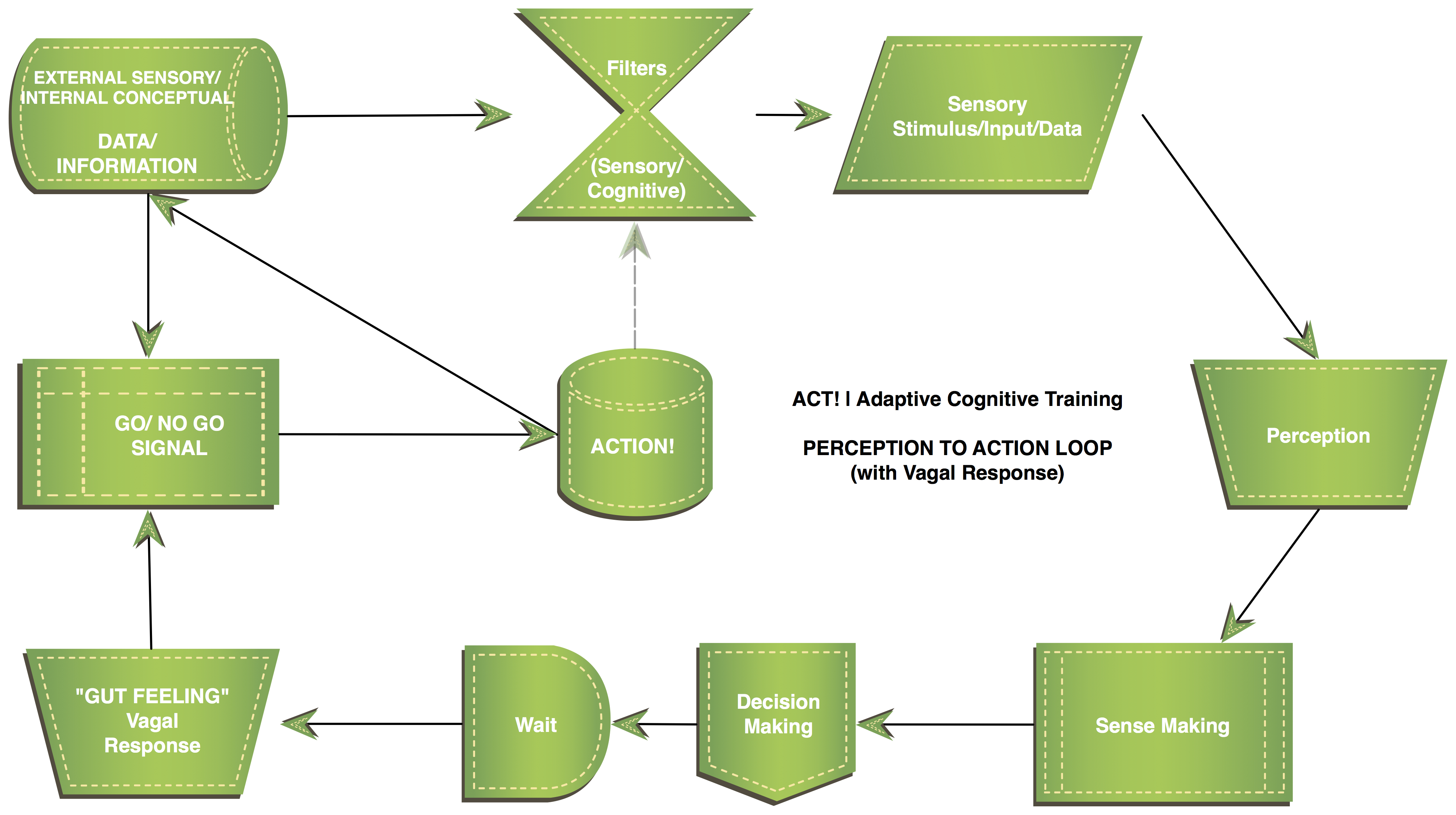
What I’ve found in my work with people is that the “GO/NO GO” signal we experience is also part of the vagal response system, and that it links to our vestibular (sense of balance) and proprioceptive (sense of self/movement) systems, the very thing that gives us the feelings of either being stuck or being motivated to take action.

As far as I can tell from my work with thousands of clients this function of the vagal response system is deeply intertwined with the Neurocognitive Developmental Level you are operating from as well. Literally, where in your brain you preference when you are noticing information in the environment, making sense of what you notice, making decisions based on what you perceive, and taking action based on the decisions you make.

Using my unique Neurocognitive Developmental Training technology, ACT! | Adaptive Cognitive Training, you can literally update your vagal response to be more resilient and effective in aligning your “GO/NO GO” signals to the actual signals in the system and the outcomes you want to achieve.

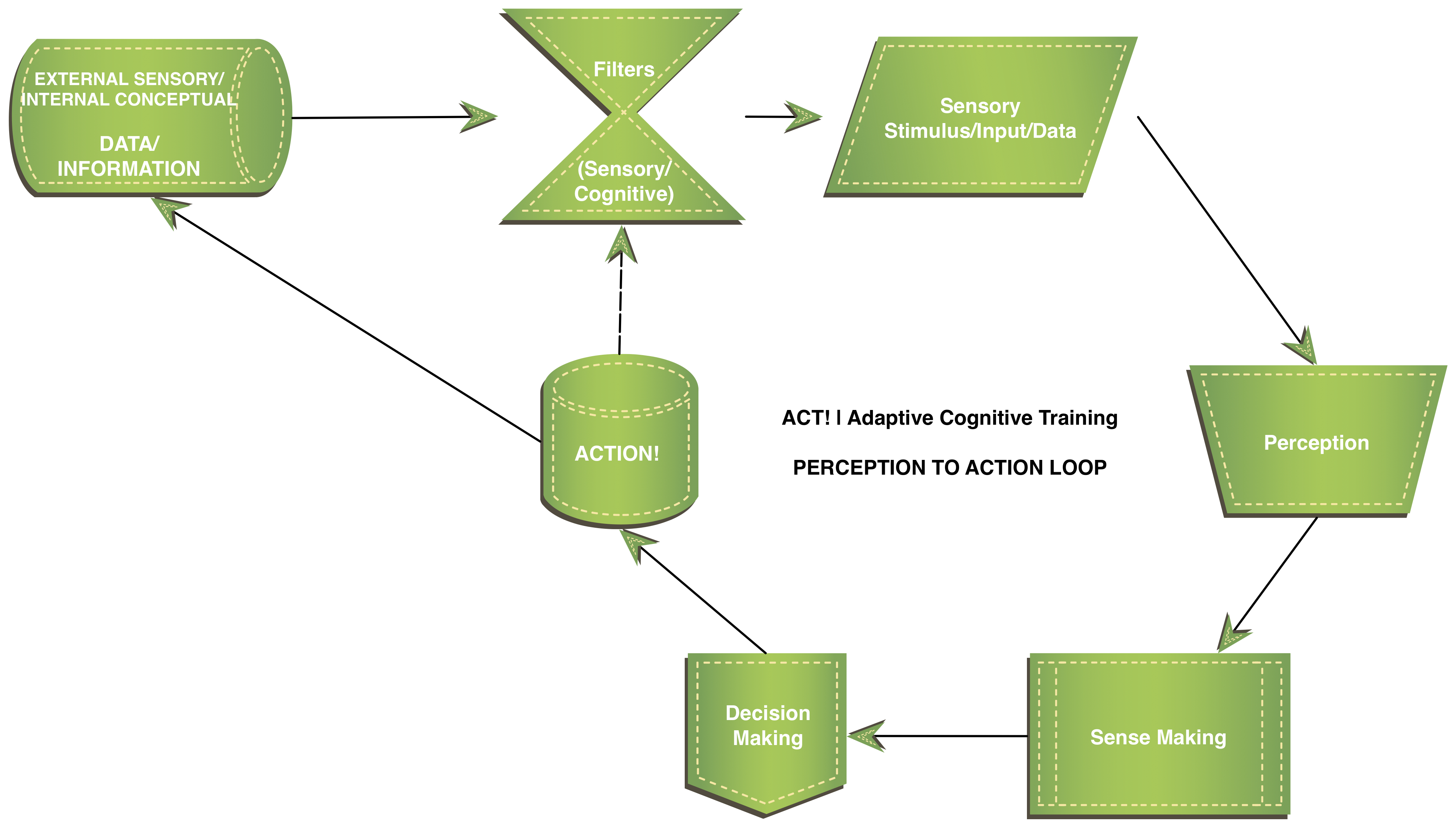
In the ACT! | Adaptive Cognitive Training model, I refer to the chain of processes from Sensory Perception to Sense Making to Decision Making to Action Taking, as the “Perception to Action Loop” in part because it’s both iterative and recursive, updating as it “loops” on itself.

Here’s a look at one way of graphically representing this system:

[File Download: ACT-PerceptiontoActionLoop]

If we add the ‘GO/NO GO” signaling process that operates through the vagal pathway the model might look like this …

[File Download: ACT-PerceptiontoActionVagalLoop]


In part, updating the Neurocognitive Developmental Level you’re operating from by default updates what you’re noticing for and how you notice for it in the environment – what I call your Perceptual Filters, and the way you make sense of information – what I call your “Sorting Patterns” … this has the effect of changing the decisions you make and the action you take, because you are noticing different information and making sense of it differently as well.

A simple example of this would be whether you are noticing for risk or opportunity, the sequence in which you do that (assuming you can notice for risk and opportunity), and the way you balance how you make sense of both in relationship to one another.

Someone who notices first for risk will tend to be “risk adverse” and protective of themselves and the relative safety of their current situation.

Someone who notices first for opportunity will tend to be “risk willing” and seek to leverage themselves and the possibilities in the current situation.

Now which one is the better choice is totally situational and contextual …

For example making a decision to walk through a dark alley late at night in an unfamiliar neighborhood to cut ten minutes off the time it would take to get to your hotel if you walked the long way might suggest that the more useful strategy is to first access the risk and act with some degree of risk aversion.

An alternative example might be making a decision to run an advertisement for your business that has an upside of 1000% return on the investment and only represents .01% of the revenue that a product or service currently generates suggests that the more useful strategy might be to first access the opportunity and act with some degree of risk willingness.

Understanding that you are not stuck to one fixed way of thinking about the world, or using one fixed, default pattern of response is the first step in freeing yourself to experience a major update to your worldview and the model of the world you operate from, as well as the ability to reap massive rewards associated with significantly increasing your level of adaptability.

When you engage in Neurocognitive Developmental Training you begin this process of loosening the lock hold that your current worldview has on you, and releases you from the limitations of the model of the world you are operating from now in those situations and contexts where it simply doesn’t serve you best.

Neurocognitive Developmental Training really gives you a smoother and more elegant access to the full range of (Human) Adaptive Intelligence, than you currently have now, and opens up your ability to access all of the Neurocognitive Developmental Levels that are innately available to you, even if you have difficulty accessing them now, or simply don’t access them at all yet.

“When man is finally able to see himself and the world around him with clear cognition, he finds a picture far more pleasant. Visible in unmistakable clarity and devastating detail is man’s failure to be what he might be and his misuse of his world.
This revelation causes him to leap out in search of a way of life and system of values which will enable him to be more than he has been. He seeks a foundation of self-respect, which will have value system rooted in knowledge and cosmic reality where he expresses himself so that all others, all beings can continue to exist.
His values now are of a different order from those at previous levels: They arise not from selfish interest but from the recognition of the magnificence of existence and the desire that it shall continue to be.”
– Clare W. Graves


Joseph Riggio, Ph.D.
Architect & Designer of the MythoSelf Process and SomaSemantics
Stockton, NJ in the Delaware River Valley

P.S. – You can also read more about ACT! | Adaptive Cognitive Training, the Perception to Action Loop, and Neurocognitive Developmental Levels here: Transformational Performance Breakthrough

Filed Under: Blog, Coaching, Cognitive Science, Elite Performance, General, Human Systems, Life, Transformational Change & Performance, Uncategorized

Claiming Your Right To Be … Become The Buddha

Claiming Your Right To Be … Become The Buddha

by Joseph Riggio · Jan 10, 2018

Taking A (Semantic) Stand …

What Would It Take To Get You To Put A Stake In The Ground, And Claim That Space As Your Own?”


[“I am Diogenes.”]
One version of the story about the Buddha sitting under the Bodhi Tree seeking the complete unfolding of consciousness tells of his last challenge by the gods before his enlightenment. Just prior to realizing his final enlightenment the gods, represented by the demon Mara had him send his most beautiful daughters, sometimes thought of as “Lust” and “Desire,” to seduce the future Buddha, but he was unmoved by them, so they departed.

Then Mara sent his monstrous army into the fray, and again Siddhartha Gautama, the future Buddha, sat unmoving and untouched. They launched their weapons, arrows and spears darkened the sky they flew in such profusion, but as they reached the future Buddha they fell around him having turned inflight into a shower of flowers. 

Finally Mara himself stood against the future Buddha, and he proclaimed his right to the seat of enlightenment by the virtue of his spiritual accomplishments, and his armies of demons and monsters all stood with him acknowledging his accomplishments as well. With this Mara asked, “My army speaks for me, who will speak for you?” and the future Buddha seemingly unmoving but for the single gesture of reaching down with two fingers of his right hand touched the earth, and in that moment claimed his right to be and the space he sat upon, and he was enlightened.

This single, final gesture of the future Buddha is captured in the “earth witness” mudra, where the left hand rests palm up upon the knee of the folded and crossed left leg, while the right hand reaches down to touch the earth and claim witness for one’s right to be. This simple expression of one’s being is the ultimate representation of steadfastness, and the silent exclamation, “I AM!”

I’ve always found this part of the story profoundly moving …

I yearn for Siddhartha Gautama’s steadfast stillness, his willingness to simply be … needing nor wanting anything more. Even when the irresistible temptations of mana … power, prestige, authority are thrust upon him he resists, or when irresistible beauty, lust and desire threaten to seduce him he never falters … remaining silent and unmoving.

As I’ve shared before I’m a “good” Roman Catholic boy by indoctrination if not actualization, and as a good student I’ve learned my lessons well. This moment of the Buddha’s reminds me as well of the moment the devil tries to seduce Jesus in the cave with temptation of worldly gain and power, even trying to trick him with simplicity by offering simple bread and water for his cavernous hunger and blistering thirst … to which Jesus replies, “Man shall not live by bread alone, but by every word that proceeds. out of the mouth of God.” rebuking Satan and his temptations.

These mythic forms of claiming one’s space, one’s right to be, have always been compelling for me.

For almost my entire adult life I have sought to incorporate and assimilate this simple understanding for myself, one’s right to be” – and to explore it and share it with others who share my fascination with this thing that I think is the ultimate expression of what it is to be human … our ability to claim our right to simply be, without adornment or even proof beyond our being itself.

The right to be shows up for me most in the idea of what I call one’s mythic form … the deep, often pre-conscious autobiographical narrative that defines and drives us. This narrative, unlike most stories that are told pre-exists in form and precedes language … it’s more somatic than it is semantic.

It’s been thirty years this year that I will have committed myself to unearthing the mystery of mythic form as I conceive of it. What I’ve convinced myself of in these three decades dedicated to the realization of, what it means to simply be, is that it is held and contained in what drives us to action, and comes to expression in our acts … on our own, with and in relation to others.

This beingness, if you will, is the source of our personal power, it is the seat of our personal performance, and yet it remains elusive at best for most of us.

So we seek to come to terms with our being, what we perceive rumbling unceasingly beneath the surface, driving us, seeking expression, willing us to become .. and, we know it only through what we can call our ‘worldview’ … the totality of the way we know the world around us and ourselves in relation to it … our private realities.

These realities are what I think of as mythic form, the massive, imposing, singularity of the autobiographic narrative that precedes language, and at the same time dominates everything thing we think and speak. Our mythic form is unmistakable in our actions, in deed and in word. And, can seem to us “a given,” fixed in space and time, an irreversible, unchangeable aspect of ourselves … ”who” we know ourselves to be.

Yet this simply isn’t true, we become what we claim to be, much more fully than what we’ve known we were. This then is your key to freedom, your key to become fully human, as the renowned scholar and mythologist Joseph Campbell suggested.

This ability to claim our future being is all about what it is to be human, and it requires us to drive a stake into the ground as surely as the Buddha showed us in his simple act of claiming his right to be be by touch the earth with the two fingers of his right hand. In his moment of defiance Siddhartha Gautama was the stake in the ground.

So, as is my wont at the start of the new year I give voice to my stake in the ground, the spot I will sit upon for this revolution of the earth around the sun.

This year I lay claim to “MAD SKILLS” … the expression of virtuosity in action, in my deeds and words. And … I invite you to join me in claiming MAD SKILLS for yourself as well, beginning at the core, with the unfolding of the mythic form, the worldview that drives you.

This surely is at the heart of it all … the chain of causality that determines not just what we do, what we accomplish, realize and gain for ourselves and with others, but ultimately who we become … the worldview we hold, the seat of our perceptions, sense-making, decision-making, action-taking … the results and outcomes we achieve, and fail achieve … our pre-conscious, and ever-present, mythic form.

I share with you that at the very center of our ability to choose and decide who we are in this moment, and who we will become in the next, is our commitment to building ”MAD SKILLS” … virtuosity in our action-taking.

There is a paradox I invite you to explore with me this year … that our doing both proceeds from our being, and precedes it as well in our becoming.

My invitation to you is to enter the liminal space of exploration that exists just before and between our acts, to take control of who we are and who we are aiming to be as well.

This is the space that opens before the Gates of Perception that determine how we know the world around us, and our place in it …

Are you ready for the journey of your life?

Remember, this ship you are upon set sails but once for you … lay claim to who you will have been and who you have become before it docks for the last time …

Best,

Joseph Riggio,Ph.D.
Architect & Designer of the MythoSelf Process and SomaSemantics

P.S. – Click this link to find out more about the Gates of Perception and how you can dive in deeper … much, much deeper than you probably ever have now.

Filed Under: Blog, Life, Mythology, Story, Transformational Change & Performance, Uncategorized

Pathways To A High Ticket Coaching Or Consulting Practice

Pathways To A High Ticket Coaching Or Consulting Practice

by Joseph Riggio · Sep 7, 2017

Or … The Gravesian Way To Making A Great Living As A Coach/Consultant/Trainer …

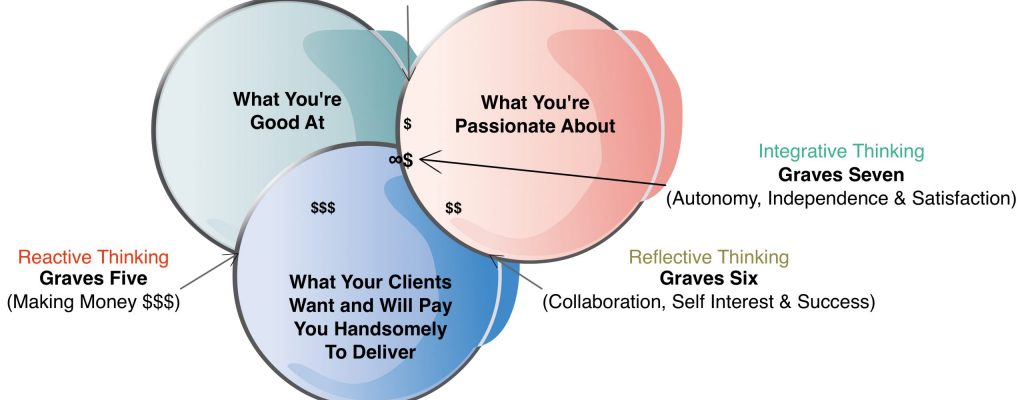
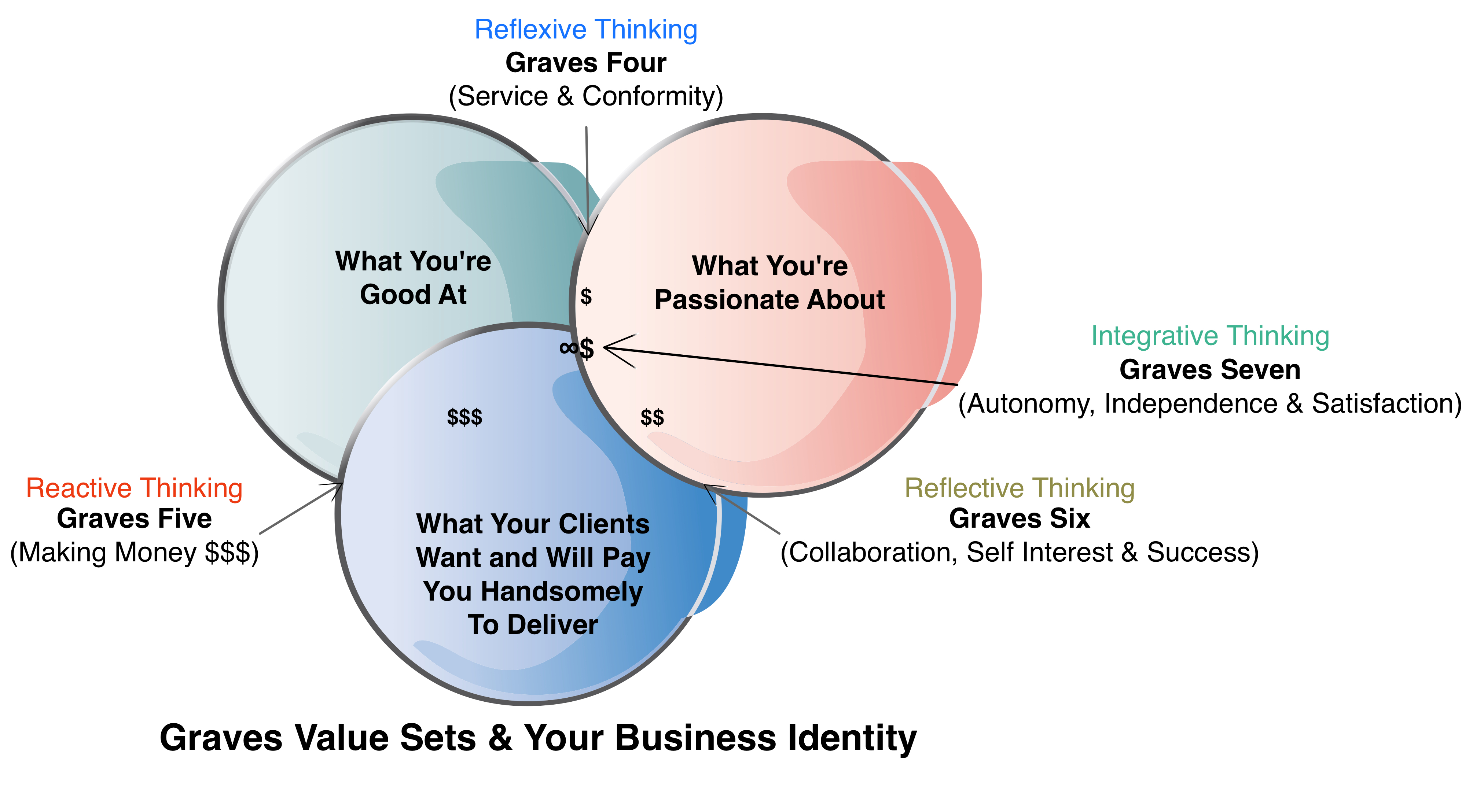
Graves Business Model Venn Diagram JSR


Okay … the idea of the Venn Diagram isn’t mine, but the commentary around it is …

Let’s take a closer look together … shall we?


Graves Business Model Venn Diagram JSR

Most of the “Build Your Coaching Business Gurus” will point you towards what I’m calling out as the “Graves Six” position where you supposedly make money by pursuing your passion … e.g.: “Your Million Dollar Message” B.S.

BUT … while you can indeed make money by overlapping “What You’re Passionate About” resides and where “What Your Clients Want and Are Willing To Pay Handsomely To Get” overlap … there ain’t no guarantee that’s gonna happen …

BECAUSE there’s no guarantee that what you’re passionate about … or your message, life story, insights, calling, whatever … is going to resonate with what customers and clients are willing to pay handsomely for today.

Now if you notice most of these “Gurus” are following the path that most of the “OnLine Business/Marketing Gurus” will point you toward (and mostly follow themselves) … i.e.: the place where “What You’re Good At” and “What Clients Want and Will Pay Handsomely For” overlap. This is the Graves Five position on the diagram, and you can indeed make loads of money when you follow this path to riches.

In other words, the Graves Six “Do What You Love Gurus” seldom follow their own advice precisely, except when there’s a lucky accident and they are actually at the Graves Seven position (think Oprah Winfrey)

I point to this position in the middle of the diagram where all three circles overlap … (BTW this is where the money you can earn is for all intents and purposes unlimited), so it all comes together for them.

Just to complete the outer positions, 90% of folks who have businesses that are actually jobs are stuck in the Graves Four position, where “What You’re Good At” and “What You’re Passionate About” overlap. (NOTE: This is Michael Gerber of “The E-Myth” fame refers to as the technician’s entrepreneurial spasm.)


OKAY, SO HERE’S THE “SKINNY” AS I LIKE TO SAY …

YOU HAVE TO DECIDE EXACTLY “WHY” YOU WANT TO RUN A COACHING/CONSULTING/TRAINING BUSINESS!!!

Or, what you get from it will not necessarily be what you want or expect.

What To Do About It …

(If You Really Want To Build A High-Ticket Practice)

A great majority of folks who are good at what they do, but they ain’t making no money, are operating at a Graves Four position on this diagram. Simple and kind of stupid (I’ll explain why later on, give me a minute to get there …)

Most folks who are willing to do what it takes, are at a Graves Five position on the diagram, and are building businesses that make money, sometimes “tons of moolah,” but they aren’t necessarily that happiest folks on the planet (in fact they are often the most anxious folks on the planet, always waiting for the house of cards they built to implode).

When you leap to the Graves Six position you find that there’s a whole spectrum of success, from what is utter financial failure to super financial success and independent wealth. Yet, these folks are living in a dream expecting to live “the dream,” i.e.: doing well by doing good, regardless of the fact the reality is that most of the time they are more interested in what they want to do for themselves than helping out the world as a form of service or sacrifice.

Now that ain’t saying that folks who are operating out of the Graves Six Value Set aren’t doing good work, it’s just that the reality is that most of the time that decision is based on what NLPers (folks trained in neurolinguistic programming, or NLP) call “Sorting By Self” and “Internal Reference.” In other words they decide what’s most “right” by their own internal measure and not necessarily what would in fact most serve the world-at-large.

For example a whole lot of these folks drive expensive SUVs and many drive expensive sports cars, that ain’t doing a whole lot for the planet they claim to love, or being particularly respectful of the percentage of resources they use compared to the least privileged folks on the planet. And those in the coaching/consulting industry don’t stay local/buy local/work local either, because they are getting on planes to go to the conventions where their “tribe” meets up and when they’re not flying to meet their “tribe” they’re looking to hook up with some tribe in Fiji or Patagonia or the Himalayas “on holiday.”

Once again, I’m NOT condemning these folks … good on the if they’ve found a way to satisfy their deepest desires and making the dosh they need to pursue them fully. BUT, as I said this is as much a lucky coincidence as it is strategic planning, and even then this is NOT the path to sainthood regardless of how many Salutations to the Sun you’ve done, or how many hours you’ve spent meditating mindfully, or even if you’ve spent two years of your youth in the Peace Corps.

The main point for anyone who’s trying to build a High-Ticket Coaching or Consulting Practice is to get that if you want to be on the path to success that IS strategic, then you’ve really got to look at WHY you want this and how you expect to pull it off in the real world where no one cares about your intention …


That’s right NO ONE CARES ABOUT YOUR INTENTION!

ALL FOLKS CARE ABOUT ARE WHAT THEY WANT AND HOW YOUR ACTIONS HELP THEM GET THAT OR NOT!

(NOTE: There is an exception to this as well … when folks believe and expect that you will help them get what they want, even when that doesn’t turn out to be true after the fact.)


So think about it … WHY DO YOU WANT TO BUILD A HIGH-TICKET COACHING OR CONSULTING PRACTICE???

In other words answer these two question for yourself:

1. What do you expect to get from building a high-ticket coaching or consulting practice?

2. How will getting this satisfy your deeper desires and values beyond JUST making money (unless your at Graves Five, JUST making money is NOT going to keep you happy).

Now going back a step …

If you both want to make money AND satisfy your deeper desires and values you’ll need to come to terms with a couple of things …

FIRST … you MUST satisfy the intention to serve your clients based on “What Your Clients Want and Will Pay You Handsomely For” … if you’re NOT starting here you are NOT operating strategically with regard to building a High-Ticket Practice.

AND … you MUST satisfy the intention to serve “What You’re Passionate About” as well.

Now, that may sound like I just recommended that you follow the Graves Six pathway to success, and that’s ALMOST correct, but as they say in the infomercial world … “WAIT THERE’S MORE!”

REMEMBER … there’s absolutely NO GUARANTEE that “What You’re Passionate About” and “What Your Client’s Want and Will Pay You Handsomely For” are aligned or will come together … if those two things aren’t also “What You’re Good At” too.

Because typically High-Ticket Clients almost always go to someone who is an expert, who does the best quality work, for what they want and expect to pay handsomely for as well. In other words, they seek out folks who are good at what they do as their primary criteria (even when they get it wrong because someone has created a reputation built on sand … probably a savvy Six BTW).


For BOTH YOU AND YOUR CLIENTS to be deeply satisfied you need to be in the Graves Five zone for them … AND the Graves Six zone for you!

And, in the world of this model Five and Six equal Seven when it comes to building a High-Ticket Coaching or Consulting Practice that satisfy BOTH YOU AND YOUR CLIENTS!


Summing It Up

Simply put STOP PAYING ATTENTION TO THE MAGICAL THINKING WORLD OF THE GET RICH QUICK BY DOING WHAT YOU LOVE Gurus!!!

While there’s nothing wrong with doing what you love … HECK I RECOMMEND IT … BUT, DO IT BY MOVING TO “SEVEN” AND HAVE IT ALL BY SATISFYING ALL THE FOLKS IN THE EQUATION … you just aren’t going to have the chance to work with the High-Ticket clients you want, or to strategically satisfy your desire to make more money … or get filthy, stinking rich for that matter … if you don’t move out of the position your in to a position where you really do satisfy all the people in the equation BASED ON THIER CRITERIA AND NOT YOUR ALONE.

As the wise men say, there are many paths to the top of mountain, but whether you get up there broken and defeated barely having survived, happily trekking with a merry band of sherpas and stopping for a week in basecamp before you turn around and head down never having seen the peak, or travel all the way in a luxury helicopter is up to you.

If you want you can indeed have it … and, knowing “WHO” you are, is at least as important as “WHAT” to do and “HOW” to do it.

So if your “guru” isn’t starting by putting you at the center of it all then at least remember this wise saying, CAVEAT EMPTOR (“buyer beware”)

Joseph Riggio, Ph.D.
Architect & Designer of the MythoSelf Process and SomaSemantics

P.S. – Let me know what you think below …

P.P.S. – If you’d like to move to “SEVEN” start by getting a little more clarity on your current identity and values in regard to your business, I can talk and walk you through where you are on the diagram today and help you make the move to the center of yourself in about 15 minutes . If you’re like to purse it you can schedule a call by clicking on this link: Get Some Clarity w/Joseph

Filed Under: Blog, Business Performance, Coaching, Mentoring, NLP, NLP & Hypnosis

SENSING TIME

SENSING TIME

by Joseph Riggio · Sep 1, 2017

Time lines in an abstract spiral

Just like seeing or hearing TIME is a sense.

I was in a brief exchange with James Tsakalos, an NLP Trainer, colleague and FB friend of mine, about setting time frames in training events.

Fundamentally it was about when we begin and end training days with groups. I mentioned that I almost always begin the first day at 10:00 or 11:00, while I think James likes to start early. typically around 8:00.

My reasoning for this is that for most folks who work they typically begin their day earlier rather than later, say 8:00 – 9:00 versus 10:00 to 11:00, and starting at a different time signals very clearly “THIS is NOT THAT.”

The same can be said for other aspects of timing during the day, e.g.: ending times, or breaks … I usually break for 90 minutes for lunch, not 30 or 60 minutes. Again in part for the distinction that it makes versus many people’s standard routine, as well as because it gives them longer to integrate and incorporate the material we covered in the morning.

Also my lunch is ordinarily set at 1:00 PM/13:00, and it’s interesting how much that can shake people up who are habituated to an earlier time for lunch.


A Sense of Time

Most folks don’t think of TIME as a sense, but when you begin to you also get that time is a sense just like seeing or hearing, touch, taste or smell.

I also count vestibulation (balance) and proprioception (spatial & movement awareness) as senses. So in my world as a neuro-cognitive scientist there are eight senses I address that we use to discern data about the world we live in, move through, manipulate and experience. FWIW I don’t limit my list to just eight, I only keep these eight in the forefront of my awareness and in the loop when I’m discussing senses and sensation.

First a little background to where I’m going …

Way back when … I started my movement into consulting, coaching and training as a hypnotist and then I studied and became an NLP trainer. NLPers (those folks who are NLP practitioners) break down the five senses into what the call representational modalities, i.e.: visual (seeing), auditory (hearing), kinesthetic (feeling), olfactory (smelling), gustatory (tasting), shortened into the acronym VAK-O/G. Then they are trained to calibrate what representational modality that someone is accessing according to the VAK-O/G.

NLPers track the VAK-O/G representations that someone is using in a number of ways, but the most common are eye accessing (noticing where locationaly relative to the individual moving their eyes they rotate their gaze to, e.g.: upper left, lower right), language predicates, e.g.: “I see” … “It’s crystal clear to me.” … “You sound funny.” … “I’m feeling excited.” …, and in a more subtle and sophiticated approach by where in their body they are breathing from and the rate of their breathing, e.g.: upper chest, rapid breathing is associated with visual accessing verus lower belly, slow breathing with kinesthetic accessing.

Ideally NLPers want to cross calibrate and confirm their assessment of which representational modality a person is accessing by having two or more of these kinds of signals simultaneously happening, e.g.: they look up to their left (a visual access), while they say, “I observed you were moving a lot when I looked across the room.” and they say it quickly for them indicating a more rapid rate of breathing and expression associated with visual accessing.

Now, a bit later on in the development of NLP, let’s call it ten years to make it simple, one of the co-developers, Richard Bandler, began putting a lot of attention on what he called “submodalities” – or, more refined distinctions of the representational modalities. For instance if we use the visual representational modality (sight/seeing), we could speak to the distinctions of location … where is the image, what is the posititonal angle of the image (relative to the individual accessing it), how far away or close is the image … then there would be other things we could notice for as well, e.g.: size, color, brightness …

Okay, so as a NLPer I learned to calibrate and track for representational modality accessing and the finer aspects of sumbmodality distinctions. BUT, as a NLPer I was only introduced to these within the traditional five senses covered by the VAK-O/G list.


More Than The Traditional Five Senses

As I continued working with people, learning and studying I realized that I had to include both vestibulation (the vestibular process of the sensation of balance) and proprioception too (the awareness of spatial perception, our bodies in space relative to other objects, movement of our own body and other objects relative to one another, and the location and movement of our body relative to ourselves, e.g.: posture, limb articulation, etc. This radically changed how I worked with clients and over time how I perceived and experienced myself, and the world around me.

Then at some point I became aware of TIME as a sense like the traditional five senses, and vestibulation or proprioception. This was a powerful moment of awareness for me. To give some credit where it’s due I had some introduction to time as sense of sorts from other sources as well. NLPers also have an awareness of time, and they have a process they use called the “timeline” that indicated how people experience and position themselves relative to time. The NLP book that addresses the “timeline proccess,” “Timeline Therapry and the Basis of Personality” by Tad James and Wyatt Woodsmall. So I’d already had some influences vis-a-vis my discoveries about time with clients.

Time was a topic that the great American anthropologist E.T. Hall explored in his book, “The Dance of Time” and I’m a great fan and virtual student of his work. His work covered many “silent languages” as he referred to the non-verbal and cultural aspects of communication, perception and awareness in his many books. The more I learned about “silent languages” the more I became intrigued with how we perceive, think, process and act outside of the normally referred to ways that are what I’ll call fully conscious for now. In other words, some of what we do is available to use as a consciously aware experience we’re having or have had, and some of what we do is utterly outside of our conscious awareness and happens silently or invisibly as E.T. Hall might refer to it.

Time for most folks is outside of their conscious awarenss, except as they track it by the clock in modern life. Yet, internally we have incredibly sophisticated ways to track time that are organized primarily around the rising and falling processes of our internal physiology and its chemistry.


The Finer Distinctions Of Time … And Other Things Too

So as I continued my exploration of time I began to realize that time also has submodality distinctions, i.e.: finer ways of thinking about time than “it passes” or that it is a particular time based on the agreed to conventions of time … “clock time.” One of the things that both NLPers and E.T. Hall point out is that time “moves” differently for differnt people in different contexts and depending on what they are experiencing.

We’ve probably all experienced a time when we were with people we enjoyed being with and the sensation was that time just flew by and our experience with them was over in what seemed an instant. If you’ve ever been in a bureaucratic or institutional loop where you need to get something done, e.g.: renew your driver’s license or get a copy of your birth certificate, you might have experienced time moving much more slowly than the clock indicates, looking up after an hour and realizing it was actually only five minutes. Now if you love someone and you’re waiting to see them again multiple that by 10, and if you’re a five year old waiting for your birthday to arrive or Christmas maybe, multiple that by 100 (then of course when your birthday comes the party only lasts 1.5 seconds)!

But time does more than this … it also organizes our lives syntactically according to the rules of computation, e.g.: this happens before that and after this. Time therefore becomes the tableau upon which we write our lives in part, since we experience our lives syntactically, or happening in a sequence or events that occur according to the movemnt of time. The brilliant theoretical physicist and cosmologist, Stephen Hawking, wrote about time and space in his popular non-fiction book for lay folks (i.e.: those of us who aren’t theoretical physicists or cosmologists), “A Brief History of Time” where he lays out the relationship of time and space syntactically for the entire universe and everything in it as well.

This realization that time and space are singular leads to a secondary realization that the perception of time and space are also singular, meaning that for humans time and proprioception are singular as well. I’d argue that we also experiene balance as a function of time and space, making the actual human perceptual singularity the interwoven realtionality of time, proprioception and vestibulation. This is more than a little relavant with regard to action and outcomes too.


The Teleological Factor

Now to make things just a little more complex, I need to address the fact that I’m a “teleologist” by inclination. By that I mean that I think in terms of the future pulling us toward it versus the past pushing us forward.

So rather than being an artifact of our history we are artifacts of our futures … i.e.: we experience ourselves in relation to what has happened, just not yet. This is the teleological equation, and is built on the beliefs and expectations we hold about what will happen when we act or not. So we don’t act based on what we’ve experienced, but rather what we expect we will act upon and experience.

So this brings me around to my next point …

TIME IS A CONTEXT.

When I’m training I consider the context as important as the content I’m delivering. And I mean that literally. I organize the context as carefully, and often more carefully, than the content I deliver.

My shifting the relationship people in my training have, by doing something as simple as changing the start time to what might be “normally” expected, say 9:00 AM to 10:00 AM, it shifts the sense of where the participants are from “this” is like any other day, to “THIS” is NOT like any other day, “THIS DAY” is special in someway.

Now they reorganize their expectations to allow for something special to happen, making it that much more likely that something special will happen. There are many reasons that this can happen, but the simplest expectation is that because they are now experiencing themselves in relation to what’s happening as extraordinary compared to their normal day. When someone expects something out of the ordinary they begin to notice for it, even when it was something that was there all along. Even when what they are noticing for might have been missed or taken for granted before.

Also, one shift leads to another, when I shift the time frame that’s typical or normally expected, the relationship to time that someone hold shifts … like when they are on vacation and move through their day differently than when they are at work. So now we can use the presumption that when someone’s relationship with time has shifted and their hold on “normal” time is looser, and I can help them move through time differently.

For example, if there is something they want to attain or achieve that they perceive as far off in the future, when their sense of time is loosened we can shift it to bring it closer (remember my teleological premise of the future pulling us forward towards it … when that future is closer the pull tends to be stronger).

We gain another shift as well. When the pull of the future is stronger, because we’ve slid it closer in time, we also tend to become more adept at noticing for what will allow us to realize what we intend more effectively and efficiently. In some ways we shift the signal to noise ratio of what’s important to notice versus random data in the system that’s unimportant to us in regard to getting out outcome. This also allows us to adust and adapt more rapidly, and therefore we expend less energy and time getting to where we’re going.

So this simple thing of doing something outside of the expected, like starting an hour or so later than people are used to starting their day, becomes a vital contextual advantage to helping them make the shifts they need to so they can both succeed in getting their outcomes and geting them with less effort and time invested.


TRANSFORMATIONAL THINKING

There’s a big difference between shifting what someone thinks about and how someone thinks. To make big shifts in life it’s important to shift the way you think, NOT just what you think about, or how you think about it (whatever the “it” may be … money, relationships, health, fitness, security …).

The most significant thing that helps shift the way you think is shifting the way you experience the context you how whatever you’re thinking about within. Part of the premise I work from is that all thinking is both embodied and situated, i.e.: it occurs in and is shaped by the context it occurs within.

Now if we shift the context we will shift what is experienced within that context, since everything is experienced within the context it occurs within and is shaped by that context. Taking that a step further we can also presume, whether it’s true or not, that it’s possible that everything we expect to experience within a context is shaped by that context as well. Since we act upon and experience what we expect, how the context affects what we expect it also affects what we act upon and experience.

When you accept these presumptions of how context shapes experience you begin to recognize the the significance of shaping the context … hence the importance of shaping time as contextual frame and using it to help shape the way we think, and not just what we think about …


I’ve been describing it…
TIME IS A TOOL FOR TRANSFORMATION.


Joseph Riggio, Ph.D.
Architect & Designer of the MythoSelf Process and SomaSemantics

P.S. – I’d love to hear what you think too … leave me a comment below …

NOTE: Join the extended conversation in my FB group: GNAU Nation at: https://www.facebook.com/groups/GNAUNATION/

Filed Under: Behavioral Communication, Blog, Cognitive Science, Elite Performance, General, Language & Linguistics, Mind Games, Transformational Change & Performance, Transformational Communication

« Previous Page
Next Page »

© 2026 ABTI | Joseph Riggio International · Rainmaker Platform

Privacy Policy

  • Services
  • Log In