This website or its third-party tools use cookies which are necessary to its functioning and required to improve your experience. By clicking the consent button, you agree to allow the site to use, collect and/or store cookies.
Please click the consent button to view this website.
I accept
Deny cookies Go Back
  • Skip to primary navigation
  • Skip to main content

ABTI | Joseph Riggio International

  • Home
  • Meet Joseph
    • To Sicily And Back … A Love Story
    • JSR Short Bio & CV
    • Abbreviated CV Timeline
  • BLOG :: “Blognostra”
  • Contact
You are here: Home / Archives for Uncategorized

Uncategorized

The Skeleton Key To Transformational Performance

The Skeleton Key To Transformational Performance

by Joseph Riggio · Jan 17, 2018

Why We Focus On Neurocognitive Developmental Training As The Basis Of Instigating Transformational Change And Peformance Breakthrough

At each stage of human existence the adult is off on his quest to his Holy Grail, the way of life he sees by which to live.
– Clare W. Graves


Because people get stuck when the worldview they are using doesn’t accommodate the outcomes they intend … they need a way to get out of their “stuck state.”

Neurocognitive Developmental Training provides the skeleton key that unlocks the mystery of success.

This is the essential and most rewarding reason “WHY” it makes sense to get Neurocognitive Developmental Training (NDT) … but, once you dive down the rabbit hole you’ll find so much more that will be valuable to you too.

Neurocognitive Developmental Training is all about building “(Human) Adaptive Intelligence” – i.e.: the ability to adapt your thinking to the situations and contexts you encounter and are engaged in at any given time.

When you put your attention on it, you’ll likely recognize that what I’m calling (Human) Adaptive Intelligence, or (H)AI, is an innate trait of almost everyone you’ve met and know, including yourself. However, you may also simultaneously recognize how most folks avoid “adapting” their way of thinking, or probably more frequently reach the limits of their capacity to adapt rather quickly.

So, why is it, if we all seem to possess the ability to use adaptive thinking, that we don’t more naturally, frequently, and easily do it?

I’d argue it’s because it makes us uncomfortable to operate outside of, or beyond, our most familiar ways of operating, in this case thinking and acting.

This is the clearly identified and documented psychological “Cognitive Dissonance Theory” …

attitude change cognitive dissonance cartoon
Cognitive Dissonance: https://www.simplypsychology.org/cognitive-dissonance.html


Essentially this theory states that people will avoid whatever is unfamiliar, and when they cannot make sense of the unfamiliar create a rational reason to explain what is unfamiliar within the boundaries of their current Model of the World, i.e.: their way of perceiving and making sense of the world around them, including their current beliefs and values.

Simply stated, Cognitive Dissonance Theory, suggests that people would rather live with discomfort and/or dissatisfaction, and continue to fail at succeeding in the ways the claim to most desire, than have to change their beliefs and values to match the situational and/or contextual evidence they confront, i.e.:

Therefore, unless AND until someone shifts the Model of the World they are operating from, they will keep repeating the same challenges they have confronted in the past, and fail to make the changes in their life would allow them to succeed, but cause them instead to continue failing in the same way that they always have in the past.– Joseph Riggio, Ph.D.

This presents people with a huge limitation in getting what they want, yet people will still avoid updating their Model of the World even when they recognize and know that’s what’s required of them to get what they want, and to find satisfaction and peace in their lives, all because the discomfort of making that change seems to them in the moment more disquieting and unreachable than not having the satisfaction and peace of getting what they deeply desire feels like to them now.

Ultimately most of us operate off of well established patterns of neurochemically and neurophysiologically ingrained behavior. These patterns arise in us as “GO” or “NO GO” signals.

Our “GO/NO GO” signals are actually organized somatically as well as psychologically, originating for the most part as shifts in our vestibular and proprioceptive systems, literally we “feel” in or out of balance, and like we’re stuck or motivated to take action.

This is deeply connected to the idea of  your “gut response” … that feeling in the pit of your stomach when you know something is wrong and it makes you a bit queasy or nauseous, or when something is very right and you feel a tingling warmth about it in your belly.

Most people have learned to override this primitive, instinctual system designed to serve as both an “early warning system” as well as a “alert system to opportunity” by processing the “signals in the system,” i.e: the data that’s present, rationally or logically instead.

So they lose out on the benefit of learning how to trust this ancient system of response that is designed to protect and serve them.

We now know, through recent neuroscientific research, that the “vagal pathway” a system of nerves that is dominated by the vagus nerve that runs from brain to the digestive organs, controls much of what we have historically thought of informally and colloquially as our “gut response” … that innate way of knowing what is bad or good for us, before we even have time to think about it.

Here’s a short list of some of the ways the vagal pathway is involved in our health and sense of wellbeing (http://upliftconnect.com/12-ways-unlock-powers-vagus-nerve/):

Vagus nerve dysfunction can result in a whole host of problems including obesity, bradycardia (abnormally slow heartbeat), difficulty swallowing, gastrointestinal diseases, fainting, mood disorders, B12 deficiency, chronic inflammation, impaired cough, and seizures.

Meanwhile, the vagus nerve stimulation has been shown to improve conditions such as:

  • Anxiety disorder
  • Heart disease
  • Tinnitus
  • Obesity
  • Alcohol addiction
  • Migraines
  • Alzheimer’s
  • Leaky gut
  • Bad blood circulation
  • Mood disorder
  • Cancer

So you can see that we’re looking at a very significant part of our nervous system as it affects us.

What I’ve found in my work with people is that the “GO/NO GO” signal we experience is also part of the vagal response system, and that it links to our vestibular (sense of balance) and proprioceptive (sense of self/movement) systems, the very thing that gives us the feelings of either being stuck or being motivated to take action.

As far as I can tell from my work with thousands of clients this function of the vagal response system is deeply intertwined with the Neurocognitive Developmental Level you are operating from as well. Literally, where in your brain you preference when you are noticing information in the environment, making sense of what you notice, making decisions based on what you perceive, and taking action based on the decisions you make.

Using my unique Neurocognitive Developmental Training technology, ACT! | Adaptive Cognitive Training, you can literally update your vagal response to be more resilient and effective in aligning your “GO/NO GO” signals to the actual signals in the system and the outcomes you want to achieve.

In the ACT! | Adaptive Cognitive Training model, I refer to the chain of processes from Sensory Perception to Sense Making to Decision Making to Action Taking, as the “Perception to Action Loop” in part because it’s both iterative and recursive, updating as it “loops” on itself.

Here’s a look at one way of graphically representing this system:
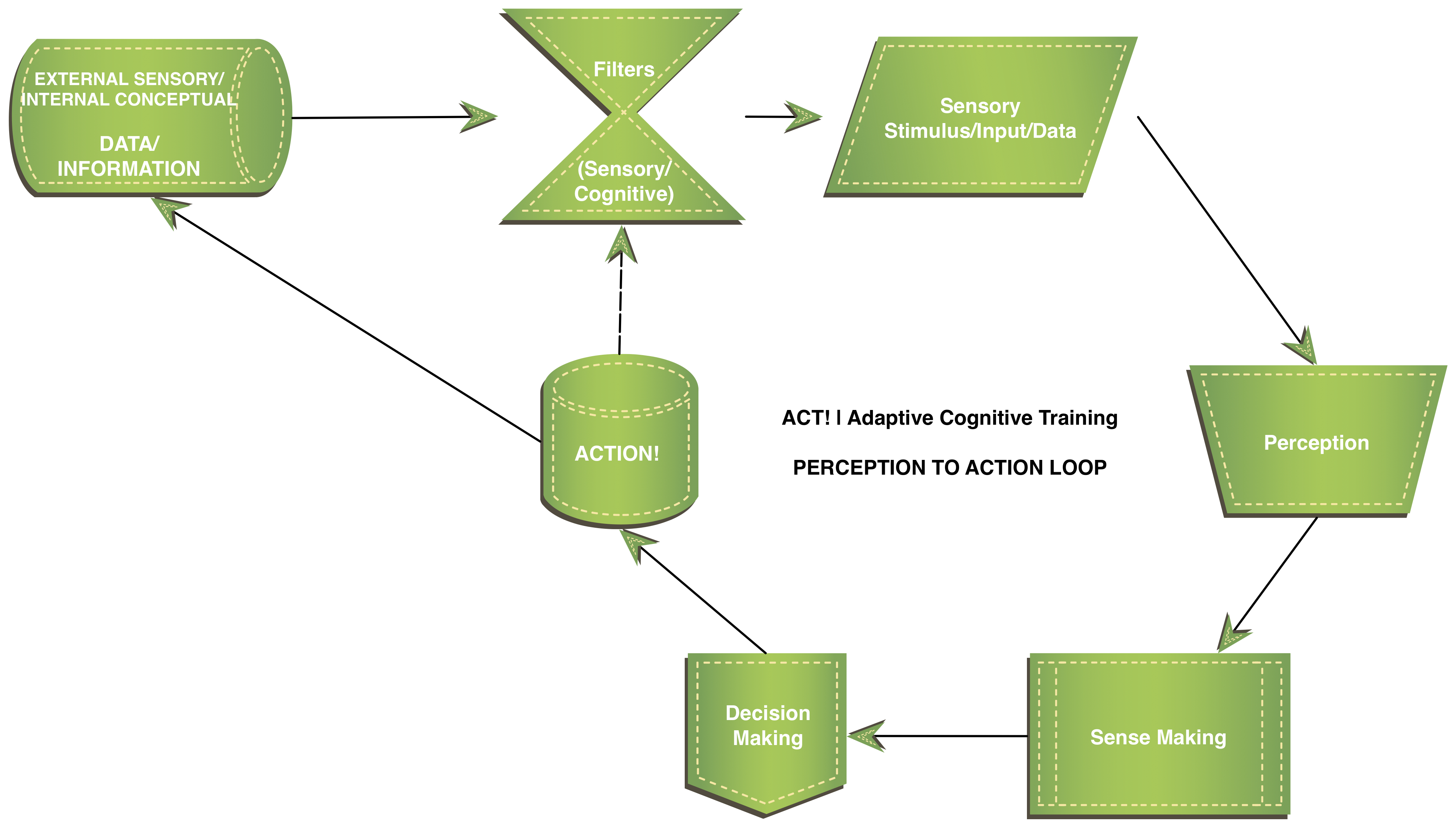
[File Download: ACT-PerceptiontoActionLoop]

If we add the ‘GO/NO GO” signaling process that operates through the vagal pathway the model might look like this …
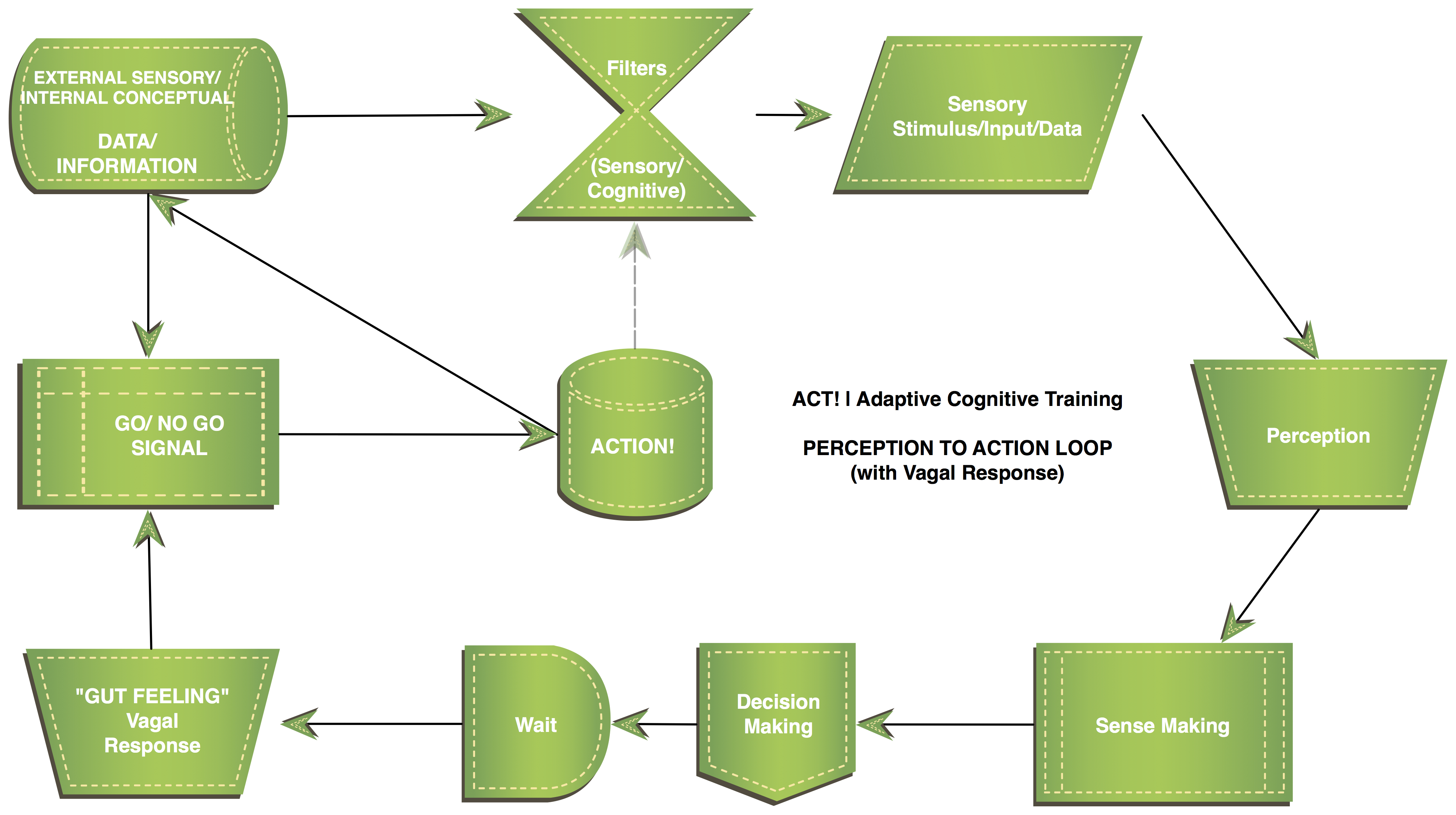
[File Download: ACT-PerceptiontoActionVagalLoop]


In part, updating the Neurocognitive Developmental Level you’re operating from by default updates what you’re noticing for and how you notice for it in the environment – what I call your Perceptual Filters, and the way you make sense of information – what I call your “Sorting Patterns” … this has the effect of changing the decisions you make and the action you take, because you are noticing different information and making sense of it differently as well.

A simple example of this would be whether you are noticing for risk or opportunity, the sequence in which you do that (assuming you can notice for risk and opportunity), and the way you balance how you make sense of both in relationship to one another.

Someone who notices first for risk will tend to be “risk adverse” and protective of themselves and the relative safety of their current situation.

Someone who notices first for opportunity will tend to be “risk willing” and seek to leverage themselves and the possibilities in the current situation.

Now which one is the better choice is totally situational and contextual …

For example making a decision to walk through a dark alley late at night in an unfamiliar neighborhood to cut ten minutes off the time it would take to get to your hotel if you walked the long way might suggest that the more useful strategy is to first access the risk and act with some degree of risk aversion.

An alternative example might be making a decision to run an advertisement for your business that has an upside of 1000% return on the investment and only represents .01% of the revenue that a product or service currently generates suggests that the more useful strategy might be to first access the opportunity and act with some degree of risk willingness.

Understanding that you are not stuck to one fixed way of thinking about the world, or using one fixed, default pattern of response is the first step in freeing yourself to experience a major update to your worldview and the model of the world you operate from, as well as the ability to reap massive rewards associated with significantly increasing your level of adaptability.

When you engage in Neurocognitive Developmental Training you begin this process of loosening the lock hold that your current worldview has on you, and releases you from the limitations of the model of the world you are operating from now in those situations and contexts where it simply doesn’t serve you best.

Neurocognitive Developmental Training really gives you a smoother and more elegant access to the full range of (Human) Adaptive Intelligence, than you currently have now, and opens up your ability to access all of the Neurocognitive Developmental Levels that are innately available to you, even if you have difficulty accessing them now, or simply don’t access them at all yet.

“When man is finally able to see himself and the world around him with clear cognition, he finds a picture far more pleasant. Visible in unmistakable clarity and devastating detail is man’s failure to be what he might be and his misuse of his world.
This revelation causes him to leap out in search of a way of life and system of values which will enable him to be more than he has been. He seeks a foundation of self-respect, which will have value system rooted in knowledge and cosmic reality where he expresses himself so that all others, all beings can continue to exist.
His values now are of a different order from those at previous levels: They arise not from selfish interest but from the recognition of the magnificence of existence and the desire that it shall continue to be.”
– Clare W. Graves


Joseph Riggio, Ph.D.
Architect & Designer of the MythoSelf Process and SomaSemantics
Stockton, NJ in the Delaware River Valley

P.S. – You can also read more about ACT! | Adaptive Cognitive Training, the Perception to Action Loop, and Neurocognitive Developmental Levels here: Transformational Performance Breakthrough


Filed Under: Blog, Coaching, Cognitive Science, Elite Performance, General, Human Systems, Life, Transformational Change & Performance, Uncategorized

Claiming Your Right To Be … Become The Buddha

Claiming Your Right To Be … Become The Buddha

by Joseph Riggio · Jan 10, 2018

Taking A (Semantic) Stand …

What Would It Take To Get You To Put A Stake In The Ground, And Claim That Space As Your Own?”


[“I am Diogenes.”]
One version of the story about the Buddha sitting under the Bodhi Tree seeking the complete unfolding of consciousness tells of his last challenge by the gods before his enlightenment. Just prior to realizing his final enlightenment the gods, represented by the demon Mara had him send his most beautiful daughters, sometimes thought of as “Lust” and “Desire,” to seduce the future Buddha, but he was unmoved by them, so they departed.

Then Mara sent his monstrous army into the fray, and again Siddhartha Gautama, the future Buddha, sat unmoving and untouched. They launched their weapons, arrows and spears darkened the sky they flew in such profusion, but as they reached the future Buddha they fell around him having turned inflight into a shower of flowers. 

Finally Mara himself stood against the future Buddha, and he proclaimed his right to the seat of enlightenment by the virtue of his spiritual accomplishments, and his armies of demons and monsters all stood with him acknowledging his accomplishments as well. With this Mara asked, “My army speaks for me, who will speak for you?” and the future Buddha seemingly unmoving but for the single gesture of reaching down with two fingers of his right hand touched the earth, and in that moment claimed his right to be and the space he sat upon, and he was enlightened.

This single, final gesture of the future Buddha is captured in the “earth witness” mudra, where the left hand rests palm up upon the knee of the folded and crossed left leg, while the right hand reaches down to touch the earth and claim witness for one’s right to be. This simple expression of one’s being is the ultimate representation of steadfastness, and the silent exclamation, “I AM!”

I’ve always found this part of the story profoundly moving …

I yearn for Siddhartha Gautama’s steadfast stillness, his willingness to simply be … needing nor wanting anything more. Even when the irresistible temptations of mana … power, prestige, authority are thrust upon him he resists, or when irresistible beauty, lust and desire threaten to seduce him he never falters … remaining silent and unmoving.

As I’ve shared before I’m a “good” Roman Catholic boy by indoctrination if not actualization, and as a good student I’ve learned my lessons well. This moment of the Buddha’s reminds me as well of the moment the devil tries to seduce Jesus in the cave with temptation of worldly gain and power, even trying to trick him with simplicity by offering simple bread and water for his cavernous hunger and blistering thirst … to which Jesus replies, “Man shall not live by bread alone, but by every word that proceeds. out of the mouth of God.” rebuking Satan and his temptations.

These mythic forms of claiming one’s space, one’s right to be, have always been compelling for me.

For almost my entire adult life I have sought to incorporate and assimilate this simple understanding for myself, one’s right to be” – and to explore it and share it with others who share my fascination with this thing that I think is the ultimate expression of what it is to be human … our ability to claim our right to simply be, without adornment or even proof beyond our being itself.

The right to be shows up for me most in the idea of what I call one’s mythic form … the deep, often pre-conscious autobiographical narrative that defines and drives us. This narrative, unlike most stories that are told pre-exists in form and precedes language … it’s more somatic than it is semantic.

It’s been thirty years this year that I will have committed myself to unearthing the mystery of mythic form as I conceive of it. What I’ve convinced myself of in these three decades dedicated to the realization of, what it means to simply be, is that it is held and contained in what drives us to action, and comes to expression in our acts … on our own, with and in relation to others.

This beingness, if you will, is the source of our personal power, it is the seat of our personal performance, and yet it remains elusive at best for most of us.

So we seek to come to terms with our being, what we perceive rumbling unceasingly beneath the surface, driving us, seeking expression, willing us to become .. and, we know it only through what we can call our ‘worldview’ … the totality of the way we know the world around us and ourselves in relation to it … our private realities.

These realities are what I think of as mythic form, the massive, imposing, singularity of the autobiographic narrative that precedes language, and at the same time dominates everything thing we think and speak. Our mythic form is unmistakable in our actions, in deed and in word. And, can seem to us “a given,” fixed in space and time, an irreversible, unchangeable aspect of ourselves … ”who” we know ourselves to be.

Yet this simply isn’t true, we become what we claim to be, much more fully than what we’ve known we were. This then is your key to freedom, your key to become fully human, as the renowned scholar and mythologist Joseph Campbell suggested.

This ability to claim our future being is all about what it is to be human, and it requires us to drive a stake into the ground as surely as the Buddha showed us in his simple act of claiming his right to be be by touch the earth with the two fingers of his right hand. In his moment of defiance Siddhartha Gautama was the stake in the ground.

So, as is my wont at the start of the new year I give voice to my stake in the ground, the spot I will sit upon for this revolution of the earth around the sun.

This year I lay claim to “MAD SKILLS” … the expression of virtuosity in action, in my deeds and words. And … I invite you to join me in claiming MAD SKILLS for yourself as well, beginning at the core, with the unfolding of the mythic form, the worldview that drives you.

This surely is at the heart of it all … the chain of causality that determines not just what we do, what we accomplish, realize and gain for ourselves and with others, but ultimately who we become … the worldview we hold, the seat of our perceptions, sense-making, decision-making, action-taking … the results and outcomes we achieve, and fail achieve … our pre-conscious, and ever-present, mythic form.

I share with you that at the very center of our ability to choose and decide who we are in this moment, and who we will become in the next, is our commitment to building ”MAD SKILLS” … virtuosity in our action-taking.

There is a paradox I invite you to explore with me this year … that our doing both proceeds from our being, and precedes it as well in our becoming.

My invitation to you is to enter the liminal space of exploration that exists just before and between our acts, to take control of who we are and who we are aiming to be as well.

This is the space that opens before the Gates of Perception that determine how we know the world around us, and our place in it …

Are you ready for the journey of your life?

Remember, this ship you are upon set sails but once for you … lay claim to who you will have been and who you have become before it docks for the last time …

Best,

Joseph Riggio,Ph.D.
Architect & Designer of the MythoSelf Process and SomaSemantics

P.S. – Click this link to find out more about the Gates of Perception and how you can dive in deeper … much, much deeper than you probably ever have now.

Filed Under: Blog, Life, Mythology, Story, Transformational Change & Performance, Uncategorized

My comments on Social Ontology

by Joseph Riggio · Mar 18, 2017

[NOTE: Copied from http://blognostra.blogspot.in/2005/08/re-sv-mythoself-tm-my-comments-on.html … reposted here in full. Response on mythoself-tm@yahoogroups.com in response to the Social Ontology blog at www.blognostra.blogspot.com – simultaneously posted in both forums. – JSR]

Robert,

Life’s but a walking shadow, a poor player, that struts and frets his hour upon the stage, and then is heard no more;

I must admit I don’t “get it” … a lot of words and little point. You the “master” of “simplicity” taking so many words to say so little. I appreciate that Najma loved it so it of course may just be me, but with absolute honesty I don’t get it … at least in relation to Social Ontology … or even the ordinary construction of logical connections.

First, as always with you, I accept that this is ultimately a trance-lation from Swedish into Swenglish … (pronounced either ‘swing-lish’ or ‘sweng-lish’ if you prefer, for those who want to know). I also accept that Najma may speak Swenglish better than I, and that may make a difference. Yet, the connection to Social Ontology, even with these exceptions escapes me.

I want to “get it” … I really do … I read and re-read what I perceive to be your rambling statements … some of which I really liked … individually … and still I must make great leaps of faith to make them connect … faith I have in droves … faith in this connections that are at best so tenuous … I don’t lack … I simply refuse to expend.


It is a tale told by an idiot, full of sound and fury, signifying nothing.
– William Shakespeare


But, maybe, just maybe there is one ‘saving grace’ … the “bridge is just a bridge” part … maybe there you could have pulled it out of the fire of ill-formedness and illogic … you didn’t but …

Let me get to my more immediate point … (and then one more beyond that if you’ll allow me … of course I’ll be writing it, but only you can choose or not to read it) … (BTW is it helpful for me to segregate my comments aside by placing them aside in brackets … in this case indicated by parenthesis) … (I expect if you choose to reply you may go line by line, or paragraph by paragraph and delineate your response in that way … so I want to set it up so that you might use my structure of presentation to make an adequate analysis and rebuttal … let me know if this works for you.) …

My immediate point is that what you write about in your “Comments on Social Ontology” have little to do with Social Ontology. I do recognize that you are disturbed when I elucidate a point with what you consider to be extravagant language, when you believe I could use simple words that would suffice just as well. In part (have spent considerable time in Denmark) this may be an issue of speaking a language based in Old Norse and using lots of “imports” … like German, English and French words … where words are not presently available in the native tongue. Svenska (Swedish for those of us speaking English) is a language that originated in Northern Germany and was imported into Sweden becoming what is sometimes called Old Norse before continuing its evolution into modern Swedish. Discounting “new” compound words that are actually words created to express an idea by combining two or more simple words – similar to the German tradition of compounding words – the language is “vocabulary poor” compared to a language like English, English being one of the worlds richest languages in terms of vocabulary.

Now being “poor” in terms of vocabulary (or “rich” as the case may be) has it pros and cons (as do most things with alternates, or options attached to them – i.e.: a “this/that” framework or framing structure … the essential basis of choice and the decision-making process that follows from it). [Do you notice the cognitive linking and logical chaining? … Do you perceive it’s enhanced by the choice to use bracketing to segment out distinct tangential but separate ideas? … Do you notice that even though I’ve wandered greatly in my response to you, somehow the ideas seem to flow and remain connected? … Have you been able to track how exactly, with precision and specificity  I manage this “trick” of presentation? … just curious …]

Nothing can come of nothing.
– William Shakespeare

So back to Swenglish … the pro proposition of a “vocabulary poor”  language is that you must use the limited vocabulary to express even the most complex ideas … and sometimes the words themselves don’t actually exist to do this … SO THE CONCEPT MUST BE MADE BY INFERENCE … i.e.: the listener/reader must generate the meaning from the words expressed for themselves. This is an interesting form that generates a specific cognitive approach. The sender and the receiver in the communication “assume” active participation, that the “message” won’t be contained completely in the content of the “expression” of the message, but in the “interpretation” of the message. This particular cognitive structuring regarding communication creates a kind of “short-hand” in communication and leads to a preference for directness, simplicity and brevity. For an insight into the expression of this cognitive structure look at the design ethos of Scandinavia (hear I reference the swath of land ranging from Norway in the west and Finland in the east, all at a latitude north of Germany for all intents and purposes). The Scandinavian design ethos is also one of simplicity, purity that emphasizes clean lines, little decorative extravagance and very direct (some would not hesitate to say “elegant” – myself included) solutions. What you may find “missing” is the “playfulness” and “joy” found in more “extravagant” design – which lead us to …

The con proposition in a “vocabulary poor” language (Swedish compared to English in this particular case) is that somethings are in fact inferred and not expressed. The speaker/writer “intends” a message BUT it is up to the listener/reader to extract it. It is ultimately imprecise in terms of expressing more abstract considerations. Compare the art of Scandinavia pre-WWII with the art now being generated when a large majority of Scandinavians are learning to speak a second language (most typically German or English) and expanding the range of their vocabulary richness. If you want what I’d consider to be the most obvious representation of the Scandinavian ethos that arises from the cognitive structure I’m pointing to follow the “humor.” In most of Scandinavia humor is based in sarcasm. This is itself based in cynicism and irony which of course would work well within the structures I’ve indicated are most present in the cognitive structure driven by a “vocabulary poor” language. By example I give you the comparison between Existentialist philosophers Kierkegaard and Sartre (French being a much more “vocabulary rich” language in comparison to Swedish). It leads to a particular kind of purity in thought, but with little extravagance … what someone raised in a “vocabulary rich” language and the associated cognitive structure might perceive as morose.

Those of you familiar with  Edmund Sapir and Benjamin Lee Whorf and their propositions regarding the influence of language (specifically the specifically the “native” and “crib” languages of an individual) will understand the significance that the native language of a speaker may have on their cognitive structure and the preferences associated with it (the theory that Sapir and Whorf developed is known as the “Sapir-Whorf Hypothesis” by linguists and cognitive scientists). I am a “believer” in the premise of their propositions regarding the influence of language on the development AND APPLICATION of the cognitive structure of an individual. For those of you who want and/or prefer it more simply … the language you use (as a native speaker) will directly influence the way in which you think. In fact this idea would more accurately along begin to represent what I’m driving at then all of what you’ve written Robert. To say it succinctly and directly I’ll actually put it to Edmund Sapir in his own words:

“Human beings do not live in the objective world alone, nor alone in the world of social activity as ordinarily understood, but are very much at the mercy of the particular language which has become the medium of expression for their society. It is quite an illusion to imagine that one adjusts to reality essentially without the use of language and that language is merely an incidental means of solving specific problems of communication or reflection. The fact of the matter is that the ‘real world’ is to a large extent unconsciously built upon the language habits of the group. No two languages are ever sufficiently similar to be considered as representing the same social reality. The worlds in which different societies live are distinct worlds, not merely the same world with different labels attached… We see and hear and otherwise experience very largely as we do because the language habits of our community predispose certain choices of interpretation.” (Sapir, 1958 [1929], p. 69)

This is the whole point of what I’m driving at … it’s called Social Ontology … and the creation of a social reality, while what you write about is almost virtually all about a subjective reality (vs. the the inter-subjective position I write about). You are an individualist while I myself more and more find myself becoming a collectivist with a strong individualist consideration. Your entire post is about how an “individual” perceives the world apart from others and then acts upon this perception for all intent and purpose ignoring the impact and influence they have both upon and most importantly from others. That in fact a bridge is only a bridge because we say so … other wise it’s just a structure spanning some gap made of something. When does a fallen tree become a “bridge” or is the answer never? This is my point is unpacking the structure of the structure of how we get to thinking what we think. The fact that the Universe may be infinite is only significant in relation to something else … attached to the cognitive consideration of how space and our relationship with impacts and interacts with our decision-making process for arguments sake. Yet you present this a a poetic “Truth” … when what I am striving for and emphasizing in my work around Social Reality is the presentation of the distinctions between “Truth” (upper-case “T” to indicate some ultimate, inviolate, metaphysical Truth) vs. “truth” (lower-case “t” to indicate something believed to be so by an individual or group based on some empirical evidence they agree to share). The same applies to the distinctions I’m making regarding “Reality” and “reality.”

So while I don’t object to your writing I object to you referring to it as “Comments on Social Reality” and by inference associating that back to what I’ve written about … and the inclusive inferences in what you’ve written about that writing.

The ultimate expression of what I’d like to see is that you express what you are expressing in a way that is intelligible to those who are reading it with regard to the subject you suggest it is in reference to, in this case Social Ontology. And to use your own criteria of “simplicity” as the measure of worth and validity to do so with the extensive suggestion of inference. Do so directly. Say what you mean and want others to “get” from what you are offering. Do this if only within the overall structure of what you say otherwise. BUT … DAMN IT … DO IT!!!

I understand as well as any “staking out a position” … and I understand as well as any staking out that position by standing on the shoulders of giants who’ve come before. I’ve stated well and full that my work, the entire body of my work rests on the enormous foundation of the work I learned with Roye Fraser and most especially his work called the Generative Imprint™ and the Function Mode™ models. Stating anything less would be at the least crude/rude and at the most plagiarism (the most deadly of sins amongst academics and scholars …). However, it is also essential to note that my work resides on a foundation supported and enhanced by the work of Grinder and Bandler called Neurolinguistic Programming or NLP – and my position in regard to these developers is one of ultimate respect, even when I am in disagreement with them. Their work “allows” for my work to exist in the way that it does. Could I have reproduced this work independently … possibly … would I have, unlikely. So to dismantle this work without regard for how it finds its way so deeply into my own is not just disrespectful but duplicitous and deceitful in the extreme … as would be the disregard, dis-acknowledgement or dismantling of the work of so, so many others … including but in no way limited to Joseph Campbell, Sigmund Freud, Edward Hall, Clare Graves, Konrad Lorenz, John Searle … and on and on and on …

Nothing is so common-place as to wish to be remarkable.
– William Shakespeare

So let’s move on, shall we … towards an end to this particular rebuttal and reframe. The comments you make have little to nothing to do with Social Ontology and in fact are more poetry than exposition (when the perfect word is available it would be sacrilegious not to glory in its use …don’t you think). The comments you make if they are explanatory or pragmatic in any way are more about the nature of individual perception and expression, or as Bandler and Grinder exposed us to about thirty years ago – subjective experience. This is so much more the domain of phenomenology (as I have clearly expressed on my blog at: http://blognostra.blogspot.com in the earlier postings positioning my take on Social Ontology) then on anything resembling the inquiry I am making into inter-subjective experience (under the rubric, Social Ontology). Further I am taking a particular tack as I move on towards the inclusion and impact of language and specifically communication in the structure and form of Social Ontology as it relates to the construction of social reality.

What I am intending to unpack and make explicit (I personally much prefer the languaging of David Bohm here, “unfolding”) is the nature of the impact and influence of the social constructs of reality on the individual – who often perceive themselves as having their “own” experience when I propose they are most clearly not.

What I am proposing is that the individual, regardless of whom they may be, is having a social experience – even when they are alone. That all of the experience of the “individual” is in fact a social experience and it is perceived individually. So to unfold that point further … the individual has a social experience through an individual perception, or an inter-subjective experience that is perceived subjectively. This is a defining point in my argument (argument as in philosophical argument or proposition put forth in discourse).

The significance I am further bringing to this argument is one of application, that the inter-subjective experience of the individual is the basis of the reality they experience act upon (as well as from). That the inter-subjective experience is the basis of all action and behavior and that this action and behavior is premised in the inter-subjective frame that they reside within. Then further that this frame is constructed in part, albeit in large part, by the structuring of the shared communication of those who participate in it; and in some unique and specific cases most especially by their shared agreements.

[Now a quick aside – how are your comments in any way related to that discussion and argument? … Back to our main program …]

These agreements are largely, if not wholly (Don’cha ya’ just love that ambiguity?) contained in language. This gives rise to the latest direction I’ve taken which is to point towards the impact and influence others who “get” this level of Social Ontology and the structuring of social reality can have on those who don’t “get” that this is the basis of their reality and decision-making process. This is called alternately propaganda, persuasion and influence to name the most prevalent forms of the application. When it’s applied in a mass communication medium it can and does shift the basis of culture and the collective decision-making process engaged in by the individuals who populate that culture (and/or society). This is the realm of Politics (upper-case “P” vs. lower-case “p” which would alternatively apply to the interactions among individuals at a level below that of the “society-at-large” or in the modern sense “Government”).

So my intention is to “set my people free” … what’s yours???

Not wine … men intoxicate themselves; Not vice … men entice themselves.
– William Shakespeare

Best regards … until we meat again,

Joseph Riggio

Architect and Designer of the MythoSelf™ Process
http://www.mythoself.com

“Kick ass, take names” – Matt Furey (http://www.mattfurey.com)

On 12/8/05 05:43, “Robert” <robert@svensknlp.nu> wrote:


Reality, ongoing and working with and without constructing or not within any boundary.
It’s just made up, right in your mind anyway, right?

I was reminded about Milton Erickson in his ways he pursued I guess so many altered states and tested along his journey ways to shift between.
What he found or what he did with that skill and knowledge isn’t for me to say since I never met him.

There are some nice passages in the books about him some about reality and what it is and how to expand on that.

I was reminded earlier this week, that people are often very judgemental about new things, either it be a particular methodology or a particular view or whatever they judge it’s never about exploring new avenues.

The beach is filled with sand, each sand particle is in itself made up by even smaller stuff and in that smaller stuff there is even smaller stuff and then “again” you know and you guessed even smaller stuff!
If I didn’t know better, I bet it would end up empty?

And you guessed right, it does!

It becomes so empty in fact it’s so large it is called space. In relation to that space the sand particle seems large even as a universe some say. Which btw is infinite, that’s how large and small the universe is, it is contained in one single word, infinite, and that if you ask me is pretty neat.
Instead of using complex math describing the universe, we simply accept it is, infinite.

Then some people tries to describe the universe, and many get mad doing so since the universe is so big, remember I did say “infinite” and those scientist cant contain the whole universe in their heads at all. It gets to big, since the brain isn’t infinite but the imagination absolutely is.

Reality is such subtle thing, I worked with realties my whole life, my own and others, its many ways to slice an apple, the description started with NLP gave humanity a way to cut down the apples and oranges to a more down to earth examples where the descriptions could be better describing the reality ongoing and in NLP they named it “a model”.
They found out, its turtles all the way down, and then again another turtle all the way down, an infinite way to say, how big is the universe really?

Infinite of course!

If there is one thing that is clear, sound and felt as it is the one thing, maybe it isn’t and then again maybe it is not that, maybe I should look elsewhere?
Epistemology, the study of how we map cognitively the minds processes and adjusted with the NLP applications by mapping that with the NLP models have brought us truly Jedi Mind powers where we can sway and opinion with just a gesture and a smile and a word…as easy anchored and fired away.

Then a few Jedi’s said, this isn’t the way, we want power, and more of it.
They are known as powerful wizards and never explain what they do and wink and say, come here and become one of power since it is all unconscious ruled and controlled.
They even use waste powers as hypnosis in ways people never before have seen.

Then there was this voice in the crowd, what about just explaining what is going on, take away all the mystery and just plainly explain what it is?
The first night an attempt on his life was made. That power he wielded shined so brightly and was feared by the power wielders as the mightiest power of all and they all missed it.

Truth is what it is, reality for some and a misconception for others, but again, into the unknown we cast our self, and I just never really got it, how can it be unknown if we know it is unknown?
It is as so many argue it is in relation to what is known, the boundary, a string of ideas where your mind just knows this is this, and nothing else it can be, unless you learn NLP or such systems to create a diversion so your mind can hide contemplating that a bridge is a bridge and then it isn’t a bridge but stones and then even other materials in that and then…even more.

Then a few wise men said, just accept it, it is a bridge, then move on to the other side.

The other side?

Yea, while your thinking about the bridge and its reality, this side is crashing down into the sea…so..move it..

Fear is a great ruler of men.
Take away fear and the bridge even if it collapses only offers us the chance of swimming or learning to swim.
Which some would argue and rightly so that seems a tad late to do so.

I saw Dr Phil doing his “get real” workshops where he scare people and even before they end up in the workshop since they are confronting the fears about things like the bridges that collapses even before they do?

That’s the beauty of our minds we can in advance know what things are to be before we even are doing the activity at all!
Doing that into the level of a model where your model is as accurate as the reality it’s applied to is a rare ability, some might argue it is about then creating the reality in your head and I think they are right.
Is the model the reality it is applied to or is the model just a description of what is currently believed to be reality?
It seems it will be a tiny difference, subtle but that level of interaction between our senses and the thing out there as described very well using the epistemology and any further attempt to explain such difference will be just further models about what is infinite.

Then when we can just plainly sit down, eat an apple and look at the waves bathing us into the serenity of life.
Take a sand particle, identify with it in such a way it’s a whole reality of the universe being infinite, and that is just a model about the universe and how you as an observer affects it.

Consciousness allow us great things, what are you going to do today?

Let’s move along, the bridge is closing down.

Where do you want to go?

If there is no fear, life then unfolds, rightly so some would argue.

Infinite

Your best

/Robert
www.riggiomodel.biz <http://www.riggiomodel.biz/>
Kicking asses anywhere and bruising egos all over the world and still sitting there enjoying life.
(Also known as a green small guy by some)
Hey, somehow Lucas got his ideas, why not small green guys from outer space?
Space, a 5 year mission to explore.


Filed Under: Behavioral Communication, Cognitive Science, General, Language & Linguistics, Mind Games, NLP, NLP & Hypnosis, Transformational Change & Performance, Transformational Communication, Uncategorized

Leaping Forward …

Leaping Forward …

by Joseph Riggio · Jan 22, 2017

Preparing The Future …
Neuro-Evolutionary Modeling


I posted something on Facebook in response to comment made there about how someone wasn’t getting the point that the person posting was trying to make … not an uncommon scenario unfortunately.


But there are different reasons people won’t get a point someone is making … maybe the point isn’t being clearly made, or getting it requires a bit of background that’s missing, or sometimes it can just be that the people disagree and that creates a block in the communication.



However, in this case I believe it was something else … a fundamental inability for people to see anything that’s beyond their neuro-evolutionary development.

Here’s my response to that posting:

I’m a big fan of neuro-evolutionary developmental modeling. Think of the work of Julian Jaynes and his bicameral mind theory, or the work of Clare Graves or Jane Lovinger, or E.O. Wilson’s work in sociobiology. This is where my attention has been for the better part of a decade now.

Rebecca Costa has summed up some of this work in her excellent book, The Watchman’s Rattle. In the book she speaks to the neuro-evolutionary trait of insight, technology, complexity and the collapse of civilizations. Well worth the read.

In my work I’ve been looking at a few things too … different from Costa or the others. I think some of my work is paralleling the things Ken Wilber has been speaking to most recently. My focus has been on how we create transformational change leading to a new position of consciousness and performance breakthroughs. NOT better performance where we already are, but performance we cannot get to from where or how we are today.

This focus forced me to look at the questions of power and complexity, and their relationships as contained in the interpersonal relationships in institutions and organizations. This is akin to what John Gatto found when deconstructing modern schooling, it’s process and intent.

Simply put there may not be a place for consensus if we want real change. This idea, of consensus, is mired in what Clare Graves points out is Level Six thinking, what Spiral Dynamics labels Green, and what Dudley Lynch calls First Dolphin or Enlightened Carp thinking.

The idea that we must create consensus and bring people along is an anchor we drag from a limited world view that has not yet leaped beyond systemic thinking to fractal thinking where deep complexity resides.

Rebecca Costa points to this limitation as reaching a cognitive threshold, and suggests it’s the basis for the collapse of civilizations. Her analysis and evidence is impressive. IMO many Western Europeans and North Americans are stuck there today, along with some others as well.

(Name Withheld) you’re suggesting something that remains in a blind spot to anyone who hasn’t fully evolved beyond Level Six mind.

This posting and the responses to it got me to thinking.


Is it unreasonable to consider that some folks are just not neuro-evolutionarily developed enough to perceive what others do as obvious?


This falls under the rubric of Developmental Modeling as I refer to it, or if I really want to be fancy about it, Neuro-Evolutionary Developmental Modeling.

In less fancy terms this is the assessment and modeling of the literal neuro-evolutionary developmental stage that someone is at, and the implications of what that means.

Let me put it another way …

My work as I said in my Facebook response focuses on:

“… how we create transformational change leading to a new position of consciousness and performance breakthroughs. NOT better performance where we already are, but performance we cannot get to from where or how we are today.”

This is about looking at levels of consciousness and meaning-making as I think about it.

There’s a cognitive consideration, i.e.: how we process information beginning with perception, moving through sense-making and decision-making, and respond in regard to the action we take and the action we choose not to take.

Within the scope of my consideration is how we process that information that leads to action, including what Cognitive Scientists refer to as Situated and Embodied Cognition.


Situated Cognition:

The school of thinking about situated cognition aligned with the cognitive scientists say that cognition is a function of where we are situated in space and time, i.e.: the situation and circumstance we find ourselves in determines how we think about the information available to us.

Simply put, cognitive scientists say that thinking cannot be separated from doing and context as a way to speak about situated cognition. The situation becomes part of our “cognitive process” as well as what we do internally with the information we have access to, including the way the information in the situation relates to other information in the situation.

For example, if we are in a diner and hungry and we see a menu advertising the “Burger Special” we will think about it differently than if we had just left a restaurant after a particularly satisfying meal and saw the same “Burger Special” advertised on a billboard as we were driving home. The situation and circumstance changes how we think about the information that’s present.

Another example might be, if we are in the diner and hungry, but we only have enough money for a cup of coffee we’d respond differently to the “Burger Special” advertisement than if we had sat down to eat with plenty of money in our pocket to choose whatever we want for dinner.

Also, what we bring to the situation ourselves affects how we process the information presented to us as well. For instance if we are vegans or eating a strict paleo/high-protein/low-carbohydrate diet will impact how we process the information about the “Burger Special” too.

The situation becomes part of our “cognitive process” as well as what we do internally with the information we have access to, including the way the information in the situation relates to other information in the situation.


Embodied Cognition:

Keeping it as simple as possible, when we refer to embodied cognition we’re referring to the idea that … we think like we do because we’re embodied in world.

This means that our thinking arises from the physical experience of having a body, and the way we experience things in and with our body.

While this might seem obvious at some level the more prominent position has been held for more than three centuries has been dualism, i.e.: the separation of body and mind. Cognitive scientists who hold a strong position about embodiment believe the mind arises from the structure, processes and actions of the body.

Early examples of embodied cognition arise in the world of the phenomenologists like Martin Heidegger, Maurice Merleau-Ponty and Pierre Teilhard de Chardin.

In the mid and late twentieth century some cognitive scientists went beyond the theories of dualism and the mind as an independent processing mechanism to considering a unified cognition that includes the body. Two of the folks who did a lot of work in the embodied cognition paradigm that influenced my thinking are Humberto Maturana and Francisco Varela. They studied and wrote about visual perception, including the biology of vision, like the physical aspects of the human eye, and how those physical aspects of embodiment effect how we perceive visually.

George Lakoff and Mark Johnson are two philosophers who are also in the embodied cognition camp who did a lot of work together around metaphor and embodiment. Their book Philosophy in the Flesh was one of the most influential early works in my own conception of mind. It was this book that led me to thinking about what cognitive scientists call enactivism.


Enactivism:

Enactivism postulates that cognition is a function of the tension between thinking and the environment, and the need or desire to respond to what’s happening. Specifically enactivism suggests that we shape our environments by the ways we respond and take action, shaping the environment in turn as we go.

This looping between the individual and their environment becomes a part of their cognitive processing, and as I think about it it’s here that situated and embodied cognition collide and become something more than either alone.

In some way we can say that enactivism brings about who we are as we know ourselves to be, as well how we know the world to be as we know it. Through enacting in the world we generate both ourselves and our sense about and knowledge of the world, including others.

This is where I mostly settle when it comes to how we process cognitively in a real sense of what happens as we’re processing information and acting on it.

Yet, I’m also influenced by other cognitive models that share how I think about enactivism, like neuro-evolutionary developmental models.


Neuro-Evolutionary Developmental Modeling:

For me the rubber hits the road when we’re talking about mental models when the dialogue revolves around neuro-evolutionary developmental modeling.

My early introduction to the idea of neuro-evolutionary developmental modeling was via the work of Dr. Clare Graves. The Graves Model lays out a double helix of stages of evolutionary bio-pyscho-social-cultural growth alternating between self-sacrificing and other-sacrificing. At each stage the dynamics of dealing with the limitations of the system the individual is contained in and relating to create a tension that leads to dialectical transformation.

According to Dr. Graves each stage of human evolutionary growth comes about as a result of dealing with the challenges presented by the environment they are contained in and operate in relation to until the operating paradigm itself becomes the generator of the challenges the individual confronts.

When the point where the operating paradigm generates irresolvable challenges as a result of functioning within it there is a point of dialectical transformation that is reached. It is at this point that individuals within the system respond by rejecting the present paradigm and leap to a new level of consideration that offers resolution to the challenges the extant operating paradigm generates.

In other words every human system can be defined by some set of boundary conditions that limit it to being what it is in the moment. These boundary conditions arise as a result of the values that are held as true, and in some regard sacred, within that human system. These values are designed to create a functioning system that resolves the challenges that system faces collectively, and become the agreed upon and accepted values of the culture.

Yet, these values require varying degrees of cognitive development to incorporate and act upon. The neuro-evolutionary developmental models I follow closely suggest that the human cognitive system evolved in relation to the stresses confronted at various stages of human evolution. Literally on one hand the brain evolved to access new ways and patterns of thinking, partially due to the interactions of the multiple brain modules that evolved in response to evolutionary pressures.

At each level of neuro-evolutionary development the individuals who have access to that level of development become able to perceive their environment in ways that individuals before them, who had not evolved that level of neuro-evolutionary development are able to comprehend. Quite literally the ability to perceive the information in the system is limited by the level of neuro-evolutionary development.

This shows up in application or practically in relation to the level complexity the individuals within a system are able to process the information present. The higher the neuro-evolutionary development of the individuals in the system the more complexity they can perceive and comprehend. These advanced stages of neuro-evolutionary development allow these individuals to make choices unavailable to those who cannot perceive and comprehend complexity at these levels.

One way to think about this would be as the scope and range of complexity that individuals in a system use to make decisions and take action. The higher the level of neuro-evolutionary development of an individual the greater the scope and range of choice they will have, theoretically giving them an edge in responding to the emergent conditions in any given system. However, there’s a strong caveat …

The theoretical best response will arise when the level of complexity present in the system and the level of neuro-evolutionary development are most closely aligned and matched. When the complexity of the system exceeds the level of the neuro-evolutionary development of the individual confronting it the lack of appropriate choices available will limit the individual to less than ideal choices and, corresponding less than ideal responses and outcomes.

Applying higher level choices in a system that operates at a lower level of complexity than the neuro-evolutionary developmental level being applied to make the choices acted upon often results in less than ideal responses and outcomes.


Therefore we can say that using the most aligned neuro-evolutionary developmental level to the situation and circumstance at hand results in the most ideal responses and outcomes being realized.

Yet, when someone simply doesn’t have access to the neuro-evolutionary developmental level required by the complexity in the system they will be limited to responding from the highest neuro-evolutionary developmental level they can access at present.

This is how individuals and system fail and go into devolution resulting in personal failure and civilization collapse.


I’m seeing more and more that individuals in our complex Western civilization are reaching cognitive thresholds, which define the limits of complexity they can perceive and comprehend. Yet the systems they are operating within require a higher level of neuro-evolutionary development then they currently have access to, to create useful choices that allow them to respond and produce the outcomes they desire.

The feelings they experience as result of reaching their cognitive threshold  include frustration, anger and despair. This leads to lashing out against others who are also experiencing the limits of their own cognitive threshold, albeit in ways different from their own.


Regardless of the level of neuro-evolutionary development that limit an individual from accessing the most useful choices to address the challenges they face, the result is the same … i.e.: they produce less then ideal responses and outcomes. 

In particular, as a result of their neuro-evolutionary developmental limitations, these folks believe they are addressing the challenges they confront in the most ideal way possible, yet the outcome they produce replicates the conditions to perpetuate the challenges they seek to resolve.

The key to resolving the limitations of neuro-evolutionary development begins with accepting that the choices available to you are constrained by your level of neuro-evolutionary development … and NOT the conditions of the challenges you face or the system they are contained within.


The first step forward then starts with exploring ideas and choices that are unfamiliar and unaccessible from the highest neuro-evolutionary developmental level you are most comfortable with today. This means opening yourself to the discomfort of confronting your most cherished values and beliefs for what they are … values and beliefs, not facts or truths.

Individuals who can do this … confront their most cherished values and beliefs and open themselves up to the discomfort of seriously considering that ideas and choices that are unfamiliar and unaccessible to them from where they are today … open themselves up to the possibility of creating responses and outcomes that were unavailable to them previously.

While this doesn’t necessarily mean they have actually evolved to a higher neuro-evolutionary developmental level, it doesn’t matter as much as having access to the strategies used by individuals who can operate at those higher levels.

But, it also requires accepting that until we actually evolve to a high neuro-evolutionary developmental level, we will remain blind to what we cannot perceive from the highest neuro-evolutionary developmental operating level we can access ourselves.

Despite the frustration, anger and despair this realization may bring, i.e.: that we are limited to the highest neuro-evolutionary developmental level we can access, it allows us to move beyond operating from distorted values and beliefs we impose, while ignoring real facts and truths that are evident to those who aren’t blind in the particular ways we are ourselves.

This work … guiding my clients beyond the limits of their current level of neuro-evolutionary development happens in my Foolish Wisdom program and private 0ne-to-one work. The feedback I get is that while the result is often transformational leading to significant performance breakthroughs, getting there isn’t always the most comfortable experience on the way, but worth it at the end.

I’d love to hear your thoughts …

Buona Fortuna and Abundanza,

Joseph Riggio, Ph.D.


P.S. – There is still time to get the details about the upcoming Foolish Wisdom program on 28 January in NJ …


FOOLISH WISDOM DETAILS


Filed Under: Blog, Business Performance, Cognitive Science, Elite Performance, General, Human Systems, Life, Transformational Change & Performance, Uncategorized

Why Hillary Clinton Lost The Election …

Why Hillary Clinton Lost The Election …

by Joseph Riggio · Nov 25, 2016

Or … Thank G-D Donald Trump Won

2a93b0af728fdccd0d0cabc4320b257fOkay, before you decide to send me death threats let’s me make something abundantly clear that it seems so many of liberal, progressive and centrist friends can’t or won’t get …


I don’t like Donald Trump and I think he’s bad for America.

But, there are caveats galore attached to that pronouncement.

  • First, compared to what Hillary Clinton, the DNC and the Democrats and Democrat Party represents today, Donald Trump is a godsend for the American people, and I believe the world-at-large too.
  • Next, Donald Trump isn’t the enemy or even the issue … it’s the arrogance that the global elites treated him, his campaign and his supporters with, starting with monied interests represented by the mainstream media.
  • Finally, Donald Trump was an inevitability given what we’ve seen happening on the world stage, centered right here in the heartland of America … the massive division between those who have and those who have not, and the smug, highbrow patrician attitude of the intellectual and monied elite from Wall Street to Hyde Park and Hollywood.


Donald Trump didn’t win the election …
Hillary Clinton lost it!


Now of course Hillary Clinton and the Democrats would like to blame everyone from James Comey to Barack Obama for her troubles, but that’s just more of the same arrogance that cost her and her party the election.

She began losing the election when she started believing she was about the law, or at least above the rules and regulations that apply to everyone else. Then her confidants and cronies allowed her to believe the false narrative they spun around her with misinformation like the fact that former Secretary of State, Colin Powell did just what she did in setting up and using a private email server. Yet the reality was that the times and the context were radically different for Colin Powell and Hillary Clinton, beginning with the fact that Colin Powell’s actions were known to and monitored by the State Department, while Hillary Clinton’s were directly against the advice and protocols of the State Department. Yet the lies were disseminated to the faithful who worshipped at the alter of the Clintons and the DNC and the chosen choose to believe despite the evidence to the contrary.

Then of course when the lies came to haunt Secretary Clinton we were fed the line that it really didn’t matter at all, that defying the State Department protocols for handling classified information were of no consequence and that there was nothing for us to see or notice there where the investigation was happening. Even when the FBI identified that classified information was mishandled, and it was likely that the server Secretary Clinton was using was penetrable to foreign powers we were again told it wasn’t really a big enough deal to prosecute or punish anyone over. But the problem for the Clinton campaign is that a substantial portion of the population just didn’t like it or believe it … including Senator Bernie Sanders, her Democrat rival for the nomination as the party candidate for president.

It was not a good report for Secretary Clinton. That is something that the American people, Democrats and delegates are going to have to take a hard look at,” he told CBS’ “Face the Nation” on Sunday. “I mean, everybody in America is keeping it in mind, and certainly the superdelegates are.”

The comments are something of a reversal for the Vermont senator, who has all but ignored the email scandal throughout the entire Democratic presidential primary. His refusal to attack the former secretary of state over her emails was a political risk; the issue plays heavily into voters’ doubts about Mrs. Clinton, who is widely seen as dishonest and untrustworthy.

Bernie Sanders seizes on Hillary Clinton’s email scandal in bid to sway superdelegates
Ben Wolfgang – The Washington Times – May 30, 2016

Then of course there was all the noise about the Clinton Foundation and Hillary’s potential “pay for play” schemes with wealthy individuals, companies and even countries. None of it was founded in hard evidence, but the general feeling amongst just about everyone except die hard Hillary Clinton sycophants was that it was an awful lot of smoke without a fire.

Recently, the Foundation and the emails have become considerably more interconnected in a kind of toxic smoothie. Yet, when it comes to the Foundation, there appear to be two main points to evaluate when all the evidence is in.

If nothing else, both are worthy of some raised eyebrows. But they are quite different in scope and import. One is the alleged influence peddling that suggests that the Clinton Foundation may have been a well-worn avenue for some donors to travel to get access to the Secretary of State. The facts are still coming out, and there are many differing views on just how much of this occurred or should be allowed. But the appearance does seem striking. For example, it is hard to explain the report that the Foundation gathered $100 million from Gulf sheikhs and billionaires, and for what promises.

The second main issue with the Foundation is pure tax issue, that of private inurement or private benefit. This one may be considerably less serious for a political candidate, but might look somehow even more unseemly. Charities are supposed to be operated exclusively for charitable purposes. In fact, the law is very clear that charitable organizations with public charity tax exemptions must benefit thepublic interest. The law requires the charity to operate exclusively for charitable purposes, and normally the IRS really means exclusively.

Clinton Foundation’s Alleged Pay To Play Or Its Private Benefits: Which Hurts Hillary More?
Robert W. Wood ,   Contributor – Forbes – August 23, 2016

Then we can top much of that off with the DNCs role in favoring the Hillary Clinton campaign over that of Senator Bernie Sanders, despite the huge groundswell of popular support for the Senator from Vermont and his truly progressive views on politics in Washington, D.C.

Many people feel that the DNC stole the nomination from Bernie Sanders and rigged it for Hillary Clinton to win despite the will of the people.

Top officials at the Democratic National Committee criticized and mocked Senator Bernie Sanders of Vermont during the primary campaign, even though the organization publicly insisted that it was neutral in the race, according to committee emails made public on Friday by WikiLeaks.

Among the emails released on Friday were several embarrassing messages that suggest the committee’s chairwoman, Representative Debbie Wasserman Schultz of Florida, and other officials favored Hillary Clintonover Mr. Sanders — a claim the senator made repeatedly during the primaries.

Released Emails Suggest the D.N.C. Derided the Sanders Campaign
Michael D. Shear and Matthew Rosenberg – The New York Times – July 22, 2016

This all showed how Hillary Clinton simply displayed an utter contempt for playing by the rules or being limited in her actions in a way that seemed to suggest she believed herself to be above the law that governs the rest of America and her ordinary citizens.

Then of course there was the whole “basket of deplorables” comment …

Memo to candidates: Stop generalizing and psychoanalyzing your opponents’ supporters. It never works out well for you.

The latest to fall into that trap is Hillary Clinton. The Democratic nominee, at a New York fundraiser Friday night with liberal donors and Barbra Streisand, said “half” of Trump supporters fit into a “basket of deplorables,” while the other half are people who feel the government has let them down and need understanding and empathy.

Hillary Clinton’s ‘Basket Of Deplorables,’ In Full Context Of This Ugly Campaign
Domenico Montanaro – NPR – September 10, 2016

Yet the Hillary Clinton’s campaign, the DNC, many of the Democrats, dozens of media personalities, and scores of folks on the Internet and in social media sites want to blame what happened on someone else other than resting the result on the shoulders of the would be coronated queen of American politics, Hillary Clinton.


Donald Trump was the solution to Hillary Clinton

What many good intentioned people who saw and see Donald Trump as the personification of white elitism, that speaks to the worst in us … the people who voted for Donald Trump saw someone who was speaking to them and not at them.

Donald Trump spoke to the unbelievable profound distrust and despair that the middle class in America felt with a country they love in the form of her political institutions centered in and around Washington.

They saw what they hoped would be a President of the people sell them out to the bankers and the war hawks.

They saw the rich getting richer, while they struggled to hang onto their jobs and their homes.

They watched the President and his family on holiday excursions costing the American taxpayers millions of dollars, or reading about how many days the President took off golfing, when they themselves couldn’t afford to take a week off just to stay at home and recover from hard year of working themselves ragged in two or three jobs to make ends meet.

They watched as family and friends lost good paying jobs and went without work for months that turned into years, and Congress voted in packages that increased their salaries and benefits, while they stripped Social Security to pay off the debts they incurred at the expense of the American people that generations to come will still be paying off as they built their personal fortunes.

Middle class, blue collar, working Americans were sick and tired of being spoken to from the raised platform that politicians like Hillary Clinton spoke from with her millions in the bank, her multi-millionaire husband, daughter and son-in-law standing behind her, and her haughty expression and commentary about how she’s always been there for the common man, woman and child.

The simple truth is the middle America was just plain sick and tired … and they began to recognize that the symptoms were all pointing to the same disease … systemic rot in Washington.

Then they saw Donald Trump as someone outside of that system … someone who promised to “drain the swamp” … and that was enormously appealing to them.

Now they are waiting to see what this “outsider” will do … and whether or not he’s just going to be more of the same or if he’ll deliver on some of the promises he made to “make America great again” … rolling back the clocks to the post-war glory years of the 1950s with it booming economy, jobs in every town, a chicken in every pot and a car in every garage.

They have forgotten the despair of those left out of that dream, or the uprisings of the 1960s that followed those golden years when those left out in the cold demanded some of the heat they were part of creating.

And, the ones who gained some ground in the decades that followed forgot the real fight was with the folks who held the reins of power and not their next door neighbors.

This is just exactly how it was planned and implemented since Bill Clinton first took office though … keep the people fighting in the streets and they’ll leave the folks in the halls of the Capitol to do their dirty deeds and create the greatest divide between the have and have-nots since Charles Dickens was writing about the best of times and the worst of times.


However … some good may still come of all this …

After decades of doing transformational change work with people from all walks of life on five continents around the world I’ve learned a significant lesson:


”People don’t change except in response to crisis.”

And, believe me this is a crisis.

I don’t think it’s the crisis that many folks think it is though. I don’t think we’re headed towards the precipice of social oblivion … or that the country will become the next historical footnote of how once great nations fall in the tyranny of fascism … or even how hate crimes, racism and misogyny will overtake civility and public decorum in the streets of America.

No, I think the crisis that’s been long coming is the crisis in faith that Americans have long held that their institutions and those that lead them were fundamentally honest and good intentioned.

The tide has changed and there are more and more people who see the government and the leaders positioned within it as the enemy of the people.

This is the basis for all great revolutions in the history of the world … especially the non-violent kind that erupt when the people demand that those who have become the corruption step down or are removed from power.

Donald Trump is the great white hope that has forced a compliant America, and much of the world to take notice of who sits on the throne of power in the Western world … and of course people are concerned.

We have been going along to get along without demanding that our representatives act as servant leaders of the people and not mouthpieces for the oligarchy that rules America.

The US is dominated by a rich and powerful elite.

So concludes a recent study by Princeton University Prof Martin Gilens and Northwestern University Prof Benjamin I Page.

This is not news, you say.

Perhaps, but the two professors have conducted exhaustive research to try to present data-driven support for this conclusion. Here’s how they explain it:

Multivariate analysis indicates that economic elites and organised groups representing business interests have substantial independent impacts on US government policy, while average citizens and mass-based interest groups have little or no independent influence.

Study: US is an oligarchy, not a democracy
Echo Chambers – BBC – April 17, 2014

Now finally we have an oligarch in the seat of power in the White House and maybe, just maybe, enough Americans will wake up and start paying attention to how the system actually works.

Maybe, just maybe, people will begin to think about who they are voting for and what these people represent.

Clearly Hillary Clinton represented the oligarchy and NOT the people.

This was and remains the main and fundamental issue this election cycle has demonstrated if nothing else.

And, until enough people who have been willing to deny what they know to be true, keeping their heads firmly below the sand, while their buttocks remain exposed and ready to receive, wake up and demand to be counted and not used and abused by those in power the raping of America will continue.

Now I know this is NOT a message many of my fellow Americans want to or are ready to hear … at least not yet, but the time is always now.

We don’t have the luxury of time to wait for when it’s comfortable and we’ve adjusted to the new reality to start acting on our own behalf, on behalf of those who have less of an opportunity to be heard, and on behalf of the planet and her people at large … NOW IS THE TIME!

Our most cherished beliefs and values are in peril … AND IT’S NOT FROM DONALD TRUMP OR HIS CREW … it’s from the entrenched military/industrial/banking complex that is the cabal that runs American and much of the world … including almost every seated politician in Washington today on both sides of the aisle.

Fortunately, I believe it’s not too late … if this election has shaken you to the core, because your candidate lost, or because your candidate won … or even if your candidate never made it to the race … if you remain awake we can take back what Abraham Lincoln so forcefully reminded us that the Constitution guarantees us … a country of the people, by the people and for the people …


“We have met the enemy and he is us.” – Pogo

(http://www.thisdayinquotes.com/2011/04/we-have-met-enemy-and-he-is-us.html)


Joseph Riggio, Ph.D.
Architect & Designer of the MythoSelf Process and SomaSemantics


P.S. – If you’re ready to take the leap and wake up a bit more you can dip into my collection of materials for revolutionaries at: ABTI | Joseph Riggio International Members Platform

P.S.S. – You can get anyone of my previous programs for 50% during my Black Friday sale when you purchase them today … use the couple code “BLACKFRIDAY” (no quotes, no spaces, all upper case) when you check out and your discount will automatically be applied.

Filed Under: Blog, General, Human Systems, Life, Uncategorized

Deciphering The Narrative

Deciphering The Narrative

by Joseph Riggio · Aug 15, 2016

How Do You Make Sense Of The World?


If you’re like most folks … you don’t.

Sorry to be so blunt but them’s the simple facts.

Most folks just “accept” the world as it’s presented to them, and don’t do much about trying to establish how they are perceiving what they experience or from what position they are experiencing it from either.

I’ve been reviewing where my clients report getting the most benefit from the work we do together, and I think more importantly where the evidence is that they have made some kind of significant positive changes as a result of the work we’ve done.

It seems it boils down to just a few simple things we do …

  1. Establishing a very clear perception of the patterns they are living from and their personal myth/story
    (i.e.: the autobiographical narrative that contains their personal myth/story)
  2. Developing the ability to “read” the Signals in the System to decipher the narrative that’s present
    (i.e.: patterns in the information they are exposed to, as well as reading between the lines for information that’s missing)
  3. Recognizing the narrative that others are operating from and the patterns of their behavior
    (i.e.: noticing for how others make decisions and take action, and the ways that differs from person to person)
  4. Gaining the ability to act on one’s own independently and to communicate with others effectively
    (i.e.: making things happen on one’s own and with others, including the ability to effectively set boundaries and influence others)

When these few things happen in the work I do with others some amazing things happen as a result.

Again, keeping it simple, what everyone wants from the work I do with them is some variation on number four above …


Gaining the ability to act on one’s own independently
and to communicate with others effectively

However, getting the ability to do so requires that 1, 2 and 3 are in place as well.


Living The Narrative 

fish_mosaic_1 300pxWe all “swim” in the waters of culture in the same way fish “swim” in the sea.

And, in the same way we might speculate that fish don’t think much about the water they’re swimming in, except when they are challenged by it in some extraordinary way … say encountering highly polluted seas, lakes, rivers or streams … we too don’t much notice our culture.

We might also extend the speculation to those particular fish who are apt to on occasion breach the surface and escape the ever present ubiquitousness of the water they dwell in to notice that there’s something beyond what they experience as ordinary and normal, in this case the entirety of the sky above the surface of the waters that contain them.

I’d go so far as to suggest that fish are more likely to breach the surface of the water than we are to breach the boundaries of our culture …

And there’s the rub …

To get more specific the “ocean of culture” we swim in is bounded by the narrative that contains it. In the same way the ponds and lakes have edges, rivers and streams have banks, and oceans have shores cultures are limited by they narratives that define them.


The challenge for most people is that the narrative has become what is real …
it is their reality in the same way the water is reality for a fish.


Okay, I’d agree with anyone who says that we can’t be without a narrative of some kind. It seems the dilemma of humanity that we are capable to both recognizing that we are living within a narrative, and noticing that the narrative is just made up … a creation of our collective agreement and imagination.

Reconciling the dilemma that the narrative is both “real” and “unreal” at the same time without giving into it is a bit more challenging.

  •  The narrative is “real” in that it sets the frame for how we interpret what is happening and in turn what to do about it.
  • The narrative is “unreal” in that it is simply one one of an infinite number of ways to interpret what what is happening.

So what are we left to do about it then?


Escaping The Charybdis

Charybdis was a whirlpool that devoured ships foolish enough to dare to sail too close. The option for a ship captain was to dare the Scylla, a dangerous rocky shoal that would tear ships to pieces instead.

The ancient Greeks described both of these originally as sea monsters that would attacks unwary captains, annihilating their ships and their crew.

In our current world we too run the risk of being devoured if we dare to venture too close perceptual reality versus the cultural narrative we’ve been led to believe as what is real … yet like Odysseus in Homer’s Odyssey, we must endure this very challenge if we intend to realize the possibility of awakening beyond the illusions of culture.

Left unchallenged the filter of culture determines how we will interpret the entirety of our life experiences and the meaning we make of them.

The collective agreements of culture are designed not only to inform us about reality, but also to shape how we perceive all the events and information we encounter.

One of the most pervasive and “essential” truths we learn within the culture of modernity assumes that we are informed because we are literate and educated … beyond this we often make the leap to the further assumption that this means we are also intelligent, when the evidence gathered from how we most often go about our lives and the current state of the world seems to suggest that nothing could be further from the truth.

We are a species hovering on the edge of destruction … not only of ourselves, but seemingly threatening the entire basis of life in the biosphere … and yet we continue unabated with the same patterns of action that brought us here.

The first thing we must agree to accept, if we intend to do anything about this state of affairs personally and collectively is …

The current narrative is broken!

The story we are living our lives from no longer supports life as the basis upon which it rests. Instead we are living from a story that has its foundations in fear and greed, built on the assumption that the only way to have enough is to get more.

We seem to desire a life worth living, filled with deep meaning and purpose attached and connected to others in meaningful and caring, if not loving, relationships.

But such a life has been supplanted by a life organized around earning a living that exceeds what we need to survive and prosper in the service of productivity and consumption.

  • We are fed lies that support a system where the majority of people live in servitude to a micro minority elites who run a corrupt and rigged system.
  • We have been led to believe that we have a say in the way that society is organized and managed, yet most of our laws are designed to improve the quality of life of the very few at the top, while minimally allowing those at the bottom merely to survive.
  • We buy into this system of lies and misinformed beliefs after more than a decade of compulsory education followed by up to another decade of voluntary education that we’ve been told is “the great equalizer” when the evidence is that some of the most privileged in our society only became that way after dropping out and opting out of the very system we’ve were led to believe would be our salvation if we just stayed the course.

When we navigate the narrative based on the evidence we find that the very systems we’ve are told will save us actually enslave us … one of the most unforgiving being the schooling we received that conditioned us to perform at the bequest of the experts and masters like trained circus animals performing on demand …

The “Gold Star” effect spanning the time from the first encounter in school with the teacher acting as overlord in the classroom, handing out rewards for good performance, to the time we either awaken, retire or die in the hands of a system that teaches us first and then tells us for the remainder of our lives … Be Good and Fit In.

Yet this narrative has been so cleverly woven that the majority living under its cloak of deception fail to see it as other than reality itself. 

However, immediate escape is available to anyone who simply recognizes the narrative for what it is … a tale told by an idiot, full of sound and fury signifying nothing.

That choice is ready at hand to anyone who wants it and opens the way to beginning to notice and perceive the signals in the system for what they are and not what we are told to believe they are … learning to trust ourselves above the overlords who would have us believe that without them and their guidance we would be lost.


The Gateways Of Perception

The beginning of the transformation from being the good boy or girl who has learned to fit in starts when we reject the veneer of truth spewed forth from the media, the politicians and the educators who swear to keep us informed and educated posing as the whole truth, when in fact it is nothing more than the tidbits they are willing to share that continue to support the story that enslaves us if we let it.

You do have a choice … accept that you are living within a perceptual position that continues to allow you to perceive and see the yourself, the world around you and your place in it as you do from that position … and that your perception isn’t what’s necessarily real. 

While you may not be able to escape the human condition of living from a perceptual position you have choices about what position you choose to inhabit at any given moment in time and space.

One of the great “truths” that has been thrust upon us from those who have spent lifetimes exploring the development of what it means to be fully human suggests that we are capable of accessing and holding multiple perceptual positions. 

Each one of these perceptual positions acts like a distinct gateway to perception and shapes what you experience and the meaning you give to your experience.

Change your perceptual position and another gateway opens for you to an alternative future with a multitude of alternative possibilities. 

This has become the essence of the work I offer to those I work with individually and organizationally … exploring with them the scope of possibilities that appear when another gateway of perception is chosen. 

While I focus on eight primary gateways of perception that have been the most fully explored and are most readily accessible, recognized and understood, I accept that the potential number of gateways humans are possible of accessing may be infinite.

What may be most useful in beginning the quest to decipher the narrative is simply the willingness to release the death grip on a singular perspective and gain access to the choice of standing at the gateways of perception that most serve the outcomes you desire.

Having read this far it’s likely you’ve already taken the first step … 


Bon voyage,

Joseph Riggio, Ph.D.
New Hope, PA


Filed Under: Blog, General, Human Systems, Life, Mythology, Transformational Change & Performance, Uncategorized

The GOD Code

The GOD Code

by Joseph Riggio · Jun 21, 2016

Disclosing Spiritual Self-Deception …

FULL DISCLOSURE WARNING: I’m frackin’ pissed … and the following post is sure to piss some people off too, and just so you know I use bad words below according to the word police who think some words are more entitled to be used than others!!!

I watched two short videos today that got me thinking … so, here I find myself sitting in front of my computer thinking about you and me, and what I do for a living that connnects us.

The first video was about “Life Coaching” recommmended by a colleague. It was one by JP Sears on his Ultra Spiritual page. He makes satirical videos about the “spiritual lifestyle and being a spiritual warrior” like, “The Tao of the Man Bun” … so you can learn how to join the New Age elite.

The second was by a well known coach who was not being satirical and talking about spirituality much more seriously, heck he even sounded serious talking seriously about what it takes to be serious about serious spirituality … well maybe I was wrong and it was a satire!

The essence of the second talk was an age old idea called “The Master Game” a phrase I first saw coined in a book by Robert S. de Ropp, originally published in 1968.

Of course no self-respecting life coach will every tell you the sources of their profound and unique revelations … so like all references this reference is never actually referenced and the idea is presented as totally original and emergent from the mind of the life coach (are you beginning to get the kind of stuff that pisses me off?).

BTW I’ve read and loved De Ropp’s book many, many moons age, long before I had “snow on top” as the Japanese masters like to say. FWIW he doesn’t present “the Way” in seven simple steps or three principals or any of that pseudo-spiritual crap (sorry to those of you who have bought into the New Age B.S. hook, line and sinker … but as per Lao Tze who wrote another great book in the genre:

”The Way that can be told of is not an unvarying way;

The names that can be named are not unvarying names.

It was from the Nameless that Heaven and Earth sprang;”

(Watley, trans. from Wikipedia: https://en.wikipedia.org/wiki/TaoTeChing)

Now let me share with you the essence of the book and the talk using the same references, albeit using different words making it totally unique and original, that I watched so we can start from a common point of reference …

You are really NOT you, you are more than you … in fact you are everything and everyone, pure embodied consciousness … the only reason you think you are you is because you have succumbed to thought i.e. bad ego informed thinking and social projections … and, now that you know that you can overcome the ego and social projection that you actually exist and return to the pure consciousness that you really are … i.e.: G-d, who by the way doesn’t exist either.


Pseudo-Spiritual Awakening

This is the essence of many pseudo-spiritial awakenings posing as enlightened souls who are now experiencing non-dualism by having shed their identities as individuals.

Of course these newly hatched spiritual beings still have the burden of body they have to use to drag their souls around, but soon that too will pass and they will regain their rightful place as the G-d of the Universe that they actually truly are … the creator of all and everything, omniscient and omnipotent.

At least the Hindus believe that this projection is actually all just a dream that Vishnu is having and none of it actually exists … that I can buy into totally, ‘cause I believe that I exist in my own dreams when I have them too.

The Abrahamistic monotheists believe there is a G-d and that G-d is beyond human understanding or containment, and frankly that makes more sense to me as well.

But the idea that I “incarnated” to have a “human experience” as a “spiritual being” because somehow being purely spiritual wasn’t actually spiritual enough and I needed to incarnate in corporeal form to experience my way back to what it is to be be spiritual is FRACKIN’ INSANE!!!

This is the worst logic I’ve ever encountered …


Why I’m Pissed Off …

Okay, again so we’re clear, I don’t want to interfer with anyone’s desire for or approach to spiritual awakening.

Fuck it man, just do your thing!

(Note: I came of age during the 1960s and 70s and the term “man” was a common non-gender reference from a patriarchal society trying to free itself from being a patriarchal society, later replaced by “dude” that also attempted to do the same thing, but less successfully because it actually did become associated with boys or men thereby extending the patriarchal forms it was intended to obliterate, thereby requiring the addition of “girl” as in “you go girl” to the common vocabulary to balance the lingo of the emergent post-partriarchal system that such changes in language forms are intented to bring about … “do your thing” from the same era of the 60s and 70s is more self explanatory.)

What I’m pissed off about are two things …

  1. The idea of pseudo-spiritual teaching posing as deeply profound consciousness raising and transformative work
  2. The positioning of pseudo-spiritual teachers who are incredibly materialistic in their approach to “spiritual” enlightenment leading incredible numbers of discontents further into the maya of their own delusions

Now to be sure, I’m no spiritual teacher, guru or Zen master, although I do think the Zen masters from the golden age of Zen are particularly cool and relevant cats to attend to in the writings and teaching we have from them, e.g.: Nagarjuna, a personal favorite of mine, who wrote “Fundamental Verses of the Middle Way”

[BTW, if you actually want to read and understand Nagarjuna I suggest you get the version of his bookshops by Gudo Wafu Nishijima and Brad Warner that makes it much more approachable than 99% of the more scholarly translations – http://amzn.to/28JEji1. (Brad Warner is a young, Gen X, ordained Zen priest and ex-Japanese monster movie fan and claymation animator, who’s one of my favorite writers on the topic, e.g.: “Hardcore Zen” another worthwhile book in the genre IMO – http://amzn.to/28M4GWW).]

Okay, now that we’re totally clear on what I’m not, i.e.: a spiritual teacher, guru or Zen master, here’s my 50 cents on the topic at hand …

Being “spiritual” has nothing to do with being “materialistic” … LITERALLY NOTHING!!!!


Being Spiritual

So, being spiritual doesn’t mean you’ll get rich … as far as I can tell G-d, Vishnu or Buddha don’t give a flying fuck about whether you’re rich or poor … because, spirituality and materiality are two completely different domains of experience.

You can be spiritual and poor, or spiritual and rich … and you can be either poor or rich and not be spiritual at all!

Are you getting it (my POV and why I’m pissed this morning)???

By the same token you can be spiritual and blissful or spiritual and miserable … or even spiritual and not give a fuck either way!

Another one of my favorite authors on spirituality is U.G. Krishnamurti (not J.K. Krishnamurti of Theosophy and Blavatsky fame.). Try his book, “Mind is Myth” for a taste – http://amzn.to/28M5PxW .

U.G. blows away about 99% of the spirituality bullshit and the bullshit spiritualists. He’s also not particularly happy about anything, or blissful … or for that matter disillusioned or sad or anything else, i.e.: he pretty much makes it clear that he doesn’t really give a fuck. I LOVE THIS GUY!!! (That’s the opposite of being pissed off BTW.)

I’m just tired of hearing all the old ways repurposed for a new and modern audience that trivializes or monetizes them for the personal gain of the presenter.

Even when the presenter is authentic in their beliefs, and their audience authentic in their acceptance and the value you find in the pablum being offered as spiritual steak, it pisses me off!


Why I Do Give A FUCK …

Okay, so why bother writing this at all???

Because the deep spiritual ways … Jewish, Christian, Islamic, Hindu, Buddhist … you choose your path, e.g.: Native American Spirituality, Siberian Shamanism … whatever, do indeed point to “The Way” IMO.

“The Way” as I use the term here is that which is beyond the self (small “s” intentionally).

To paraquote one of my intellectual heroes and mentors, Joseph Campbell …

“The hero is committed to something larger than themselves.”

We are in a state of flux … in society, in the world, in our professional and personal lives.

We are raising children without a shred of resilience, who require “safe spaces” and “trigger word warnings” on university campuses to feel complete, whole and secure as they move through the world … or they collapse in a heap of emotional overload and require counseling and reparations (of course reparations, because after all a significant sum of money will repair their damaged or broken soul considerably, right?) … and pseudo-adult, pseudo-intellectual university chancellors, presidents, deans and chairs who support them!!!

We have pseudo-adults who cannot and do not take responsibility for their beliefs or actions, even after it has been pointed out to them they actually own both … instead they blame “mommy” or “daddy” who didn’t love them enough or at all, or who left them when they were young and now that have an irreparable hole in their soul … or the system or the man … or white priviledge, black hoodlums, immigrants, the godless, the fundamentally religious … there’s always someone to point a finger towards for these folks.

We have and support politicians who are ruthless and self-serving, and an entire system that allows and even encourages “politics for profit.”

We have a movement here in the U.S. of A. in the 2016 election cycle of people who believe it’s time for a woman to be President as though one’s genitals are up for election …

WHAT THE FUCK HAS GONE WRONG WITH US???!!!!!????


The Re-Enchantment of the Self

From an anthropological, psychological profiling position it’s seems simple enough … society is under a mass delusion and it’s members are hypnotized into what appears to be a form of group insanity.

Or going back to one of my uber sources, Joseph Campbell the renowned mythological scholar, again …

We don’t have a cosmology that supports us and the soceity we are living in today … so we depend mostly on cosmologies that are multiple millennias older than we are to make sense of the world based on a way that no longer exists.

This opens the door for pseudo-spiritual teachers and outright spiritual charlatans to occupy our minds and hearts, leading us astray in our desire to regain our center … and, from my view at the edge of the stage it’s causing us untold amounts of misery.

I could list the things I see …

  • environmental degradation to the point of dead bio-zones that once flourished with life …
  • totalitarian, oppressive political regimes posing as democratic states offering their citizens the illusion of freedom while indenturing them to the bankers that keep them eternally indebted and working as serfs for the system …
  • abject poverty raging across the globe for a majority of the people living on it, while others live in decadent abundance , conspicuous consumption and wasteful ignorance …
  • and there are more …

But, these are all just symptoms of a deep spiritual vacuum that appears when we are left without a cosmology that fits the times and helps us to make sense of our lives in the shadow of the ineffable.

We are spiritually adrift because we are bereft of a cosmology, or as I say it … we are suffering from mythological distress.

As individuals and as a people we have lost our way, and to find the path we must approach it in that order IMO … we must find ourselves and then our people.

When we discover the center of our being, who we essentially are before all else, we will liberate what it has always been possible for us to become … i.e.: fully human.

Our humanity allows us to connect and participate in the lives of others, to become part of society that we find ourselves within, that contains us and washes over us endlessly with the primordial promise of culture as we know it to be … informing us about what is real and what is not.

Only once we’ve uncovered and made free the unchangable center of ourselves can we hope to withstand the waves of culture pointing us to the “real” and directing our attention away from and outside of ourselves.

Yet, time and again, when I have sat with those who have begun to realize themselves as they are … unchanging and unchangable … they are free to come out and play in the world as it is, without demanding it to be different or changing for them to be at peace with it either.

So this is why I’m pissed … the world does indeed need spiritual warriors to survive, thrive and prosper … and those warriors need to be outward looking, not lost in the contemplation of themselves as the center of the Universe and demanding repartaions when they could be walking lightly and sharing this window of light we call our lives with those they love and the world-at-large.

We do need heroes … those who are committed to something greater than themselves … and heroes need to know the myth they are living so they can escape it and live they myth they are …

Namaste,

Joseph Riggio, Ph.D.

Architect & Designer of the MythoSelf Process and SomaSemantics

Filed Under: Blog, General, Human Systems, Life, Mythology, Uncategorized

« Previous Page
Next Page »

© 2025 ABTI | Joseph Riggio International · Rainmaker Platform

Privacy Policy

  • Services
  • Log In