This website or its third-party tools use cookies which are necessary to its functioning and required to improve your experience. By clicking the consent button, you agree to allow the site to use, collect and/or store cookies.
Please click the consent button to view this website.
I accept
Deny cookies Go Back
  • Skip to primary navigation
  • Skip to main content

ABTI | Joseph Riggio International

  • Home
  • Meet Joseph
    • To Sicily And Back … A Love Story
    • JSR Short Bio & CV
    • Abbreviated CV Timeline
  • BLOG :: “Blognostra”
  • Contact
You are here: Home / Archives for Transformational Change & Performance

Transformational Change & Performance

Leaping Forward …

Leaping Forward …

by Joseph Riggio · Jan 22, 2017

Preparing The Future …
Neuro-Evolutionary Modeling


I posted something on Facebook in response to comment made there about how someone wasn’t getting the point that the person posting was trying to make … not an uncommon scenario unfortunately.

 

But there are different reasons people won’t get a point someone is making … maybe the point isn’t being clearly made, or getting it requires a bit of background that’s missing, or sometimes it can just be that the people disagree and that creates a block in the communication.

However, in this case I believe it was something else … a fundamental inability for people to see anything that’s beyond their neuro-evolutionary development.

Here’s my response to that posting:

I’m a big fan of neuro-evolutionary developmental modeling. Think of the work of Julian Jaynes and his bicameral mind theory, or the work of Clare Graves or Jane Lovinger, or E.O. Wilson’s work in sociobiology. This is where my attention has been for the better part of a decade now.

Rebecca Costa has summed up some of this work in her excellent book, The Watchman’s Rattle. In the book she speaks to the neuro-evolutionary trait of insight, technology, complexity and the collapse of civilizations. Well worth the read.

In my work I’ve been looking at a few things too … different from Costa or the others. I think some of my work is paralleling the things Ken Wilber has been speaking to most recently. My focus has been on how we create transformational change leading to a new position of consciousness and performance breakthroughs. NOT better performance where we already are, but performance we cannot get to from where or how we are today.

This focus forced me to look at the questions of power and complexity, and their relationships as contained in the interpersonal relationships in institutions and organizations. This is akin to what John Gatto found when deconstructing modern schooling, it’s process and intent.

Simply put there may not be a place for consensus if we want real change. This idea, of consensus, is mired in what Clare Graves points out is Level Six thinking, what Spiral Dynamics labels Green, and what Dudley Lynch calls First Dolphin or Enlightened Carp thinking.

The idea that we must create consensus and bring people along is an anchor we drag from a limited world view that has not yet leaped beyond systemic thinking to fractal thinking where deep complexity resides.

Rebecca Costa points to this limitation as reaching a cognitive threshold, and suggests it’s the basis for the collapse of civilizations. Her analysis and evidence is impressive. IMO many Western Europeans and North Americans are stuck there today, along with some others as well.

(Name Withheld) you’re suggesting something that remains in a blind spot to anyone who hasn’t fully evolved beyond Level Six mind.

This posting and the responses to it got me to thinking.


Is it unreasonable to consider that some folks are just not neuro-evolutionarily developed enough to perceive what others do as obvious?


This falls under the rubric of Developmental Modeling as I refer to it, or if I really want to be fancy about it, Neuro-Evolutionary Developmental Modeling.

In less fancy terms this is the assessment and modeling of the literal neuro-evolutionary developmental stage that someone is at, and the implications of what that means.

Let me put it another way …

My work as I said in my Facebook response focuses on:

“… how we create transformational change leading to a new position of consciousness and performance breakthroughs. NOT better performance where we already are, but performance we cannot get to from where or how we are today.”

This is about looking at levels of consciousness and meaning-making as I think about it.

There’s a cognitive consideration, i.e.: how we process information beginning with perception, moving through sense-making and decision-making, and respond in regard to the action we take and the action we choose not to take.

Within the scope of my consideration is how we process that information that leads to action, including what Cognitive Scientists refer to as Situated and Embodied Cognition.


Situated Cognition:

The school of thinking about situated cognition aligned with the cognitive scientists say that cognition is a function of where we are situated in space and time, i.e.: the situation and circumstance we find ourselves in determines how we think about the information available to us.

Simply put, cognitive scientists say that thinking cannot be separated from doing and context as a way to speak about situated cognition. The situation becomes part of our “cognitive process” as well as what we do internally with the information we have access to, including the way the information in the situation relates to other information in the situation.

For example, if we are in a diner and hungry and we see a menu advertising the “Burger Special” we will think about it differently than if we had just left a restaurant after a particularly satisfying meal and saw the same “Burger Special” advertised on a billboard as we were driving home. The situation and circumstance changes how we think about the information that’s present.

Another example might be, if we are in the diner and hungry, but we only have enough money for a cup of coffee we’d respond differently to the “Burger Special” advertisement than if we had sat down to eat with plenty of money in our pocket to choose whatever we want for dinner.

Also, what we bring to the situation ourselves affects how we process the information presented to us as well. For instance if we are vegans or eating a strict paleo/high-protein/low-carbohydrate diet will impact how we process the information about the “Burger Special” too.

The situation becomes part of our “cognitive process” as well as what we do internally with the information we have access to, including the way the information in the situation relates to other information in the situation.


Embodied Cognition:

Keeping it as simple as possible, when we refer to embodied cognition we’re referring to the idea that … we think like we do because we’re embodied in world.

This means that our thinking arises from the physical experience of having a body, and the way we experience things in and with our body.

While this might seem obvious at some level the more prominent position has been held for more than three centuries has been dualism, i.e.: the separation of body and mind. Cognitive scientists who hold a strong position about embodiment believe the mind arises from the structure, processes and actions of the body.

Early examples of embodied cognition arise in the world of the phenomenologists like Martin Heidegger, Maurice Merleau-Ponty and Pierre Teilhard de Chardin.

In the mid and late twentieth century some cognitive scientists went beyond the theories of dualism and the mind as an independent processing mechanism to considering a unified cognition that includes the body. Two of the folks who did a lot of work in the embodied cognition paradigm that influenced my thinking are Humberto Maturana and Francisco Varela. They studied and wrote about visual perception, including the biology of vision, like the physical aspects of the human eye, and how those physical aspects of embodiment effect how we perceive visually.

George Lakoff and Mark Johnson are two philosophers who are also in the embodied cognition camp who did a lot of work together around metaphor and embodiment. Their book Philosophy in the Flesh was one of the most influential early works in my own conception of mind. It was this book that led me to thinking about what cognitive scientists call enactivism.


Enactivism:

Enactivism postulates that cognition is a function of the tension between thinking and the environment, and the need or desire to respond to what’s happening. Specifically enactivism suggests that we shape our environments by the ways we respond and take action, shaping the environment in turn as we go.

This looping between the individual and their environment becomes a part of their cognitive processing, and as I think about it it’s here that situated and embodied cognition collide and become something more than either alone.

In some way we can say that enactivism brings about who we are as we know ourselves to be, as well how we know the world to be as we know it. Through enacting in the world we generate both ourselves and our sense about and knowledge of the world, including others.

This is where I mostly settle when it comes to how we process cognitively in a real sense of what happens as we’re processing information and acting on it.

Yet, I’m also influenced by other cognitive models that share how I think about enactivism, like neuro-evolutionary developmental models.


Neuro-Evolutionary Developmental Modeling:

For me the rubber hits the road when we’re talking about mental models when the dialogue revolves around neuro-evolutionary developmental modeling.

My early introduction to the idea of neuro-evolutionary developmental modeling was via the work of Dr. Clare Graves. The Graves Model lays out a double helix of stages of evolutionary bio-pyscho-social-cultural growth alternating between self-sacrificing and other-sacrificing. At each stage the dynamics of dealing with the limitations of the system the individual is contained in and relating to create a tension that leads to dialectical transformation.

According to Dr. Graves each stage of human evolutionary growth comes about as a result of dealing with the challenges presented by the environment they are contained in and operate in relation to until the operating paradigm itself becomes the generator of the challenges the individual confronts.

When the point where the operating paradigm generates irresolvable challenges as a result of functioning within it there is a point of dialectical transformation that is reached. It is at this point that individuals within the system respond by rejecting the present paradigm and leap to a new level of consideration that offers resolution to the challenges the extant operating paradigm generates.

In other words every human system can be defined by some set of boundary conditions that limit it to being what it is in the moment. These boundary conditions arise as a result of the values that are held as true, and in some regard sacred, within that human system. These values are designed to create a functioning system that resolves the challenges that system faces collectively, and become the agreed upon and accepted values of the culture.

Yet, these values require varying degrees of cognitive development to incorporate and act upon. The neuro-evolutionary developmental models I follow closely suggest that the human cognitive system evolved in relation to the stresses confronted at various stages of human evolution. Literally on one hand the brain evolved to access new ways and patterns of thinking, partially due to the interactions of the multiple brain modules that evolved in response to evolutionary pressures.

At each level of neuro-evolutionary development the individuals who have access to that level of development become able to perceive their environment in ways that individuals before them, who had not evolved that level of neuro-evolutionary development are able to comprehend. Quite literally the ability to perceive the information in the system is limited by the level of neuro-evolutionary development.

This shows up in application or practically in relation to the level complexity the individuals within a system are able to process the information present. The higher the neuro-evolutionary development of the individuals in the system the more complexity they can perceive and comprehend. These advanced stages of neuro-evolutionary development allow these individuals to make choices unavailable to those who cannot perceive and comprehend complexity at these levels.

One way to think about this would be as the scope and range of complexity that individuals in a system use to make decisions and take action. The higher the level of neuro-evolutionary development of an individual the greater the scope and range of choice they will have, theoretically giving them an edge in responding to the emergent conditions in any given system. However, there’s a strong caveat …

The theoretical best response will arise when the level of complexity present in the system and the level of neuro-evolutionary development are most closely aligned and matched. When the complexity of the system exceeds the level of the neuro-evolutionary development of the individual confronting it the lack of appropriate choices available will limit the individual to less than ideal choices and, corresponding less than ideal responses and outcomes.

Applying higher level choices in a system that operates at a lower level of complexity than the neuro-evolutionary developmental level being applied to make the choices acted upon often results in less than ideal responses and outcomes.


Therefore we can say that using the most aligned neuro-evolutionary developmental level to the situation and circumstance at hand results in the most ideal responses and outcomes being realized.

Yet, when someone simply doesn’t have access to the neuro-evolutionary developmental level required by the complexity in the system they will be limited to responding from the highest neuro-evolutionary developmental level they can access at present.

This is how individuals and system fail and go into devolution resulting in personal failure and civilization collapse.


I’m seeing more and more that individuals in our complex Western civilization are reaching cognitive thresholds, which define the limits of complexity they can perceive and comprehend. Yet the systems they are operating within require a higher level of neuro-evolutionary development then they currently have access to, to create useful choices that allow them to respond and produce the outcomes they desire.

The feelings they experience as result of reaching their cognitive threshold  include frustration, anger and despair. This leads to lashing out against others who are also experiencing the limits of their own cognitive threshold, albeit in ways different from their own.


Regardless of the level of neuro-evolutionary development that limit an individual from accessing the most useful choices to address the challenges they face, the result is the same … i.e.: they produce less then ideal responses and outcomes. 

In particular, as a result of their neuro-evolutionary developmental limitations, these folks believe they are addressing the challenges they confront in the most ideal way possible, yet the outcome they produce replicates the conditions to perpetuate the challenges they seek to resolve.

The key to resolving the limitations of neuro-evolutionary development begins with accepting that the choices available to you are constrained by your level of neuro-evolutionary development … and NOT the conditions of the challenges you face or the system they are contained within.


The first step forward then starts with exploring ideas and choices that are unfamiliar and unaccessible from the highest neuro-evolutionary developmental level you are most comfortable with today. This means opening yourself to the discomfort of confronting your most cherished values and beliefs for what they are … values and beliefs, not facts or truths.

Individuals who can do this … confront their most cherished values and beliefs and open themselves up to the discomfort of seriously considering that ideas and choices that are unfamiliar and unaccessible to them from where they are today … open themselves up to the possibility of creating responses and outcomes that were unavailable to them previously.

While this doesn’t necessarily mean they have actually evolved to a higher neuro-evolutionary developmental level, it doesn’t matter as much as having access to the strategies used by individuals who can operate at those higher levels.

But, it also requires accepting that until we actually evolve to a high neuro-evolutionary developmental level, we will remain blind to what we cannot perceive from the highest neuro-evolutionary developmental operating level we can access ourselves.

Despite the frustration, anger and despair this realization may bring, i.e.: that we are limited to the highest neuro-evolutionary developmental level we can access, it allows us to move beyond operating from distorted values and beliefs we impose, while ignoring real facts and truths that are evident to those who aren’t blind in the particular ways we are ourselves.

This work … guiding my clients beyond the limits of their current level of neuro-evolutionary development happens in my Foolish Wisdom program and private 0ne-to-one work. The feedback I get is that while the result is often transformational leading to significant performance breakthroughs, getting there isn’t always the most comfortable experience on the way, but worth it at the end.

I’d love to hear your thoughts …

Buona Fortuna and Abundanza,

Joseph Riggio, Ph.D.


P.S. – There is still time to get the details about the upcoming Foolish Wisdom program on 28 January in NJ …


FOOLISH WISDOM DETAILS



Filed Under: Blog, Business Performance, Cognitive Science, Elite Performance, General, Human Systems, Life, Transformational Change & Performance, Uncategorized

Deciphering The Narrative

Deciphering The Narrative

by Joseph Riggio · Aug 15, 2016

How Do You Make Sense Of The World?


If you’re like most folks … you don’t.

Sorry to be so blunt but them’s the simple facts.

Most folks just “accept” the world as it’s presented to them, and don’t do much about trying to establish how they are perceiving what they experience or from what position they are experiencing it from either.

I’ve been reviewing where my clients report getting the most benefit from the work we do together, and I think more importantly where the evidence is that they have made some kind of significant positive changes as a result of the work we’ve done.

It seems it boils down to just a few simple things we do …

  1. Establishing a very clear perception of the patterns they are living from and their personal myth/story
    (i.e.: the autobiographical narrative that contains their personal myth/story)
  2. Developing the ability to “read” the Signals in the System to decipher the narrative that’s present
    (i.e.: patterns in the information they are exposed to, as well as reading between the lines for information that’s missing)
  3. Recognizing the narrative that others are operating from and the patterns of their behavior
    (i.e.: noticing for how others make decisions and take action, and the ways that differs from person to person)
  4. Gaining the ability to act on one’s own independently and to communicate with others effectively
    (i.e.: making things happen on one’s own and with others, including the ability to effectively set boundaries and influence others)

When these few things happen in the work I do with others some amazing things happen as a result.

Again, keeping it simple, what everyone wants from the work I do with them is some variation on number four above …


Gaining the ability to act on one’s own independently
and to communicate with others effectively

However, getting the ability to do so requires that 1, 2 and 3 are in place as well.


Living The Narrative 

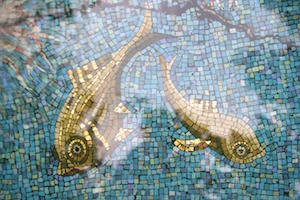
fish_mosaic_1 300pxWe all “swim” in the waters of culture in the same way fish “swim” in the sea.

And, in the same way we might speculate that fish don’t think much about the water they’re swimming in, except when they are challenged by it in some extraordinary way … say encountering highly polluted seas, lakes, rivers or streams … we too don’t much notice our culture.

We might also extend the speculation to those particular fish who are apt to on occasion breach the surface and escape the ever present ubiquitousness of the water they dwell in to notice that there’s something beyond what they experience as ordinary and normal, in this case the entirety of the sky above the surface of the waters that contain them.

I’d go so far as to suggest that fish are more likely to breach the surface of the water than we are to breach the boundaries of our culture …

And there’s the rub …

To get more specific the “ocean of culture” we swim in is bounded by the narrative that contains it. In the same way the ponds and lakes have edges, rivers and streams have banks, and oceans have shores cultures are limited by they narratives that define them.


The challenge for most people is that the narrative has become what is real …
it is their reality in the same way the water is reality for a fish.


Okay, I’d agree with anyone who says that we can’t be without a narrative of some kind. It seems the dilemma of humanity that we are capable to both recognizing that we are living within a narrative, and noticing that the narrative is just made up … a creation of our collective agreement and imagination.

Reconciling the dilemma that the narrative is both “real” and “unreal” at the same time without giving into it is a bit more challenging.

  •  The narrative is “real” in that it sets the frame for how we interpret what is happening and in turn what to do about it.
  • The narrative is “unreal” in that it is simply one one of an infinite number of ways to interpret what what is happening.

So what are we left to do about it then?


Escaping The Charybdis

Charybdis was a whirlpool that devoured ships foolish enough to dare to sail too close. The option for a ship captain was to dare the Scylla, a dangerous rocky shoal that would tear ships to pieces instead.

The ancient Greeks described both of these originally as sea monsters that would attacks unwary captains, annihilating their ships and their crew.

In our current world we too run the risk of being devoured if we dare to venture too close perceptual reality versus the cultural narrative we’ve been led to believe as what is real … yet like Odysseus in Homer’s Odyssey, we must endure this very challenge if we intend to realize the possibility of awakening beyond the illusions of culture.

Left unchallenged the filter of culture determines how we will interpret the entirety of our life experiences and the meaning we make of them.

The collective agreements of culture are designed not only to inform us about reality, but also to shape how we perceive all the events and information we encounter.

One of the most pervasive and “essential” truths we learn within the culture of modernity assumes that we are informed because we are literate and educated … beyond this we often make the leap to the further assumption that this means we are also intelligent, when the evidence gathered from how we most often go about our lives and the current state of the world seems to suggest that nothing could be further from the truth.

We are a species hovering on the edge of destruction … not only of ourselves, but seemingly threatening the entire basis of life in the biosphere … and yet we continue unabated with the same patterns of action that brought us here.

The first thing we must agree to accept, if we intend to do anything about this state of affairs personally and collectively is …

The current narrative is broken!

The story we are living our lives from no longer supports life as the basis upon which it rests. Instead we are living from a story that has its foundations in fear and greed, built on the assumption that the only way to have enough is to get more.

We seem to desire a life worth living, filled with deep meaning and purpose attached and connected to others in meaningful and caring, if not loving, relationships.

But such a life has been supplanted by a life organized around earning a living that exceeds what we need to survive and prosper in the service of productivity and consumption.

  • We are fed lies that support a system where the majority of people live in servitude to a micro minority elites who run a corrupt and rigged system.
  • We have been led to believe that we have a say in the way that society is organized and managed, yet most of our laws are designed to improve the quality of life of the very few at the top, while minimally allowing those at the bottom merely to survive.
  • We buy into this system of lies and misinformed beliefs after more than a decade of compulsory education followed by up to another decade of voluntary education that we’ve been told is “the great equalizer” when the evidence is that some of the most privileged in our society only became that way after dropping out and opting out of the very system we’ve were led to believe would be our salvation if we just stayed the course.

When we navigate the narrative based on the evidence we find that the very systems we’ve are told will save us actually enslave us … one of the most unforgiving being the schooling we received that conditioned us to perform at the bequest of the experts and masters like trained circus animals performing on demand …

The “Gold Star” effect spanning the time from the first encounter in school with the teacher acting as overlord in the classroom, handing out rewards for good performance, to the time we either awaken, retire or die in the hands of a system that teaches us first and then tells us for the remainder of our lives … Be Good and Fit In.

Yet this narrative has been so cleverly woven that the majority living under its cloak of deception fail to see it as other than reality itself. 

However, immediate escape is available to anyone who simply recognizes the narrative for what it is … a tale told by an idiot, full of sound and fury signifying nothing.

That choice is ready at hand to anyone who wants it and opens the way to beginning to notice and perceive the signals in the system for what they are and not what we are told to believe they are … learning to trust ourselves above the overlords who would have us believe that without them and their guidance we would be lost.


The Gateways Of Perception

The beginning of the transformation from being the good boy or girl who has learned to fit in starts when we reject the veneer of truth spewed forth from the media, the politicians and the educators who swear to keep us informed and educated posing as the whole truth, when in fact it is nothing more than the tidbits they are willing to share that continue to support the story that enslaves us if we let it.

You do have a choice … accept that you are living within a perceptual position that continues to allow you to perceive and see the yourself, the world around you and your place in it as you do from that position … and that your perception isn’t what’s necessarily real. 

While you may not be able to escape the human condition of living from a perceptual position you have choices about what position you choose to inhabit at any given moment in time and space.

One of the great “truths” that has been thrust upon us from those who have spent lifetimes exploring the development of what it means to be fully human suggests that we are capable of accessing and holding multiple perceptual positions. 

Each one of these perceptual positions acts like a distinct gateway to perception and shapes what you experience and the meaning you give to your experience.

Change your perceptual position and another gateway opens for you to an alternative future with a multitude of alternative possibilities. 

This has become the essence of the work I offer to those I work with individually and organizationally … exploring with them the scope of possibilities that appear when another gateway of perception is chosen. 

While I focus on eight primary gateways of perception that have been the most fully explored and are most readily accessible, recognized and understood, I accept that the potential number of gateways humans are possible of accessing may be infinite.

What may be most useful in beginning the quest to decipher the narrative is simply the willingness to release the death grip on a singular perspective and gain access to the choice of standing at the gateways of perception that most serve the outcomes you desire.

Having read this far it’s likely you’ve already taken the first step … 


Bon voyage,

Joseph Riggio, Ph.D.
New Hope, PA


Filed Under: Blog, General, Human Systems, Life, Mythology, Transformational Change & Performance, Uncategorized

MythoSelf Process Cheatsheet

MythoSelf Process Cheatsheet

by Joseph Riggio · May 15, 2016

purple coral - morguefile 1e80cd4be36b4bbc6c07d46a7c3a4f35

I put together a new, more simplified “Cheatsheet” for the MythoSelf Process showing the structure, application, principals and essential notions.

This sheet updates the last modeling of the model I created, and it also simplifies the presentation into what are mostly a series of lists.

The really essential aspects of the MythoSelf Process model are layout in a kind of step-by-step fashion to show the structure of the model, how it’s applied and the foundations it rests on that facilitators and trainers operate from as well.

You can see it here:

MythoSelf Process Model Cheatsheet


Let me know what you think …

Joseph Riggio, Ph.D.
Architect& Designer of the MythoSelf Process

New Hope, PA


Filed Under: Blog, Transformational Change & Performance, Uncategorized

The Mythogenic Self Revolution

The Mythogenic Self Revolution

by Joseph Riggio · Apr 23, 2016

You Are A Myth Making Machine

Excaliber - Lady of the Lake  morgue-file000620790792

This is the fundamental idea of the MythoSelf Process. Not that you are living inside of a myth, that was Joseph Campbell’s offer, understanding and contribution, not mine.

My observations are about a way of life, living it … not peering into it to understand it better or more deeply.

Oh, okay, to live life better and more deeply we may have to dive into understanding it better and more deeply as well.

But, never mistake understanding for diving directly into life itselt and experiencing it … they are not the same things.

The revolution is aesthetic … NOT intellectual … NOT psychological … NOT philosophical … AESTHETIC.

The revolution begins when you take back your life and begin living it, as opposed to thinking about it.

That’s what I mean by aethetic … diving into the deep end of sensuality.

Experiencing your life directly through your sense and sensate experience, as opposed to intellectualizing you life and ideation.

You may be challenged by never having had any formal aesthetic education, and I don’t mean art history, learning to read poetry or appreciating good music.

I mean learning how to recognize the signals from your senses directly … to experience physical sensation DIRECTLY!

There are lots of psycho-somatic practices that teach people to attend to their physical feelings and then make meaning of them … or figure out what the sensation is trying to offer you about whatever you’re feeling (instead of just feeling it).

WTF???!!!!!?????!!!!???!!!

That’s exactly NOT WHAT I’M TALKING ABOUT!!!!!

I designed the MythoSelf Process to lead people back to themselves.

Back from the edges of interpreting to the direct sensations of experiencing.

The MythoSelf Process leads people back to becoming aware of being.

We use an ontological stance, NOT an epistemological one, as the root of our practice.

BEING!!!!!

When I refer to being I refer to the very basic experience of living life as you find it.

Read that once again please …

… the very basic experience of living life as you find it.

Now I make my living as a change artist, i.e.: someone gifted in the art of helping people to change and experience transformation.

Yet … I have no intention to help people to learn how to make change happen in their life, other than to get to a state where they have become unchanging as they experience themselves …

I AM THIS

Then life happens … you can neither stop that, nor do anything about it.

(On another note, why would you want to if you could?)

The MythoSelf Process directs you to become saturated with life, stepping into it fully, not away from it with “meta-meanings” that remove you from it.

The MythoSelf Process moves you to the MESA-STATE … to the center of the swirling experience you call your life to experience the entirety of it … fully and completely.

To quote myself … the MythoSelf Process leads you to “have the experience of YOUR life” not some shadow of it … or projection … or interpretation … or something designed to represent your life as intended by others (what we commonly call culture and arrived at by the process of enculturation).

This is the revolution …

Years ago I used to talk a lot more about UNLEARNING … the process of learning how to forget what you had learned that ain’t true.

It’s about remembering to forget what you know as truth that has no basis in fact, e.g.: you should be polite to strangers.

Why?

A child immersed in natural learning often asks “Why?” as the most basic question that comes to them about what they are learning.

“Why do caterpillers turn into butterflies?”

NOT, “How?” … but, “WHY???”

(“How” comes later … and, despite the curiousity surrounding “how” for the most deeply curious “why” remains more persistent.)

Soon enough however, the most persistent child learns that “WHY?” will never be rewarded in the same ways as “how.”

Knowing “WHY” we do math, will never get the child the same rewards as knowing “how” to do math.

Yet, knowing “WHY” before knowing “how” might have saved humanity countless tears.

“WHY” do we want to or need to win the war? shifts the conversation.

“How do we win the war? directs our attention to create an “other” that must be defeated or conquered.

When we examine the “WHY” we often find ourselves at odds with what we hold as our fundamental values and beliefs.

“Why go to war?” … because we want their stuff … their land, their women and children, their food, their minerals … their stuff.

Yet we tell ourselves that we are doing the moral and just thing, and often justify it by proclaiming our gods want it to be this way … i.e.: with us as the victors and confiscators of the spoils of war.

One of the first aphorisms I learned was about how the victors write the history books.

Now I’m not writig a treatise on war, but I am using the example to make a point.

By directing the attention away from “WHY” and over to “how” we take away the naive curiousity and wisdom of our children and “turn them into adults” … in other words, good little worker bees.

To take back you life means first and foremost you’ll have to leave the hive …

Finding life as it comes to you

We’re all experiencing a great shift in how we know the world.

Too much happens too quickly to track it all effectively … and most of it not at all.

We are at a time of a great confluence … of cultures, ideas, information, resources … and it goes on and on.

We live in a shrinking world with regard to time and space as our sense of distances becomes ever smaller as we continue to refine our technologies and dream about reaching beyond our solar system and colonizing the outer planets of our galaxy … and then we reach again with our mind’s eye beyond that as well.

Yet, in deference to Joseph Campbell, we don’t have a mythology that supports the dreams we hold in our mind’s eye.

Our mythologies are from another time and space.

We inherited the mythologies of questing and conquering, without gaining the wisdom required to limit our thirst for what we don’t yet have and don’t yet know … worshiping not the gods and their circumscriptions about unlimited knowledge and power, but hubris itself … overbearing pride and arrogance that we alone hold the keys to the Universe.

AND, we have largely succeeded in exceeding ourselves.

We have at hand the means for destroying that which sustains us and make us as we know ourselves to be possible.

Yet we seem NOT to have the means to limit ourselves to what we can sustain … to what will allow us to remain and prosper.

We are systematically killing the planet and raping her resources, to the point where what was unimaginable fecundity has begun to look less like the Garden of Eden or Paradise, and more like an over used landfill, heaped with waste and heaving with disease.

FWIW I don’t believe this is irresolvable or irrecoverable … BUT IT WILL TAKE A NEW MIND.

This has always been the focus, direction and intention of the MythoSelf Process model and work … designing a new mind for a new world.

The MythoSelf Process does not attend to fixing problems or even curing their cause.

The MythoSelf Process aims at building a new mind that transcends problem formulation and construction.

The MythoSelf Process organizes around a new paradigm of connectivity, beginning with the elevation of becoming connected to one’s self.

The MythoSelf Process insists on a revolution based in accepting things as they are, not as we wish or hope they would be or will be, because as we look away from where we find ourselves we remain unable to do what we must in the moment we are living our experience and acting on a phantasm we perceive to be real.

The revolution is almost over

We all seem to sense that things are moving faster than our old minds can keep up with … and simultaneously many, if not most … if not all … of us are waiting for the revolution that will allow us to make the leap beyond the tragedy we are witnessing to the ability to do something about it.

And, for many, if not most … if not all … of us, we continue to act in the same ways we have learned that got us to where we find ourselves now.

Our hubris drives us forward believing that MORE IS BETTER, when the evidence we faces shows us that more may be too much.

We silently tremble in fear about not having enough in a world of unbelievable plenty, because some want much more than they need or could even ever use or consume … while others want more than that for themselves and theirs alone.

We live in a world run by an elite class that thinks like the old farmer who claims that he doesn’t want all the farm land there is, just the farm land that next to the farm land he already has and just what’s next to that too.

But the real REVOLUTION will be INTERNAL and not external … the revolution will be a changing of the mind we use, not how we use the mind we have now.

The OLD MIND asks, “How do I …” … the NEW MIND asks, “Why do we …”

When we make this shift we will become what we are destined to be again … myth-makers, i.e.: mythogenic beings.

We will rewrite the codes of life in the service of life … and not in the service of death and the extraction of wealth from the dying … the dying planet or those who live upon it.

In the new world view that the revolution brings we will not seek to change things and make them better, we will seek to perceive life as it comes and lives in harmony and balance with it.

The old revolution was technological … the new revolution is biological.

LIFE WILL AGAIN BECOME THE DRIVING MEASURE OF VALUE.

We will put technology in the service of life, and not life in the service of technology.

The NEW REVOLUTION will be quiet and personal, one person at a time arriving at the new mind that honors and reveres life as the most desirable asset … to live fully and saturated with the experience of living … beyond the acquisition, accumulation and consumption of things, or information, or even experiences … coming to rest in simply being, and respecting life as it comes.

The MythoSelf Process proposes this radical assumption: that we are moving beyond the paradigm of fear that leads to the avarice and greed that forces us to acquire, accumulate and consume more than we need.

The MythoSelf Process proposes that we are whole and complete as we are, without the need for the props of culture to support or steady us in our desire to fully experience our lives as fully intact sensate beings.

The MythoSelf Process proposes that we are beyond the cusp of beginning to realize what we are capable of becoming, and have stepped across the threshold of being that which we already are when we have become fully human.

The MythoSelf Process proposes that we are capable of writing a new story, of redefining the myth of being human and living in a cosmos beyond our comprehension, to a new myth that recognizes us as fitting into a cosmos that works perfectly and that we are designed to fit into perfectly as well.

Imagine that … the absolute sense of certainty that the Universe works perfectly and that you have been designed to fit it just as perfectly, just as you are now.

Not by some grand scheme necessarily, not by some divine decree – although that too may be possible, but rather by the endless unfolding of the Universe coming into being and revealing you to yourself as part and parcel of its own being.

You cannot not be of the Universe that contains you, and despite that fleeting sense you may have of either you or it not being complete and whole, there can be no other reasonable conclusion.

So I am proposing that you join me in the revolution willingly, openly, wholeheartedly … and do whatever it takes to learn to become fully human … to manifest, realize and reveal that which you already are.

Write the myth that lives within you by releasing it in the acts and actions of your life … join me, the revolution awaits you.

Joseph Riggio, Ph.D.
New Hope, PA

Architect and Designer of the MythoSelf Process

Filed Under: Blog, General, Human Systems, Life, Transformational Change & Performance

Which Brain Are You Using?

Which Brain Are You Using?

by Joseph Riggio · Mar 29, 2016

Silent Brain Learning

brain01 125NOTE: Read this article and watch the video first …

[The Enormous Power of the Unconscious Brain]

It’s a great article, but the journalist has it all wrong IMO. In fact he completely contradicts himself …

Silence is Golden

In the video you see the comparison between the journalist’s brain and the world-champ’s brain (that’s right the 10 year old is a world champion cup stacker … what have you done lately???).

In that video the journalist’s brain is lit up like a Christmas tree .. whle the champ’s brain is virtually silent. Yet the journalist claims he’s wired in the programming to his cortical processing to run the patterns he’s running without processing them.

That’s fundamentally absurd!!! (Go ahead, read the paragraph above again.)

The argument I’m making is that what the champ did was to get his brain out of the way (okay, not his whole brain, but the part we “think” with normally … or at least consciously … the cortical brain (the neocortex).

His brain is silent because it’s not working … and even the little blips we see have little to nothing to do with what his hands are doing.

That’s not about training the cortical processing, or learning to submerge the conscious processing function.

The champ used his neocortex to train his cerebellum to take over … i.e.: his Silent Brain!


Why Performance Mastery Is “Silent”

Performance is a function of the ability to act in response and relation to the stream of data flowing in the system that you’re operating in to create your intended outcome.

The more accurately you perceive and interpret the data present in the system, the more accurately you can adumbrate what’s coming next … and, make adjustment to your responses.

Ultimately, your performance is a function of behavior, i.e.: the actions you take and don’t take in response to the way you percieve and interpret the data in the system. The more closely your actions align with the simplest, most direct path with the least resistence between where you are in the present moment and what you intend as your outcome, the more elgant, efficient and effective your performance will be … let’s call this the “Path of Perfection.”

When you can act consistently and reliably along the Path of Perfection, you will gained mastery in that behavioral performance … whether that’s mastery in sports, communication, business … or some other domain of action.

This kind of performance, i.e.: mastery, is a function of processing done beyond the reach of cortical processing … or at least solely by cortical processing.

The primary driver of mastery at the behavioral level of performance is processed in the cerebellum.

This is the seat of the silent processing we see in the video of the champ’s brain …

He’s not showing activity in the neocortex, because he’s off-loaded the processing to the cerebellum and gotten his cortical processing out of the way of his faster, more elegant cerebellar processing.
 

Blind But Not Dumb

The cerebellum may be blind, but it’s not dumb.

Cerebellar processing operates differently from cortical processing because it’s non-representational.
We see this when the champ puts on the blindfold and still runs the behavioral performance as well as when he’s not blindfolded. Although he’s not getting any visual input his motor facilities still function as accurately in the task he’s trained them to do.

He’s using a combination of kinesthetic input and spatial mapping to function at that level of performance. This is the magic of training the vestibular and proprioceptive systems to take over for the more common sensory system processing task, e.g.: looking at the cups, his hands and what he’s doing with them.

The silence of the cerebellum is it’s trick. The cerebellar processing pathways are more efficient because they are closer to the direct sensory data. The cortex almost immediately transforms direct sensory data into representations, abstractions and intellectualizations … at least one step removed from the actual data itself.

One of the most obvious examples, especially if you have yet to master something at the level of the world cup stacking champion (5 seconds for that whole routine, again and again, even blindfolded) … is the transformation of direct emotional experience into an intellectualization. Anger, joy, grief, ecstacy … all have an actual body experience, a felt sense … but the way the average person experiences their emotions has as much or more to do with the associations they make with the way they label their experience.


Cerebellar Training & Learning

The basis of virtually all the work I do is framed in relation to moving unnecessary cortical processing out of the way of performance.
This is not saying there is no place for corical processing, of course our neocortex is one of our most amazing evolutionary gifts … but, all things at the right time and in the right place … preferencing cortical processing over all other kinds of “thinking” or kinds of neurological processing.

The real “trick” is knowing how to get the cortex out of the way, freeing it to do what it does best … i.e.: make connections in time and space that don’t yet exist … creating future memories.

To do that the behavioral part of performance must be off-loaded whenever possible to the more efficient cerebellum.

When the cerebellum is in charge of responding there is a direct line to taking action, that cortical processing must run through multiple channels to get to first, creating a slower, more cumbersome response.

For some people (especially those who remain untrained) in getting through the levels and complexity of cortial processing they run out of steam before they get to action, i.e.: they find themselves unable to take action or constantly hesitating and procrastinating when immediate action would have served them (and, possibly others) best.

Knowing how to organize yourself to take action is the key to mastery.

In otherwords, if you want to attain mastery you must develop the ability to train and learn at the cerebellar level of response.

When you’re ready give me a call …

(You’ll find my contact details here: Joseph Riggio DotCom)
Joseph Riggio, Ph.D.
New Hope, PA

PS – The most effective way “cerebellar training” I’ve ever put together is my “Foolish Wisdom” group coaching program. I’m running a program in New Hope, PA in a couple of weeks on Saturday & Sunday, 16/17 April 2016.

Check out the Foolish Wisdom Workshop details here:
https://www.amiando.com/HSNIUBF.html

Filed Under: Blog, Business Performance, Coaching, Cognitive Science, Elite Performance, Transformational Change & Performance, Uncategorized, Upcoming Events

Reinventing Reality …

Reinventing Reality …

by Joseph Riggio · Feb 23, 2016

Why Sir Issac Newton Had To “INVENT” Calculus … (and why his reason should matter to you)

Defying Gravity - One-person-acrobatic-jumping-scene-symbolize-vitality,-aspiration,-success,-progress-000010811119_400px“If you can’t tell if it’s reality you’re dealing with, you can’t possibly expect take action to create the results you want.” – Joseph Riggio, Ph.D. author of “The State of Pefection: Unleashing Your Hidden Code To Mastery”

For decades I’ve been on about the alignment between our perceptions of reality (all I believe we ever have with regard to our sense of reality and our ability to act in the world as we know and experience it) and …

What’s beyond beyond our subjective, or constructed, experience .. the manifest and extant data in the environment … “objective, empirical evidence” … what we must accept as true even when we don’t agree with it or like it … as we know it to be through our own empirical, sensory perceptual experience.

BUT … this is no ordinary or easy task … i.e.: arriving at an empirical experience of reality that simultaneously allows for what cannot be known except by one’s own subjective, empirical perception and understanding.

AND, I beleive it is what Newton solved in creating “the Calculus.”
Give me a minute or two more and I’ll explain why I believe that … and what it means to you too.


Newton’s “Fluxional” Calculus:

Okay, to begin with we can’t really know if it was actually Issac Newton or Gottfied Leibniz who actually invented modern Calculus (the term was in use long before either of these 17th century genius, but referred to mathematics in general before it was formalized in the approach that we simply refer to as “calculus” today).

And … I don’t really care either …

The reason I want to focus on Newton is because his path to “the Calculus” was more general and applicable, and less theoretcial and sweeping philosophically than Leibniz’s approach.

Leibniz believed that “the Calculus” was a metaphysical explanation of change, i.e.: beyond the material realm, but nonetheless fascinating as a method to explore what was not possible to capture in the physical plane of existence, his was the “Infinitesimal Calculus” the sought to explore infinitesimal events as they were held as concepts of thought.

Newton on the other hand saw Calculus as a general explanation of change, and in specific a way to mathematically understand, capture and describe the motion of objects … especially when dealing with the magnitude of the motion of the objects in question.

Another reason is that I love the way Newton referred to what we know think of as formalization of the Calculus he developed; “Fluxional Calculus” … it just appeals to me.

However, the deep distinction in Newton’s calculus was that he tried to avoid infinitesimals, i.e.: that which could not be grasped empirically, but defaulting to a strictly rigorous epiricism. His was a task of explaining “the indisputable fact of motion” by accepting that as objects moved they were transiting a path that was continuous and not made up of infinitesimally small increments of movement.

This is a distinction between the empiricism of the analog in motion and the imaginal of the digial points that a moving object occupys in some unique, divided and separate instant from all other instants it occupies along the path it transits.

&nspb;

Why Newton HAD To Invent Calculus”


It’s claimed that Newton “HAD” to invent the Calculus to gain acceptance of his theory of gravity with the Royal Academy of Science in England … and there’s some truth to that, but it wasn’t the only reason he began or became obsessed with the path that led to his Fluxional Calculus.

Newton HAD to invent calculus to give him a way to describe the world that had become empirically obvious and undeniable to him … a world filled with motion and change that was constant, continuous, inevitable and unbroken or indissolvable into discreet and distinct separate elements or moments in space or time.

One of the most fascinating things about Newton’s (and Leibniz’s) calculus, that described motion and change, to me was that it demanded the creation of an entire new system of mathematical representation for the elements and concepts that it was addressing and workign with as a “tautology” … a closed, self-contained, way of considering reality as we know it, with it own set of self-referencing, self-organizing principals, rules and language.


So Why Should You Care About Any Of This???


The reason to care about this is simple … because your life depends on it!

Okay … Okay … maybe I’m being a little melodramatic for effect.

BUT, let’s say that the quality of your life, and the experiences you have, do actually depend on it … i.e.: your ability to describe reality beyond yourself, or your solipsistic, singular way of knowing.

To put it another way … YOU NEED TO HAVE MULTIPLE POINTS OF VIEW TO MAKE SENSE OF ANYTHING BEYOND A WILD HALLUCINATION OF WHAT YOU THINK IS “OUT THERE” IN THE WORLD BEYOND YOURSELF … that thing we call “reality.”

You see your own personal experience of anything is “non-falsifiable” as your experience. Your experience is what it is absolutely, undeniably and indisputedly … just like an object in motion is an object in motion.

However, to make sense of your experience in relation to the world beyond yourself … the experience others are having – of themselves, of you, of the world you are experiencing in simultaneity … or, the events that are occuring that are beyond your ability to contain personally … just about any event that includes more than just you yourself experiencing just you yourself … you must have a way to “triangulate” and navigate your experience in reference to what is beyond just you.

(I recommend you slow down … go back … and re-read that paragraph a few more times. It’s both essential to what I’m offering you here, and also critical if you want the value of what I’m offering you here as well.)

This is the essence of the work I refer to as accessing “The State of Perfection” … a way of moving towards a more rigorous empiricial position that begins by having access to and the ability to sustain multiple points of view …

  1. One point of view that you must gain a handle on is what we can call a “first person point of view” (FP-POV). A FP-POV is the point of view that you have from within yourself, i.e.: your experience of your experience … the point of view that is absolute, undeniable and indisputable.
  2. Another point of view you can have is a “second person point of view” (SP-POV). A SP-POV is one in which you consider what it would be like to experience the experience you’re having if you were another person having the experience of being with you … having your experience.This one’s a little more complex in that you have to hold two points of view simutaneously to get there … the point of view of what it would be like to notice another person having an experience of being with you while you’re having the experience you’re having … AND, the point of view of noticing the experience that other person would be having of being with you.
  3. A third point of view could be one in which you are simply in an observer’s position noticing what there is to notice without referencing it as subjective experience … for example; “My arm is moving” as the pure experience of noticing that your arm is moving in detached way, almost as though it’s not your arm that’s moving … like you would notice someone else’s, anyone else’s arm moving. This would be a third person point of view (TP-POV).What’s significant is that you can extend the TP-POV to experiences that are not externally observable, for example: “I am angry … AND I’m feeling it as a tension in my abdominal area, while my hands and jaw are clenching, and I’m constracting all the muscles along my back from my waist to my next far more than I am usually aware of contracting them … and, I also notice that my field of vision seems to be much narrower and more tightly focused than is usual to me.” without becoming attached to any of that description beyond noticing what’s there … i.e.: not wanting or needing it to be anything other than or different than what it is “as is.”The TP-POV would then become a kind of “empirical” or “epistemlogical” phenomenology … i.e.: an examination of the content of your own experience as though from a position beyond, or outside of yourself, where you are extremely interested in and observant of the data about what you are experiencing without attaching any meaning to it beyond a pure description of what you’re observing about it.

When you can access these multiple points of view, especially a TP-POV … an epistemological phenomenological” point of view … you will be infinitely better at managing your perceptions and actions to direct them to the outcome positions you most want to attain.

This is how you will begin to gather the ability to optimize all your experiences … regardless of the circumstance or situation, on your own and/or with others.


So Why Bring Newton Into This Conversation About Optimal Experience Then???


There are two reasons that the discussion about Newton creating Fluxtional Calculus are important to this conversation …

  • First, because it clarifies the distinction of subjective and empirical perception. Newton based virtually all of his discoveries and genius on holding a TP-POV that opened up a window to perceiving reality from simultaneous, multiple points of view … a kind of “G-d’s Eye” position, where Newton could and did perceive more of the hidden and elusive nature of reality than is immediately or ordinarily observable.E.g.: that gravity was a universal and constant force, that was changed depending on the factors of mass and distance of the objects exerting and being effected by the force of gravity … or the idea that white light was only a single way of perceiving multiple spectrums or bands of light that were simultaneoulsy present and experienced by the human eye as a single band of light, i.e.: white light, and that white light is unique in that it contains all the other bands of light that humans are capable of perceiving.
  • Second, because Newton needed to create a separate specical language to describe the unique characteristics of reality that he was observing. Without the Calculus not only was it not possible to share with others what he was empirically observing as he experienced it … but it was impossible to share with them the ability to make similar observations and discoveries for themselves.Yet, with the new “language” of Fluxional Calculus anyone who choose to could use the tautological space created by it to replicate the observations of Newton from all three perceptual positions described above, a FP-POV, SP-POV or TP-POV, and also using this “language” begin to describe observations of their own and share them with others who could also experience them from a FP-POV, SP-POV or TP-POV for themselves including observations that Newton had not made, but opened up the possibility of making using the new form he had created and shared with them.


You Need A SPECIAL LANGUAGE To Describe The Otherwise Indescribable


In my own work, the MythoSelf Process model, I deal with an set of observations about the world that are premised on some special conditions as well …

  • Starting from a uniquely positive point of view – the “excitatory state” or the neurological condition of the system remaining open to the inclusion of new data, even data that is contridictory, unfamiliar or previously unknown or unaccceptable
  • Assuming a stance of possibility rather than limitation – the premise that any data, evidence or experience can lead to the next step to be taken toward as desired outcome, and not a limitation that prevents the possibility of achieving the outcome eventually
  • Using the body as the basis of primary data about what is happening, rather than the distortion of tranforming sensory data into intellectualizations and abstractions – holding an embodied and situated way of experiencing real and imaginal events by attending first and foremost to the sensorial data, i.e.: the experience of seeing, hearing, feeling, tasting and smelling, as well as the body sense of balance and proprioception in an integrated and cumulative way as the singluarity of the felt sense of the experience as well as the individual components that comprise it (the felt sense)
  • Organizing the totality of experience as containing the singularity of space and time as mythic form – understanding the primary autobiographical narrative that is your own Life Story, i.e.: who you perceive yourself to be in relation to the world-at-large and the cosmos within which that world is situated
  • Recognizing the “storied nature” of experience and how we tend to experience events in an integrated way happenign simultaneously in terms of all the data that is present along a continuum of time that we later describe in discreet packets of information – e.g.: first this happened and then that, separating the analog nature of actual space-time into a digital representation of space-time
  • Defaulting to the premise of wholeform learning and communication in that we accept that all experience is wholeform with all events containing all the information present in simultaneity – this presupposes that all of our experiences are also had in simultaneity with all of the data impressing itself on our senses as a singluarity in any given space-time moment, despite our desire to keep things discreet to make sense of them as individual events happening in parallel, i.e.: there is no separation posssible in the events we experience that happen in the same space-time moment
  • That we can and do create our own experiences, constructing them out of wholeform structures, and then accept our constructions as what is “real” – and, by accepting that our experience is at least in part “made up” by us in wholeform that we also have the ability to choose the form we give to our experience
  • That the primary mechanism we have for managing the way we construct our experience is somatic, i.e.: body-based, and that our somatic experience gives rise to our stories and the meaning we make of them, i.e.: our semantic experience – knowing that we only know what we know, and know what that (what we know) means, in the form of the stories we tell ourselves and others, and in the stories others tell us
  • Only be integrating and aligning the somatic and semnatic forms we hold can we arrive at an integrated sense of ourselves and the world-at-large, as well as the cosmos and our place in it – this is the basis for the approach and methodology I use in working with the MythoSelf Process model, i.e.: Soma-Semantics, a way of simulaneously accessing and address the somatic and semantic forms that are the ways we represent reality to ourselves and others

So, fundamentally to do the work I do I had to create a tautology for the model, i.e.: a self-contained, self-referencing, self-organizing system with it’s own set of principals and rules, as well as it’s own language … in much the same way that Newton and Leibniz had to do to form a way to capture and describe the nature of motion and change that is the Calculus.

In my case, the approach and methology of Soma-Semantics, is the form of describing how we capture and describe the nature of subjective experience and change within it. This is the basis for transformational change – the changing of our experince of reality NOT the change of what we do in response to our experience of realty.

Within the application of the MythoSelf Process model from the transformational shift that becomes possible using the approach and methodology of Soma-Semantics, a second possiblity emerges … that of realizing a significant performance breakthrough, which is only possible to the extent that it is when transformational change has happened first, i.e.: a shift in the fundamental perception of reality.

The essential starting point for achieving transformational performance, where transformational change and performance breakthrough intersect, is the State of Perfection the state experience that is established at the start of the application of the MythoSelf Process work. Without this body-based, felt sense of being in the world what follows would not be possible, with it nothing remains impossible …

Yet, once you have accessed and sustain the State of Perfection all things become possible to you.


All the Best,

Joseph Riggio, Ph.D.

Creator of the MythoSelf Process and Soma-Semantics
New Hope, PA

23 February 2016

PS – If you are interested in experiencing the State of Perfection for yourself … click on this link for more:
The State of Perfection


PPS – I will be holding a special one time only 2-hour webcast event, “Accessing & Sustaining The State Of Perfection” on 8 March 2016

Filed Under: Behavioral Communication, Blog, Cognitive Science, Story, Transformational Change & Performance

Revisiting Bliss …

Revisiting Bliss …

by Joseph Riggio · Dec 21, 2015

Follow your bliss …

and the universe will open doors

where there were only walls.

Joseph Campbell


Coffee & Croisant Sq 200px


Wow!


I was a little stunned myself at how much more clarity and focus about what counts in life can be achieved in about the time it takes to have a cappuccino and a croissant.


If you’re … lost … tired … unmotivated … or, yearning for something elusive that you hope will give you the sense of destiny and  fulfillment you desperately desire … but have been unable to find … what I discovered accidentally one morning over breakfast with a friend may just be the answer you’ve been looking for …

But first indulge me in sharing a little bit of background.
Joseph Campbell is remembered by many for his injunction to …

Follow your bliss …

It always amazes me how little people expect of life that really counts for something, and how hard they are willing to work to get it.


I think that’s mostly because they don’t get what Joseph Campbell meant when he referred to “bliss” …

Most people think “BLISS” refers to being happy or comfortable, or more than that a kind of ecstasy of spirit. 

Yet, I’m confident it has nothing to do with any of those things …

As I understand it, and work with my clients around it, “BLISS” refers to being fully and completely aligned with one’s self … identifying and moving in sync with your true nature.

Think about it … Joseph Campbell says when you follow your bliss “the universe will open doors where there were only walls” … he says nothing about feeling “happy” or “being comfortable” …

In Joseph Campbell’s magnum opus, “The Hero With A Thousand Faces” … he lays out the structure of the “Hero’s Journey” and shows us that the hero/heroine must enter the “belly of the beast” first … facing their fears and overcoming many trials before achieving their bliss.

But, while the “Journey” can be wrought with difficulty it doesn’t have to be that way …

Joseph Campbell also points us to other aspects of the “Hero’s Journey” … in this case specifically the “Guide” and the “Magic Helper” … Luke Skywalker’s “Obi Wan Kenobe” and “Hans Solo” in StarWars, or Daniel’s “Mr. Miyagi” and “Ali” from The Karate Kid are examples … but, my favorite guide and magic helper are Carlos Castaneda’s “Don Juan” (Juan Mateus) and “Don Genaro” (Genaro Flores).

The guide and the magic helper are crucial when you are ready to transcend what limits you.

In the past there were many who fulfilled these traditional roles of guiding the seeker over the threshold … the shaman … the medicine man/woman … the witch doctor … the priest/priestess … and on and on.

Today some hope for this kind of facilitation with their psychologist, counselor or therapist … yet the medical models these folks work from is often completely lacking in achieving such transcendence.

However, all is not lost … there are still some models which seek to fulfill these sacred roles … I got this many years ago when I was apprenticing with Roye, my own mentor.

A little over two months ago I began something extraordinary … a *NEW* program for one to one private work I designed, i.e.: the Breakfast Discovery Process … an extremely focused, a single 45 minute coaching session.

Both my client and I agree at the outset that the intention of our time together will be to arrive at an extraordinary clarity about the current situation and the realization of a direction leading forward … a path through the next steps to take.

According to great Swiss psychologist, Carl Jung, there are two tasks of life:

  • In the first half of life arriving at ego differentiation … to find yourself at home in the external world.

  • In the second half of life the task becomes about … discovering who you are as an individual.

I had a conversation about a month ago with a twenty-something client who was striving to achieve the realization of the first task … to find himself at home in the external world, i.e.: to know what to do with his life.

The conversation began naturally enough, around how he was not sure about what to be doing with his life … the direction he should be taking to build a career and find success in his life. The real issue was one I’ve heard again and again, “I get started on something new with a sense of excitement and hope that this thing will be it … then I quickly get bored and disinterested.”

Twenty-somethings … Thirty-somethings … even some Forty-somethings find themselves lost in this loop … looking for bliss in their lives, but only finding boredom instead. 

This comes with incredible possibility … with options and choices, i.e.: boredom common to folks who are ambitious and desire more from life than a guarantee of a place to go from 9-5 everyday and a paycheck at the end of the week.

Transcending the re-occurring boredom that comes with opportunity requires a special kind of vision and perspective to see beyond the obvious. Yet, when that special perspective is achieved what had been hidden with it becomes obvious as well.

This is the foundation for BLISS.

We discussed a lot of things, beginning with an exploration of where he’d been in his life and where he found himself in the moment … all very casual, all very conversational.

At some point he began revealing his deeper thoughts and desires … what really held him back and where he really wanted to be … what it was exactly that he was revealing, all spoken outside of his conscious awareness (… and that’s what made is so unavailable to him).

Although it was now obvious to me the path forward remained inaccessible to him …

The key to his movement was actually remarkably simple … a single powerful insight followed by an equally powerful single action were all it took to transform his blindness to clarity.

A critical point is that insight without action is most often meaningless … yet, insight followed by action can be the most powerful transformative process available to you.

Now like most things … any old action won’t cut it.

The action must be precisely aligned with the insight, and the insight must cut through to the core of your hidden identity to create the alignment that leads to BLISS.

My client wanted to know the next steps …

  • First of all he was (and is) a truly talented programmer … code comes to him like babbling comes to a baby.
  • He was a dream employee for every up and coming start up he ever worked for … for the first month or two … and then he’d simply get bored and lose interest in the project and ultimately the company.
  • Then he’d move along to the next bright and shiny thing that came along (usually at an increased salary and bonus package) … doing well, until that too got boring … and so it went.
  • What he kept missing … that was actually supremely obvious despite how elusive it was for him … was that he was the world’s best starter and problem solver when it came to coding … and the world’s worst finisher … he didn’t get bored with coding, he got bored with finishing.
  • What he was really missing was a way to structure his talent in relation to a team that could and would support what he was best at … that would allow him to step away and move on as soon as he began to get bored BEFORE he lost interest.
  • Next step … get hired in a leadership role with a team under him to support his remarkable talent as a coder and a way to keep him motivated about moving the project forward without him having to be responsible for doing it himself.
  • So we designed a way for him to find and move into role where he could get just that, including all the steps he needed to take immediately to make that happen … and he was on his way.

Okay, so you get the idea … a carefully crafted conversation that leads to the insight and action creating the transformation from existential angst to BLISS is what my accidental discovery led me to … and I built an entire process to deliver this kind of clarity to anyone who wants it in about 45 minutes.

I call this process the Breakfast Discovery Process (or BDP in my personal shorthand).

I have a limited number of openings available at the current investment level … and when they are gone the price will more than double.

I’m also including bonuses worth more than three times what the current investment for BDP | Breakfast Discovery Process is today that you’ll get when you register before 1 January 2016.

Here’s your link:

Get all the details and register here:
The Breakfast Discovery Process


All the best,

Joseph Riggio, Ph.D.
New Hope, PA

PS – If you are ready to get started here’s the place to register before the program investment more than doubles (from $447 to $975) … and you’ll get my year-end special bonus package when you sign-up before the 1st of January 2016 … including permanent access to TCP | The Complete Package … my premier Personal Development DFY (done for you) program, and Story Control … the complete videos from the three-day program I ran with Jamie Smart … the bonuses alone are worth about three times what I’m charging for the BDP | Breakfast Discovery Process before I raise the price in less than two weeks from now.

The Breakfast Discovery Process


Filed Under: Blog, Life, Mentoring, Story, Transformational Change & Performance, Transformational Communication

« Previous Page
Next Page »

© 2025 ABTI | Joseph Riggio International · Rainmaker Platform

Privacy Policy

  • Services
  • Log In