This website or its third-party tools use cookies which are necessary to its functioning and required to improve your experience. By clicking the consent button, you agree to allow the site to use, collect and/or store cookies.
Please click the consent button to view this website.
I accept
Deny cookies Go Back
  • Skip to primary navigation
  • Skip to main content

ABTI | Joseph Riggio International

  • Home
  • Meet Joseph
    • To Sicily And Back … A Love Story
    • JSR Short Bio & CV
    • Abbreviated CV Timeline
  • BLOG :: “Blognostra”
  • Contact
You are here: Home / Archives for Human Systems

Human Systems

This Ain’t No Zen!

This Ain’t No Zen!

by Joseph Riggio · Jun 27, 2018

If it ain’t Zen, WTF is the MythoSelf Process then???

 

Essentially the MythoSelf Process is the “the ability to freely play and take action” it’s about “being childlike and creative in the way you experience, approach and show up in the world” … but, it ain’t Zen, or any other frackin’ thing either … we’ll come back to all this, but first we need to lay some groundwork.


Sometimes folks who come to experience the MythoSelf Process or to learn “how to do it” meaning that they want to become proficient in running the process with others as well as for themselves, assume that the MythoSelf Process is “like” Zen or something.

Here’s the first rule of the MythoSelf Process (NO! The first rule of MythoSelf is NOT: “You do not talk about MythoSelf.”):

The first rule of MythoSelf is: “THIS IS NOT THAT.”

Let’s start there things are themselves, i.e: what they are, no more, no less and not “LIKE” something other than themselves, regardless of what we’re referring or pointing to, things are just themselves … objects, people, places, events, ideas, and yes, the MythoSelf Process is just the MythoSelf Process … it ain’t Zen (or any other bloody thing you can imagine in the distortions of your mind “it’s LIKE” … ‘cause it ain’t!).

Okay, so then what “IS” the MythoSelf Process???

The MythoSelf Process is dynamic, i.e.: it’s a process:

proc·ess

ˈpräˌses,ˈprōˌses

noun

  1. a series of actions or steps taken in order to achieve a particular end.”military operations could jeopardize the peace process”synonyms: procedure, operation, action, activity, exercise, affair, business, job, task, undertaking”investigation is a long process”

The MythoSelf Process “happens” (NOTE: it’s never “DONE” to someone, it “HAPPENS” with someone or a group of people).

The MythoSelf Process reveals what we call the “source code” that a person uses to know themselves to be alive. It uses an “if/then” algorithm, “if THIS, then THAT” … if “this” is present then I am alive.

This is the essence of awakening, becoming aware that you are alive, you are present, this is happening right here, right now … and you are able to remain present to it as it unfolds and is coming into being, moment by moment by moment responding to what “IS” …

”Like THIS …”

We often say, “Like THIS …” as a way of referencing what is present that acknowledges the presence of being alive to the individual experiencing the “this” of their own internal awareness.

Unlike many other approaches to “awakening” the MythoSelf Process bases the way to awakening in the experience of the body, the somatic experience, or how you notice yourself being in your body in this moment right here, right now.

Ultimately with training and experience you become able to track this experience almost unconsciously, but fully competently, making adjustments and compensating to be at your best at all times … or at the very least to know when you are not, and give yourself permission to get back to yourself before you make any major commitments or take any major action. (We usually recommend, “WHEN IN DOUBT, DON’T!”)

Signals in the System

The skill I’m referring to above is a subtle awareness to notice for the way you are in your body, or how your body is responding in the moment to what we call “The Signals in the System” or all the stuff that’s happening right here, right now, including all the stuff that’s happening internally for you … your thoughts, how you feel, where you are tense or relaxed, what urges you’re feeling, all those internal signals are part of the totality of what we call the signals in the system.

What you need to get for now is that the signals in the system we’re mostly concerned with are the ones that mostly go unnoticed, e.g.: what’s not being said, or the breeze that’s blowing as you’re thinking about how to invest the inheritance you just found out about from your great uncle George, or whatever. Signals in the system points to that stuff in the background, that’s there not just imagined or projected magically, but so often is left out of the calculation of what’s going on and how that’s affecting you and how you’re responding to what’s happening.

Okay, that might sound like a lot to keep track of, we know. Here are a couple of things that might help you relax about all the possible signals in the system that you could be noticing for:

  1. You don’t need to do anything about the signals in the system, just let them be for now
  2. You don’t need to even pay any particular attention to the signals in the system, as long as you know they are there even when you are not paying attention to them

What you do want to do about the signals in the system is pay attention to the ones you do notice!

If something stands out from the background to you, regardless of what it may be or how insignificant it may seem, just agree with yourself to notice it … trust us, there’s a reason you noticed it, there’s a reason your system responded to it. Now immediately check how you are in yourself, what are you doing in your body?

The easiest way to learn to check what’s going on within yourself, what you’re doing with your body, is to check for where you are holding any kind of tension. For now try to relax that tension and notice what happens as a result. You’re not trying to make a change in terms of what you notice, other than relaxing wherever you find tension in your body. Then, just notice what you notice. If it’s nothing, let it be. If you find you’ve changed the way your thinking, or what you’re thinking about, or how you’re feeling … or, if a sudden seemingly random thought pops up in mind … pay attention to that and consider what it means to you in terms of adjusting how you’ll respond to whatever is going on as a result of noticing what came up for you.

Eventually, with practice and some discipline, you’ll begin to “notice for” the signals in the system automatically, and the “distance” between the incoming signals as well as you internal signals, and your response will be virtually nonexistent, essentially you’ll begin to respond instantly and highly effectively with regard to moving in the direction of the outcomes you intend.

Taking Action … Playfully

So this brings us full circle.

When you are able to be present to what’s happening in the moment … right here, right now … you’ll find you’re able to respond to things in a way the feels like playing, as well as instantly and effectively, regardless of the context or circumstance.

This is the beginning of freedom, i.e: the freedom to take action.

Most people experience times where they are hesitant, or get caught and freeze, or maybe they wish they had responded differently after the fact.

Yet, when we watch children at play, while they may not like the outcome they seldom if ever go back and think, “I wish I had done that differently.” or get stuck in their play unable to act at all. They simply act out of their innate nature.

This is the idea of what we mean by becoming “childlike” … having access to your innate, natural way of taking action freely.

When you “arrive” at the point where you are both able to track the signals in the system in regard to your intended outcomes and you also have the ability to respond creatively, as though you are at play, you are free in a way very few adults will ever experience.

This is essentially what the MythoSelf Process leads to … “the ability to freely play and take action” it’s about “being childlike and creative in the way you experience, approach and show up in the world.” …

So, when someone asks, “Is the MythoSelf Process like Zen.” I get how they can be confused … but, regardless of where there may be similarities, THIS ISN’T THAT.”

If you are interested in learning more about the MythoSelf Process I’ve got a short video I made here: MythoSelf Professional Training

All the best,

Joseph Riggio, Ph.D.

Architect & Designer of the MythoSelf Process and SomaSemantics

P.S.: If you’re also interested in getting trained in the MythoSelf Process yourself you can also get that information here as well: MythoSelf Professional Training


Filed Under: Blog, Elite Performance, General, Human Systems, Transformational Change & Performance, Uncategorized

L’Chaim …

L’Chaim …

by Joseph Riggio · Mar 22, 2018

“To Life …”


This morning I was inexplicably brought back to a memory of sitting on a small bench overlooking the bridge that crossed the pond at the Blue Dell Farm in Pemberton, NJ during a break, while at an NLP training with Roye Fraser. I’d gone there to study NLP with him, and discovered he was weaving a magical score with something he called “The Generative Imprint” using NLP to deliver and train in this model of transformational change he’d been developing for about a decade at that time.

This was an unusual way to teach NLP, not by a series of exercises to teach either concepts or techniques, like representational systems or swish patterns, but in what he called “wholeform” (something I’d come to appreciate more as I delved into the work of the quantum physicist David Bohm).

We’d all sit in the “Hypnotorium” Roye’s name for the room we worked in with him, that was a converted mechanics garage on the property he owned there in Pemberton. Roye would begin talking about something, then he’d ask us all “What do you want?” and someone would say or do something that would catch his attention and he’d “bring them up” … meaning he’d bring them to the front of the room and begin working with them. Not demonstrating a concept or technique, but using concepts and techniques to create profound transformational change with whomever he’d brought up tot he front.

Then we’d be instructed to “Go do the exercise.” … and, everyone in the room would be like, “What exercise?!!???” (even though the exercise was clearly spelled out on a flip chart with steps to take to do whatever it was that we’d be working on at that moment) … because, we’d just seen a seamless flow of concept and technique customized to the exacting needs of an individual that no one there at the time could hope to replicate. So we’d walk off, spellbound, to do our best to “Do the exercise.”

It was in the Hypnotorium with Roye that the phrase, “L’Chaim” uttered in a deep, resonant, voice with a ting of a South African accent, usually proceeded or followed by a deep, roaring burst of laughter, became etched in my mind.

“L’Chaim!” … TO LIFE!

The work Roye did was about “LIFE!” … discovering the wonder and joy of being alive … fully, completely and with abandon.

I took this on in my years of apprenticing with Roye, dedicating myself to helping others find for themselves “the wonder and joy of being alive … fully, completely and with abandon.”

“L’Chaim!”

Many times since those early years I myself uttered that phrase after completing a piece of work with someone … often to Jewish clients I’ve had who I hoped would recognize my toasting their new awakening to themselves, sometimes to gentiles like myself who I hoped would recognize the intention if not the literary meaning of the phrase.

A way I’ll often end a piece of work, or a training session, or even many of my posts is with the bastardized Italian-American, “Buona Fortuna and Abundanza!” … which I state as a prayer and a blessing, i.e.: “May you have good fortune and abundance in your life.” (there is no word “abundanza” in Italian, the Italian word is “abbondanza” meaning “plenty”).

Another phrase I picked up from Roye was his colorful way of sending folks off, “Go forth and fructify.” … said with a glint in his eye and a conspiratorial tone to his voice.

fruc·ti·fy

ˈfrəktəˌfī/

verbformal

verb: fructify; 3rd person present: fructifies; past tense: fructified; past participle: fructified; gerund or present participle: fructifying

1. make (something) fruitful or productive.

◦ bear fruit or become productive.

Origin:

Middle English: from Old French fructifier, from Latin fructificare, from fructus ‘fruit.’

You may think, “Ahhh, this Roye fellow was a very playful sort!” … and you my friend would be correct. But, you’d be missing the deadly serious side of him. He was playful only in respect to achieving the outcome, i.e.: to lead his clients to living their lives … fully, completely and with abandon.

More than anything that’s what I got from my years with Roye, first to, “ live my life fully, completely and with abandon” and then to commit to this as the first principal of the work I learned with him as I share it with others.

After some years I began to bring my own approach to this work to life, the MythoSelf Process. This model was born from drawing on some distinctions that came from my own personal history and the study of other intellectual and transformational giants … folks like the renowned mythologist Joseph Campbell, and the masterful somatic practitioner Moshe Feldenkrais, and seeing how our life stories are carried within us in word and deed.

I began to develop a unique way of working with folks using both transformational stories and subtle somatic interventions to shift the fundamental position of perception and decision making of the clients I work with today. This way of approaching transformational change that leads to breakthrough performance emerged from that early work I began learning with Roye in the Hypnotorium.

Roye taught me to attend to gross and subtle “idiosyncratic movement” aligned with “ideomatic phrases” … individualized ways people express something that is not easily captured in language and is highly unique to them personally. From this early training I began to notice something more about what I today refer to as “micro-muscular response” and “dynamic patterns of movement” … the basis of the Soma-Semantics model I’ve been developing and refining for the past thirty years.

In my observations with clients over tens of thousands of hours of doing work with them in training rooms, groups and one-to-one private work, I’ve noticed how deep values that guide perception, decision making and behavioral responses are reflected in the way the body configuration adjusts to reflect the mind of the individuals I’m working with irrefutably and absolutely.

As a person accesses these values, that are the basis of their personal identity, i.e.: what’s most meaningful to them before any conscious awareness or processing take place, they automatically and irrevocably make somatic adjustments that are the physical manifestations of what they are accessing.

The resulting somatic pattern generates a state change, or a way of being, that is consistent with the values and identity position they have been accessing.

This is a physical declaration of themselves, like a bold pronouncement, “I AM THIS!” … or at a more fundamental level of awareness that is barely conscious for them most of the time, “I AM!”

This then becomes the basis, or the ground, from which all the work that proceeds is built upon.

From this most fundamental, unspoken declaration of “I AM!” we work to extract the narrative form in story and in idiom, often expressed in paradoxical form, e.g.: “supple steel” … “calm intensity” … this is the semantic expression of the Soma-Semantic pair.

When these are firmly inhabited they individual who possesses them has the basis for accessing how they know themselves to be alive in the most fundamental and primal way possible (NOTE: to get here takes a bit of expertise and tradecraft).

This has now become the starting point … beginning the journey that follows, remaining always grounded in and tethered to the fundamental distinction of being alive …
fully, completely and with abandon …
—
“L’Chaim!”
.

It’s not always so easy for clients who haven’t yet experienced the wholeform way of learning that is the basis for the MythoSelf Process and the Soma-Semantics model to see the value of investing in getting to this fundamental position from which to live their life.

Far too often folks are consumed with the urgency of the immediate …

– resolving some crisis that has arisen

– paying the bills

– sending the children off to school

– getting the next promotion, contract or client

– growing their business or practice

– caring for an elderly parent

– insuring their own future or legacy …

whatever is staring them in the face in the moment.

Yet, doing all these things, even extraordinarily well, will not bring you peace or peace of mind. These things will not satisfy the deep existential and ontological longings you have to know and live your purpose, and to fully manifest and express all you are capable of being.

And, despite the deep, compelling call of the adventure Jospeh Campbell speaks of in the Hero’s Journey … i.e.: to become fully human and realize yourself in all your magnificent splendor … most folks will pursue the urgent and trivial at the cost of the significant and substantial.

But, I persist because I have seen the difference that establishing the fundamental awareness and access to this way of being makes in every other moment of one’s life.

Instead of trying to “get somewhere” the basis of the work I do with clients is to have them stop where they are and experience themselves in this moment … fully, completely and with abandon.

This is difficult, I know.

To simply slow down enough to face yourself and come to the complex realization of where you are, how you and who you are in this moment … before rushing off to the next thing, or just proceeding to get on with your life.

However, all the accomplishments, achievements and accumulation of wealth and material success in your life will never satisfy you if you are missing this fundamental grounding in being fully , completely and with abandon present to yourself and your life as it is … right here, right now.

Then you can make the essential and substantive decisions you need to that will both satisfy your existential and ontological longings, giving your life meaning, purpose and direction … and, also ”get on with it”, knowing that where you are aiming yourself is a destination worth arriving at in the end.

Not having this one distinction in place keeps virtually everyone stuck without the hesitation, concern, worry, anxiety or fear that stops them from being able to “get on with it” … and create the life they desire and dream of for themselves, and those they care about and love.

Even when all the other pieces are seemingly in place, ignoring this crucial foundation for everything else will leave you at the top of having climbed the wrong ladder, and possibly with no way of getting back down to start over or the time left to do it if you could.

In fact, the greatest challenge is having enough success to dig in and fortify the position you’ve established, even when you sense that the peak you’re standing on isn’t one that serves you or those you truly care about and love.

Here’s the good news …

I’ve worked with enough folks, from 5 – 95, to know that remembering the deep call to life … your source code to living fully, completely and with abandon … is available to you regardless of where you find yourself standing today.

You may have to give up some of what you have, to get what you truly and deeply want, but the reward is worth the sacrifice every time.

The realization of yourself, and the potency of action that comes with that release, will allow you to build the significance and substance you desire in your life, both on your own and with others.

If you are ready there is a way …

“L’Chaim!” … it’s still ringing in my ears after all this time.

With grace and humility,

Joseph Riggio, Ph.D.
Architect & Designer of the MythoSelf Process and SomaSemantics

(On a snowy morning from) Parsippany, NJ

P.S.: If you’re interested in exploring experience Foolish Wisdom with me live in Lambertville, NJ, 2-days Live, Saturday & Sunday, 31 March/1 April (or join me for just one day on Saturday, 31 March).

Find out more: Foolish Wisdom
Let me know what you think otherwise in the comments below or by sending me a private message …

BUONA FORTUNA AND ABUNDAZA!

Filed Under: Blog, General, Human Systems, Life, Mentoring, Story, Transformational Change & Performance, Uncategorized

The Skeleton Key To Transformational Performance

The Skeleton Key To Transformational Performance

by Joseph Riggio · Jan 17, 2018

Why We Focus On Neurocognitive Developmental Training As The Basis Of Instigating Transformational Change And Peformance Breakthrough

At each stage of human existence the adult is off on his quest to his Holy Grail, the way of life he sees by which to live.
– Clare W. Graves


Because people get stuck when the worldview they are using doesn’t accommodate the outcomes they intend … they need a way to get out of their “stuck state.”

Neurocognitive Developmental Training provides the skeleton key that unlocks the mystery of success.

This is the essential and most rewarding reason “WHY” it makes sense to get Neurocognitive Developmental Training (NDT) … but, once you dive down the rabbit hole you’ll find so much more that will be valuable to you too.

Neurocognitive Developmental Training is all about building “(Human) Adaptive Intelligence” – i.e.: the ability to adapt your thinking to the situations and contexts you encounter and are engaged in at any given time.

When you put your attention on it, you’ll likely recognize that what I’m calling (Human) Adaptive Intelligence, or (H)AI, is an innate trait of almost everyone you’ve met and know, including yourself. However, you may also simultaneously recognize how most folks avoid “adapting” their way of thinking, or probably more frequently reach the limits of their capacity to adapt rather quickly.

So, why is it, if we all seem to possess the ability to use adaptive thinking, that we don’t more naturally, frequently, and easily do it?

I’d argue it’s because it makes us uncomfortable to operate outside of, or beyond, our most familiar ways of operating, in this case thinking and acting.

This is the clearly identified and documented psychological “Cognitive Dissonance Theory” …

attitude change cognitive dissonance cartoon
Cognitive Dissonance: https://www.simplypsychology.org/cognitive-dissonance.html


Essentially this theory states that people will avoid whatever is unfamiliar, and when they cannot make sense of the unfamiliar create a rational reason to explain what is unfamiliar within the boundaries of their current Model of the World, i.e.: their way of perceiving and making sense of the world around them, including their current beliefs and values.

Simply stated, Cognitive Dissonance Theory, suggests that people would rather live with discomfort and/or dissatisfaction, and continue to fail at succeeding in the ways the claim to most desire, than have to change their beliefs and values to match the situational and/or contextual evidence they confront, i.e.:

Therefore, unless AND until someone shifts the Model of the World they are operating from, they will keep repeating the same challenges they have confronted in the past, and fail to make the changes in their life would allow them to succeed, but cause them instead to continue failing in the same way that they always have in the past.– Joseph Riggio, Ph.D.

This presents people with a huge limitation in getting what they want, yet people will still avoid updating their Model of the World even when they recognize and know that’s what’s required of them to get what they want, and to find satisfaction and peace in their lives, all because the discomfort of making that change seems to them in the moment more disquieting and unreachable than not having the satisfaction and peace of getting what they deeply desire feels like to them now.

Ultimately most of us operate off of well established patterns of neurochemically and neurophysiologically ingrained behavior. These patterns arise in us as “GO” or “NO GO” signals.

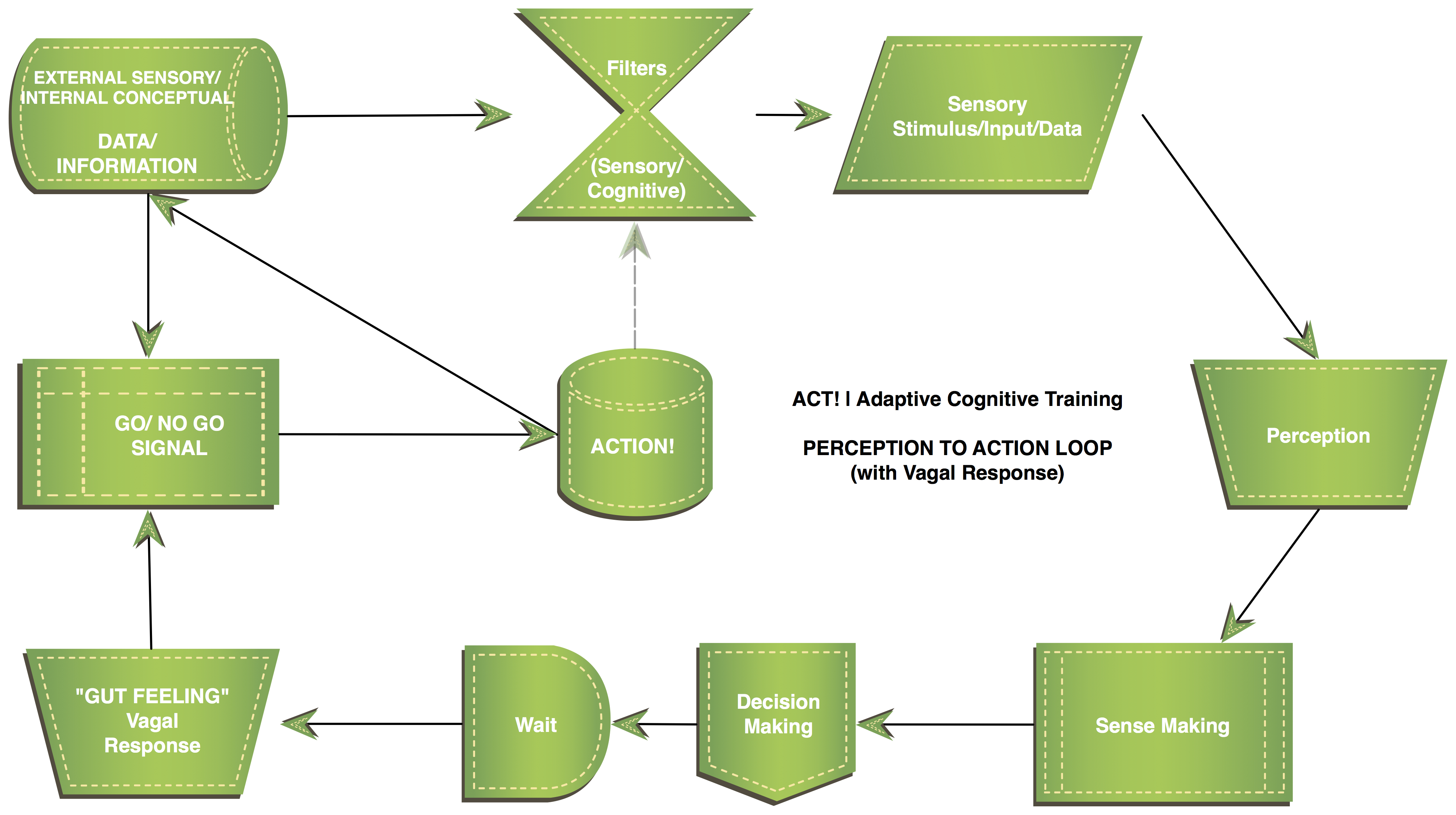
Our “GO/NO GO” signals are actually organized somatically as well as psychologically, originating for the most part as shifts in our vestibular and proprioceptive systems, literally we “feel” in or out of balance, and like we’re stuck or motivated to take action.

This is deeply connected to the idea of  your “gut response” … that feeling in the pit of your stomach when you know something is wrong and it makes you a bit queasy or nauseous, or when something is very right and you feel a tingling warmth about it in your belly.

Most people have learned to override this primitive, instinctual system designed to serve as both an “early warning system” as well as a “alert system to opportunity” by processing the “signals in the system,” i.e: the data that’s present, rationally or logically instead.

So they lose out on the benefit of learning how to trust this ancient system of response that is designed to protect and serve them.

We now know, through recent neuroscientific research, that the “vagal pathway” a system of nerves that is dominated by the vagus nerve that runs from brain to the digestive organs, controls much of what we have historically thought of informally and colloquially as our “gut response” … that innate way of knowing what is bad or good for us, before we even have time to think about it.

Here’s a short list of some of the ways the vagal pathway is involved in our health and sense of wellbeing (http://upliftconnect.com/12-ways-unlock-powers-vagus-nerve/):

Vagus nerve dysfunction can result in a whole host of problems including obesity, bradycardia (abnormally slow heartbeat), difficulty swallowing, gastrointestinal diseases, fainting, mood disorders, B12 deficiency, chronic inflammation, impaired cough, and seizures.

Meanwhile, the vagus nerve stimulation has been shown to improve conditions such as:

  • Anxiety disorder
  • Heart disease
  • Tinnitus
  • Obesity
  • Alcohol addiction
  • Migraines
  • Alzheimer’s
  • Leaky gut
  • Bad blood circulation
  • Mood disorder
  • Cancer

So you can see that we’re looking at a very significant part of our nervous system as it affects us.

What I’ve found in my work with people is that the “GO/NO GO” signal we experience is also part of the vagal response system, and that it links to our vestibular (sense of balance) and proprioceptive (sense of self/movement) systems, the very thing that gives us the feelings of either being stuck or being motivated to take action.

As far as I can tell from my work with thousands of clients this function of the vagal response system is deeply intertwined with the Neurocognitive Developmental Level you are operating from as well. Literally, where in your brain you preference when you are noticing information in the environment, making sense of what you notice, making decisions based on what you perceive, and taking action based on the decisions you make.

Using my unique Neurocognitive Developmental Training technology, ACT! | Adaptive Cognitive Training, you can literally update your vagal response to be more resilient and effective in aligning your “GO/NO GO” signals to the actual signals in the system and the outcomes you want to achieve.

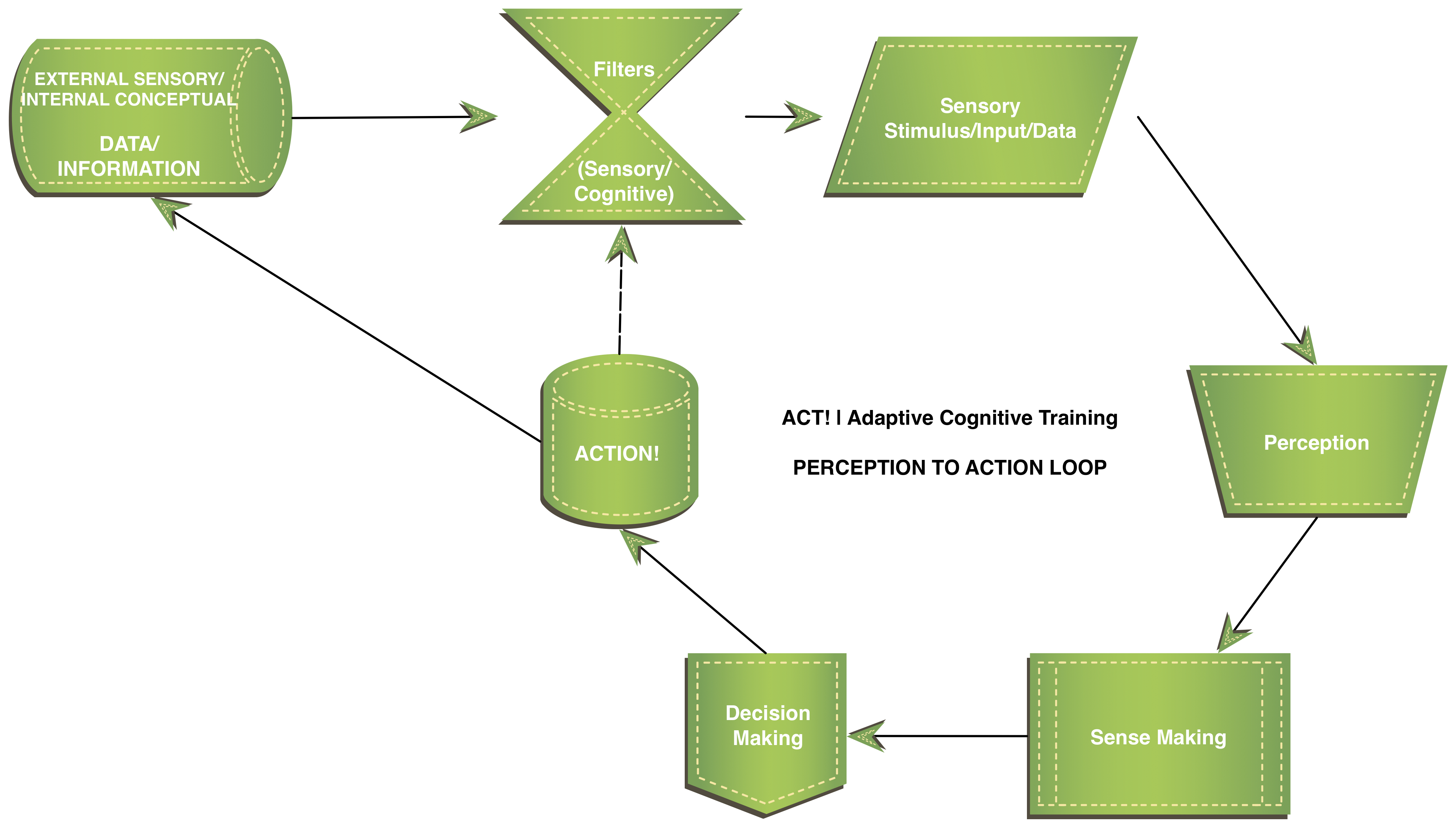
In the ACT! | Adaptive Cognitive Training model, I refer to the chain of processes from Sensory Perception to Sense Making to Decision Making to Action Taking, as the “Perception to Action Loop” in part because it’s both iterative and recursive, updating as it “loops” on itself.

Here’s a look at one way of graphically representing this system:

[File Download: ACT-PerceptiontoActionLoop]

If we add the ‘GO/NO GO” signaling process that operates through the vagal pathway the model might look like this …

[File Download: ACT-PerceptiontoActionVagalLoop]


In part, updating the Neurocognitive Developmental Level you’re operating from by default updates what you’re noticing for and how you notice for it in the environment – what I call your Perceptual Filters, and the way you make sense of information – what I call your “Sorting Patterns” … this has the effect of changing the decisions you make and the action you take, because you are noticing different information and making sense of it differently as well.

A simple example of this would be whether you are noticing for risk or opportunity, the sequence in which you do that (assuming you can notice for risk and opportunity), and the way you balance how you make sense of both in relationship to one another.

Someone who notices first for risk will tend to be “risk adverse” and protective of themselves and the relative safety of their current situation.

Someone who notices first for opportunity will tend to be “risk willing” and seek to leverage themselves and the possibilities in the current situation.

Now which one is the better choice is totally situational and contextual …

For example making a decision to walk through a dark alley late at night in an unfamiliar neighborhood to cut ten minutes off the time it would take to get to your hotel if you walked the long way might suggest that the more useful strategy is to first access the risk and act with some degree of risk aversion.

An alternative example might be making a decision to run an advertisement for your business that has an upside of 1000% return on the investment and only represents .01% of the revenue that a product or service currently generates suggests that the more useful strategy might be to first access the opportunity and act with some degree of risk willingness.

Understanding that you are not stuck to one fixed way of thinking about the world, or using one fixed, default pattern of response is the first step in freeing yourself to experience a major update to your worldview and the model of the world you operate from, as well as the ability to reap massive rewards associated with significantly increasing your level of adaptability.

When you engage in Neurocognitive Developmental Training you begin this process of loosening the lock hold that your current worldview has on you, and releases you from the limitations of the model of the world you are operating from now in those situations and contexts where it simply doesn’t serve you best.

Neurocognitive Developmental Training really gives you a smoother and more elegant access to the full range of (Human) Adaptive Intelligence, than you currently have now, and opens up your ability to access all of the Neurocognitive Developmental Levels that are innately available to you, even if you have difficulty accessing them now, or simply don’t access them at all yet.

“When man is finally able to see himself and the world around him with clear cognition, he finds a picture far more pleasant. Visible in unmistakable clarity and devastating detail is man’s failure to be what he might be and his misuse of his world.
This revelation causes him to leap out in search of a way of life and system of values which will enable him to be more than he has been. He seeks a foundation of self-respect, which will have value system rooted in knowledge and cosmic reality where he expresses himself so that all others, all beings can continue to exist.
His values now are of a different order from those at previous levels: They arise not from selfish interest but from the recognition of the magnificence of existence and the desire that it shall continue to be.”
– Clare W. Graves


Joseph Riggio, Ph.D.
Architect & Designer of the MythoSelf Process and SomaSemantics
Stockton, NJ in the Delaware River Valley

P.S. – You can also read more about ACT! | Adaptive Cognitive Training, the Perception to Action Loop, and Neurocognitive Developmental Levels here: Transformational Performance Breakthrough

Filed Under: Blog, Coaching, Cognitive Science, Elite Performance, General, Human Systems, Life, Transformational Change & Performance, Uncategorized

Hi, I’m from New Netherland …

Hi, I’m from New Netherland …

by Joseph Riggio · Feb 20, 2017

11 nations of the US Map

The US really has 11 separate ‘nations’ with entirely different cultures

(From Business Insider July 27, 2015)


In my work I travel extensively, and I’ve been fortunate enough to visit many countries and also to meet many people who live in those countries. In some I’ve even built lasting friendships.

When I speak to my foreign friends about the United State I keep trying to explain that distinction that the United States is really very, very different depending on where you are from and/or living.

Colin Woodward is a journalist, who’s originally from Maine, making him a true Yankee born in the nation of Yankeedom according to what he writes in his book, “American Nations: A History of the Eleven Rival Regional Cultures of North America.” 

In this book he makes the cogent argument that America is really a nation of nations, and not one undivided nation coast to coast as we have been led to think about it. 

Of course, I’m not suggesting that politically the United States of America is not one sovereign nation under the Constitution organized as a Federal Republic of individual sovereign States, and neither is Colin Woodward. The argument is that the regions of the United States have such unique points of view that they can be looked at as absolutely distinct, similarly to the individual nations of Europe for instance.

I totally agree with his fundamental premise that the United States is regionally diverse … politically, economically, socially and in terms of the basic and fundamental things we value the most from region to region. Using his book as the starting point then …


Here are my tongue-in-cheek analysis and observations on the article:

I’m from what the author, Colin Woodward, calls, “New Netherlands” … and I now live in what the author refers to as “The Midlands.” I have both friends and family in “Yankeedom,” and on “The Left Coast,” as well as in “The Deep South” but most of those are displaced “New Netherland-ers.”

I know people from all the other regions and find it easier and more difficult to relate to their way of seeing the world depending on where they are from on this map. Sometimes I think those of use from the New Netherlands are the hardest for folks from almost all the other regions to fit in with over the long haul, because we’re both headstrong and pushy about our beliefs in a way that comes across as harsh, abrupt and/or rude to most others.

Once they know you’re from the New Netherlands they’ll accept the attitude that brings, but that isn’t the same as liking it. Those of us from the New Netherlands have just as hard a time at the close-minded, myopic ways we sometimes perceive those from these other nations operating. It’s also sometimes difficult to deal with what we see to be the naive and privileged attitude of the Left Coast-ers.

However, for New Netherland-ers it all begins and end with “Attitude” …

New Netherland-ers are particularly proud of their “Attitude” and see it as quite special, even unique. There’s a time element to it, i.e.: they expect everything to happen “yesterday” and only minimally accept “now” as an answer for when. They move fast and live fast, much faster for instance than the rest of the nations indicated on the map, with some few exceptions in the largest cities in Yankeedom, The Midlands, Tidewater, and surprisingly The Deep South, but that’s because of how many displaced New Netherland-ers there are in some of The Deep South cities.

The Greater Appalachia, The Far West and El Norte are foreign lands for us from the New Netherlands. We try not to go there, except for those New Netherland-ers who somehow have opted out of real life and work, and have the time to ski. Otherwise we avoid the natives of those regions, because we’ve heard strange stories of abductions and dueling banjos, a ritual we don’t actually comprehend ourselves.

One of the unique aspects of each of the nations of the United States are our food rituals …

The New Netherlands boasts a remarkably varied ethnic smorgasbord of foods … Italian (predominate), Chinese, Indian, Japanese, Greek, French, German, Ethiopian, Jamaican … and it goes on and on. We often refer to the option to go out by the question, “What do you want to eat tonight?” meaning which kind of ethnic cuisine. The other unique thing about food in the New Netherlands is that it is the only place on the planet with authentic pizza – forget Naples!

The other regions also have their unique cuisines … the southern New France has something they call “creole” food … worth a trip across the border to get. Tidewaters does some remarkable things with seafood, and the Midlands and some of Appalachia are masters of a meat dish called, bar-b-que. The Left Coast is highly influenced by both Asian and Mexican cooking, and you’ll find some unique fusions of these cuisines there, as well as an assortment of ethnic foods rivaling the New Netherlands. El Norte of course is where they have mastered the art of what’s called “Tex-Mex” cooking as well as some truly traditional Mexican foods. I’m not sure if or what they eat in Yankeedom or The Far West, but I hear it’s got to do with a lot of lobster, beef and dairy.

But, above and beyond all of these distinctions of the nations of the United States we see some of the greatest ways they differ politically and socially. What each region needs and wants in these arenas isn’t just different or unique, but literally oppositional.

For instance while the New Netherlands shares much in common with The Left Coast in many ways, they are in many other ways almost in direct conflict on some major political issues and how they think about social justice. In the New Netherlands it’s all about “applied politics and social justice” a kind of social street code. On The Left Coast it’s much more about an idealism and activism that’s divorced from the reality of many, if not the actual majority, of the inhabitants. I think I’d apply the word “gritty” to the politics and social issues of the New Netherlands, where I’d call them “idealistic” on The Left Coast. So sometimes those of us from the New Netherlands see the Left Coast-ers as somewhat prissy in their approach, while I’m guessing they see our way of attacking the same issues as aggressive.

The other regions also have their thoughts and approaches to politics and social justice. I don’t feel equipped to address them as they often make little to no sense to me personally. Like many of the Midland-ers have a kind of live and let live attitude they share with much of New France as I see it, while the Greater Appalachians and The Far West-ers have a more “Don’t Tread on Me” attitude they share in common with much of Yankeedom. The Deep South, again along with much of Greater Appalachia, is still trying to get past 1865 and into the modern world I think I live in, but I get that’s just a point of view for both of us. Tidewater folks really believe they are a separate country, and are more or less just annoyed to be attached to the mainland and have to deal with its issues along with their own, but they’re happy at least that they run the country-at-large. El Norte … who the hell know what they’re all about, except possibly wanting to annex the area they live in back to Mexico???

So it’s really useful for folks outside the United States to get that there is no such thing as “an American” if you’re thinking about some creature that’s the same from coast-to-coast.

It’s also just as useful for Americans to get that we are a divided people united by choice and affiliation, and that a dominant federal government or system doesn’t truly serve as it did when we were evolving from thirteen colonies to the fifty states we’ve become. We haven’t even included the lands of Polynesia or The Far North here either, just to make the issues even more complex.

Trying to unite our great country as fifty individual sovereign States under one singular federal government that we allow almost absolute power over us legally and economically is no longer as feasible or useful as it once was in simpler times. It may be that we look to this map to establish regional governments, that abide to a common agreement to collaboration via a centralized federal government, but with much more autonomy from it than the States are currently operating under, despite the promises of the Constitution that officially governs us, but has been continually degraded over time. Let the regions rule their lands and their people, and make the federal government beholding to them instead of the other way ’round.

Joseph Riggio, Ph.D.
Architect & Designer of the MythoSelf Process and SomaSemantics

P.S. – As always I’d love to read your own observations and comments … in fact I’m already looking forward to them!

P.P.S. – The original article from Business Insider, Jul. 27, 2015, can be found here: “This map shows the US really has 11 separate ‘nations’ with entirely different cultures” and you’ll find the book by the author, Colin Woodward, on Amazon here; “American Nations: A History of the Eleven Rival Regional Cultures in North America”

Filed Under: Blog, General, Human Systems, Life, Mythology

Leaping Forward …

Leaping Forward …

by Joseph Riggio · Jan 22, 2017

Preparing The Future …
Neuro-Evolutionary Modeling


I posted something on Facebook in response to comment made there about how someone wasn’t getting the point that the person posting was trying to make … not an uncommon scenario unfortunately.


But there are different reasons people won’t get a point someone is making … maybe the point isn’t being clearly made, or getting it requires a bit of background that’s missing, or sometimes it can just be that the people disagree and that creates a block in the communication.



However, in this case I believe it was something else … a fundamental inability for people to see anything that’s beyond their neuro-evolutionary development.

Here’s my response to that posting:

I’m a big fan of neuro-evolutionary developmental modeling. Think of the work of Julian Jaynes and his bicameral mind theory, or the work of Clare Graves or Jane Lovinger, or E.O. Wilson’s work in sociobiology. This is where my attention has been for the better part of a decade now.

Rebecca Costa has summed up some of this work in her excellent book, The Watchman’s Rattle. In the book she speaks to the neuro-evolutionary trait of insight, technology, complexity and the collapse of civilizations. Well worth the read.

In my work I’ve been looking at a few things too … different from Costa or the others. I think some of my work is paralleling the things Ken Wilber has been speaking to most recently. My focus has been on how we create transformational change leading to a new position of consciousness and performance breakthroughs. NOT better performance where we already are, but performance we cannot get to from where or how we are today.

This focus forced me to look at the questions of power and complexity, and their relationships as contained in the interpersonal relationships in institutions and organizations. This is akin to what John Gatto found when deconstructing modern schooling, it’s process and intent.

Simply put there may not be a place for consensus if we want real change. This idea, of consensus, is mired in what Clare Graves points out is Level Six thinking, what Spiral Dynamics labels Green, and what Dudley Lynch calls First Dolphin or Enlightened Carp thinking.

The idea that we must create consensus and bring people along is an anchor we drag from a limited world view that has not yet leaped beyond systemic thinking to fractal thinking where deep complexity resides.

Rebecca Costa points to this limitation as reaching a cognitive threshold, and suggests it’s the basis for the collapse of civilizations. Her analysis and evidence is impressive. IMO many Western Europeans and North Americans are stuck there today, along with some others as well.

(Name Withheld) you’re suggesting something that remains in a blind spot to anyone who hasn’t fully evolved beyond Level Six mind.

This posting and the responses to it got me to thinking.


Is it unreasonable to consider that some folks are just not neuro-evolutionarily developed enough to perceive what others do as obvious?


This falls under the rubric of Developmental Modeling as I refer to it, or if I really want to be fancy about it, Neuro-Evolutionary Developmental Modeling.

In less fancy terms this is the assessment and modeling of the literal neuro-evolutionary developmental stage that someone is at, and the implications of what that means.

Let me put it another way …

My work as I said in my Facebook response focuses on:

“… how we create transformational change leading to a new position of consciousness and performance breakthroughs. NOT better performance where we already are, but performance we cannot get to from where or how we are today.”

This is about looking at levels of consciousness and meaning-making as I think about it.

There’s a cognitive consideration, i.e.: how we process information beginning with perception, moving through sense-making and decision-making, and respond in regard to the action we take and the action we choose not to take.

Within the scope of my consideration is how we process that information that leads to action, including what Cognitive Scientists refer to as Situated and Embodied Cognition.


Situated Cognition:

The school of thinking about situated cognition aligned with the cognitive scientists say that cognition is a function of where we are situated in space and time, i.e.: the situation and circumstance we find ourselves in determines how we think about the information available to us.

Simply put, cognitive scientists say that thinking cannot be separated from doing and context as a way to speak about situated cognition. The situation becomes part of our “cognitive process” as well as what we do internally with the information we have access to, including the way the information in the situation relates to other information in the situation.

For example, if we are in a diner and hungry and we see a menu advertising the “Burger Special” we will think about it differently than if we had just left a restaurant after a particularly satisfying meal and saw the same “Burger Special” advertised on a billboard as we were driving home. The situation and circumstance changes how we think about the information that’s present.

Another example might be, if we are in the diner and hungry, but we only have enough money for a cup of coffee we’d respond differently to the “Burger Special” advertisement than if we had sat down to eat with plenty of money in our pocket to choose whatever we want for dinner.

Also, what we bring to the situation ourselves affects how we process the information presented to us as well. For instance if we are vegans or eating a strict paleo/high-protein/low-carbohydrate diet will impact how we process the information about the “Burger Special” too.

The situation becomes part of our “cognitive process” as well as what we do internally with the information we have access to, including the way the information in the situation relates to other information in the situation.


Embodied Cognition:

Keeping it as simple as possible, when we refer to embodied cognition we’re referring to the idea that … we think like we do because we’re embodied in world.

This means that our thinking arises from the physical experience of having a body, and the way we experience things in and with our body.

While this might seem obvious at some level the more prominent position has been held for more than three centuries has been dualism, i.e.: the separation of body and mind. Cognitive scientists who hold a strong position about embodiment believe the mind arises from the structure, processes and actions of the body.

Early examples of embodied cognition arise in the world of the phenomenologists like Martin Heidegger, Maurice Merleau-Ponty and Pierre Teilhard de Chardin.

In the mid and late twentieth century some cognitive scientists went beyond the theories of dualism and the mind as an independent processing mechanism to considering a unified cognition that includes the body. Two of the folks who did a lot of work in the embodied cognition paradigm that influenced my thinking are Humberto Maturana and Francisco Varela. They studied and wrote about visual perception, including the biology of vision, like the physical aspects of the human eye, and how those physical aspects of embodiment effect how we perceive visually.

George Lakoff and Mark Johnson are two philosophers who are also in the embodied cognition camp who did a lot of work together around metaphor and embodiment. Their book Philosophy in the Flesh was one of the most influential early works in my own conception of mind. It was this book that led me to thinking about what cognitive scientists call enactivism.


Enactivism:

Enactivism postulates that cognition is a function of the tension between thinking and the environment, and the need or desire to respond to what’s happening. Specifically enactivism suggests that we shape our environments by the ways we respond and take action, shaping the environment in turn as we go.

This looping between the individual and their environment becomes a part of their cognitive processing, and as I think about it it’s here that situated and embodied cognition collide and become something more than either alone.

In some way we can say that enactivism brings about who we are as we know ourselves to be, as well how we know the world to be as we know it. Through enacting in the world we generate both ourselves and our sense about and knowledge of the world, including others.

This is where I mostly settle when it comes to how we process cognitively in a real sense of what happens as we’re processing information and acting on it.

Yet, I’m also influenced by other cognitive models that share how I think about enactivism, like neuro-evolutionary developmental models.


Neuro-Evolutionary Developmental Modeling:

For me the rubber hits the road when we’re talking about mental models when the dialogue revolves around neuro-evolutionary developmental modeling.

My early introduction to the idea of neuro-evolutionary developmental modeling was via the work of Dr. Clare Graves. The Graves Model lays out a double helix of stages of evolutionary bio-pyscho-social-cultural growth alternating between self-sacrificing and other-sacrificing. At each stage the dynamics of dealing with the limitations of the system the individual is contained in and relating to create a tension that leads to dialectical transformation.

According to Dr. Graves each stage of human evolutionary growth comes about as a result of dealing with the challenges presented by the environment they are contained in and operate in relation to until the operating paradigm itself becomes the generator of the challenges the individual confronts.

When the point where the operating paradigm generates irresolvable challenges as a result of functioning within it there is a point of dialectical transformation that is reached. It is at this point that individuals within the system respond by rejecting the present paradigm and leap to a new level of consideration that offers resolution to the challenges the extant operating paradigm generates.

In other words every human system can be defined by some set of boundary conditions that limit it to being what it is in the moment. These boundary conditions arise as a result of the values that are held as true, and in some regard sacred, within that human system. These values are designed to create a functioning system that resolves the challenges that system faces collectively, and become the agreed upon and accepted values of the culture.

Yet, these values require varying degrees of cognitive development to incorporate and act upon. The neuro-evolutionary developmental models I follow closely suggest that the human cognitive system evolved in relation to the stresses confronted at various stages of human evolution. Literally on one hand the brain evolved to access new ways and patterns of thinking, partially due to the interactions of the multiple brain modules that evolved in response to evolutionary pressures.

At each level of neuro-evolutionary development the individuals who have access to that level of development become able to perceive their environment in ways that individuals before them, who had not evolved that level of neuro-evolutionary development are able to comprehend. Quite literally the ability to perceive the information in the system is limited by the level of neuro-evolutionary development.

This shows up in application or practically in relation to the level complexity the individuals within a system are able to process the information present. The higher the neuro-evolutionary development of the individuals in the system the more complexity they can perceive and comprehend. These advanced stages of neuro-evolutionary development allow these individuals to make choices unavailable to those who cannot perceive and comprehend complexity at these levels.

One way to think about this would be as the scope and range of complexity that individuals in a system use to make decisions and take action. The higher the level of neuro-evolutionary development of an individual the greater the scope and range of choice they will have, theoretically giving them an edge in responding to the emergent conditions in any given system. However, there’s a strong caveat …

The theoretical best response will arise when the level of complexity present in the system and the level of neuro-evolutionary development are most closely aligned and matched. When the complexity of the system exceeds the level of the neuro-evolutionary development of the individual confronting it the lack of appropriate choices available will limit the individual to less than ideal choices and, corresponding less than ideal responses and outcomes.

Applying higher level choices in a system that operates at a lower level of complexity than the neuro-evolutionary developmental level being applied to make the choices acted upon often results in less than ideal responses and outcomes.


Therefore we can say that using the most aligned neuro-evolutionary developmental level to the situation and circumstance at hand results in the most ideal responses and outcomes being realized.

Yet, when someone simply doesn’t have access to the neuro-evolutionary developmental level required by the complexity in the system they will be limited to responding from the highest neuro-evolutionary developmental level they can access at present.

This is how individuals and system fail and go into devolution resulting in personal failure and civilization collapse.


I’m seeing more and more that individuals in our complex Western civilization are reaching cognitive thresholds, which define the limits of complexity they can perceive and comprehend. Yet the systems they are operating within require a higher level of neuro-evolutionary development then they currently have access to, to create useful choices that allow them to respond and produce the outcomes they desire.

The feelings they experience as result of reaching their cognitive threshold  include frustration, anger and despair. This leads to lashing out against others who are also experiencing the limits of their own cognitive threshold, albeit in ways different from their own.


Regardless of the level of neuro-evolutionary development that limit an individual from accessing the most useful choices to address the challenges they face, the result is the same … i.e.: they produce less then ideal responses and outcomes. 

In particular, as a result of their neuro-evolutionary developmental limitations, these folks believe they are addressing the challenges they confront in the most ideal way possible, yet the outcome they produce replicates the conditions to perpetuate the challenges they seek to resolve.

The key to resolving the limitations of neuro-evolutionary development begins with accepting that the choices available to you are constrained by your level of neuro-evolutionary development … and NOT the conditions of the challenges you face or the system they are contained within.


The first step forward then starts with exploring ideas and choices that are unfamiliar and unaccessible from the highest neuro-evolutionary developmental level you are most comfortable with today. This means opening yourself to the discomfort of confronting your most cherished values and beliefs for what they are … values and beliefs, not facts or truths.

Individuals who can do this … confront their most cherished values and beliefs and open themselves up to the discomfort of seriously considering that ideas and choices that are unfamiliar and unaccessible to them from where they are today … open themselves up to the possibility of creating responses and outcomes that were unavailable to them previously.

While this doesn’t necessarily mean they have actually evolved to a higher neuro-evolutionary developmental level, it doesn’t matter as much as having access to the strategies used by individuals who can operate at those higher levels.

But, it also requires accepting that until we actually evolve to a high neuro-evolutionary developmental level, we will remain blind to what we cannot perceive from the highest neuro-evolutionary developmental operating level we can access ourselves.

Despite the frustration, anger and despair this realization may bring, i.e.: that we are limited to the highest neuro-evolutionary developmental level we can access, it allows us to move beyond operating from distorted values and beliefs we impose, while ignoring real facts and truths that are evident to those who aren’t blind in the particular ways we are ourselves.

This work … guiding my clients beyond the limits of their current level of neuro-evolutionary development happens in my Foolish Wisdom program and private 0ne-to-one work. The feedback I get is that while the result is often transformational leading to significant performance breakthroughs, getting there isn’t always the most comfortable experience on the way, but worth it at the end.

I’d love to hear your thoughts …

Buona Fortuna and Abundanza,

Joseph Riggio, Ph.D.


P.S. – There is still time to get the details about the upcoming Foolish Wisdom program on 28 January in NJ …


FOOLISH WISDOM DETAILS


Filed Under: Blog, Business Performance, Cognitive Science, Elite Performance, General, Human Systems, Life, Transformational Change & Performance, Uncategorized

Why Hillary Clinton Lost The Election …

Why Hillary Clinton Lost The Election …

by Joseph Riggio · Nov 25, 2016

Or … Thank G-D Donald Trump Won

2a93b0af728fdccd0d0cabc4320b257fOkay, before you decide to send me death threats let’s me make something abundantly clear that it seems so many of liberal, progressive and centrist friends can’t or won’t get …


I don’t like Donald Trump and I think he’s bad for America.

But, there are caveats galore attached to that pronouncement.

  • First, compared to what Hillary Clinton, the DNC and the Democrats and Democrat Party represents today, Donald Trump is a godsend for the American people, and I believe the world-at-large too.
  • Next, Donald Trump isn’t the enemy or even the issue … it’s the arrogance that the global elites treated him, his campaign and his supporters with, starting with monied interests represented by the mainstream media.
  • Finally, Donald Trump was an inevitability given what we’ve seen happening on the world stage, centered right here in the heartland of America … the massive division between those who have and those who have not, and the smug, highbrow patrician attitude of the intellectual and monied elite from Wall Street to Hyde Park and Hollywood.


Donald Trump didn’t win the election …
Hillary Clinton lost it!


Now of course Hillary Clinton and the Democrats would like to blame everyone from James Comey to Barack Obama for her troubles, but that’s just more of the same arrogance that cost her and her party the election.

She began losing the election when she started believing she was about the law, or at least above the rules and regulations that apply to everyone else. Then her confidants and cronies allowed her to believe the false narrative they spun around her with misinformation like the fact that former Secretary of State, Colin Powell did just what she did in setting up and using a private email server. Yet the reality was that the times and the context were radically different for Colin Powell and Hillary Clinton, beginning with the fact that Colin Powell’s actions were known to and monitored by the State Department, while Hillary Clinton’s were directly against the advice and protocols of the State Department. Yet the lies were disseminated to the faithful who worshipped at the alter of the Clintons and the DNC and the chosen choose to believe despite the evidence to the contrary.

Then of course when the lies came to haunt Secretary Clinton we were fed the line that it really didn’t matter at all, that defying the State Department protocols for handling classified information were of no consequence and that there was nothing for us to see or notice there where the investigation was happening. Even when the FBI identified that classified information was mishandled, and it was likely that the server Secretary Clinton was using was penetrable to foreign powers we were again told it wasn’t really a big enough deal to prosecute or punish anyone over. But the problem for the Clinton campaign is that a substantial portion of the population just didn’t like it or believe it … including Senator Bernie Sanders, her Democrat rival for the nomination as the party candidate for president.

It was not a good report for Secretary Clinton. That is something that the American people, Democrats and delegates are going to have to take a hard look at,” he told CBS’ “Face the Nation” on Sunday. “I mean, everybody in America is keeping it in mind, and certainly the superdelegates are.”

The comments are something of a reversal for the Vermont senator, who has all but ignored the email scandal throughout the entire Democratic presidential primary. His refusal to attack the former secretary of state over her emails was a political risk; the issue plays heavily into voters’ doubts about Mrs. Clinton, who is widely seen as dishonest and untrustworthy.

Bernie Sanders seizes on Hillary Clinton’s email scandal in bid to sway superdelegates
Ben Wolfgang – The Washington Times – May 30, 2016

Then of course there was all the noise about the Clinton Foundation and Hillary’s potential “pay for play” schemes with wealthy individuals, companies and even countries. None of it was founded in hard evidence, but the general feeling amongst just about everyone except die hard Hillary Clinton sycophants was that it was an awful lot of smoke without a fire.

Recently, the Foundation and the emails have become considerably more interconnected in a kind of toxic smoothie. Yet, when it comes to the Foundation, there appear to be two main points to evaluate when all the evidence is in.

If nothing else, both are worthy of some raised eyebrows. But they are quite different in scope and import. One is the alleged influence peddling that suggests that the Clinton Foundation may have been a well-worn avenue for some donors to travel to get access to the Secretary of State. The facts are still coming out, and there are many differing views on just how much of this occurred or should be allowed. But the appearance does seem striking. For example, it is hard to explain the report that the Foundation gathered $100 million from Gulf sheikhs and billionaires, and for what promises.

The second main issue with the Foundation is pure tax issue, that of private inurement or private benefit. This one may be considerably less serious for a political candidate, but might look somehow even more unseemly. Charities are supposed to be operated exclusively for charitable purposes. In fact, the law is very clear that charitable organizations with public charity tax exemptions must benefit thepublic interest. The law requires the charity to operate exclusively for charitable purposes, and normally the IRS really means exclusively.

Clinton Foundation’s Alleged Pay To Play Or Its Private Benefits: Which Hurts Hillary More?
Robert W. Wood ,   Contributor – Forbes – August 23, 2016

Then we can top much of that off with the DNCs role in favoring the Hillary Clinton campaign over that of Senator Bernie Sanders, despite the huge groundswell of popular support for the Senator from Vermont and his truly progressive views on politics in Washington, D.C.

Many people feel that the DNC stole the nomination from Bernie Sanders and rigged it for Hillary Clinton to win despite the will of the people.

Top officials at the Democratic National Committee criticized and mocked Senator Bernie Sanders of Vermont during the primary campaign, even though the organization publicly insisted that it was neutral in the race, according to committee emails made public on Friday by WikiLeaks.

Among the emails released on Friday were several embarrassing messages that suggest the committee’s chairwoman, Representative Debbie Wasserman Schultz of Florida, and other officials favored Hillary Clintonover Mr. Sanders — a claim the senator made repeatedly during the primaries.

Released Emails Suggest the D.N.C. Derided the Sanders Campaign
Michael D. Shear and Matthew Rosenberg – The New York Times – July 22, 2016

This all showed how Hillary Clinton simply displayed an utter contempt for playing by the rules or being limited in her actions in a way that seemed to suggest she believed herself to be above the law that governs the rest of America and her ordinary citizens.

Then of course there was the whole “basket of deplorables” comment …

Memo to candidates: Stop generalizing and psychoanalyzing your opponents’ supporters. It never works out well for you.

The latest to fall into that trap is Hillary Clinton. The Democratic nominee, at a New York fundraiser Friday night with liberal donors and Barbra Streisand, said “half” of Trump supporters fit into a “basket of deplorables,” while the other half are people who feel the government has let them down and need understanding and empathy.

Hillary Clinton’s ‘Basket Of Deplorables,’ In Full Context Of This Ugly Campaign
Domenico Montanaro – NPR – September 10, 2016

Yet the Hillary Clinton’s campaign, the DNC, many of the Democrats, dozens of media personalities, and scores of folks on the Internet and in social media sites want to blame what happened on someone else other than resting the result on the shoulders of the would be coronated queen of American politics, Hillary Clinton.


Donald Trump was the solution to Hillary Clinton

What many good intentioned people who saw and see Donald Trump as the personification of white elitism, that speaks to the worst in us … the people who voted for Donald Trump saw someone who was speaking to them and not at them.

Donald Trump spoke to the unbelievable profound distrust and despair that the middle class in America felt with a country they love in the form of her political institutions centered in and around Washington.

They saw what they hoped would be a President of the people sell them out to the bankers and the war hawks.

They saw the rich getting richer, while they struggled to hang onto their jobs and their homes.

They watched the President and his family on holiday excursions costing the American taxpayers millions of dollars, or reading about how many days the President took off golfing, when they themselves couldn’t afford to take a week off just to stay at home and recover from hard year of working themselves ragged in two or three jobs to make ends meet.

They watched as family and friends lost good paying jobs and went without work for months that turned into years, and Congress voted in packages that increased their salaries and benefits, while they stripped Social Security to pay off the debts they incurred at the expense of the American people that generations to come will still be paying off as they built their personal fortunes.

Middle class, blue collar, working Americans were sick and tired of being spoken to from the raised platform that politicians like Hillary Clinton spoke from with her millions in the bank, her multi-millionaire husband, daughter and son-in-law standing behind her, and her haughty expression and commentary about how she’s always been there for the common man, woman and child.

The simple truth is the middle America was just plain sick and tired … and they began to recognize that the symptoms were all pointing to the same disease … systemic rot in Washington.

Then they saw Donald Trump as someone outside of that system … someone who promised to “drain the swamp” … and that was enormously appealing to them.

Now they are waiting to see what this “outsider” will do … and whether or not he’s just going to be more of the same or if he’ll deliver on some of the promises he made to “make America great again” … rolling back the clocks to the post-war glory years of the 1950s with it booming economy, jobs in every town, a chicken in every pot and a car in every garage.

They have forgotten the despair of those left out of that dream, or the uprisings of the 1960s that followed those golden years when those left out in the cold demanded some of the heat they were part of creating.

And, the ones who gained some ground in the decades that followed forgot the real fight was with the folks who held the reins of power and not their next door neighbors.

This is just exactly how it was planned and implemented since Bill Clinton first took office though … keep the people fighting in the streets and they’ll leave the folks in the halls of the Capitol to do their dirty deeds and create the greatest divide between the have and have-nots since Charles Dickens was writing about the best of times and the worst of times.


However … some good may still come of all this …

After decades of doing transformational change work with people from all walks of life on five continents around the world I’ve learned a significant lesson:


”People don’t change except in response to crisis.”

And, believe me this is a crisis.

I don’t think it’s the crisis that many folks think it is though. I don’t think we’re headed towards the precipice of social oblivion … or that the country will become the next historical footnote of how once great nations fall in the tyranny of fascism … or even how hate crimes, racism and misogyny will overtake civility and public decorum in the streets of America.

No, I think the crisis that’s been long coming is the crisis in faith that Americans have long held that their institutions and those that lead them were fundamentally honest and good intentioned.

The tide has changed and there are more and more people who see the government and the leaders positioned within it as the enemy of the people.

This is the basis for all great revolutions in the history of the world … especially the non-violent kind that erupt when the people demand that those who have become the corruption step down or are removed from power.

Donald Trump is the great white hope that has forced a compliant America, and much of the world to take notice of who sits on the throne of power in the Western world … and of course people are concerned.

We have been going along to get along without demanding that our representatives act as servant leaders of the people and not mouthpieces for the oligarchy that rules America.

The US is dominated by a rich and powerful elite.

So concludes a recent study by Princeton University Prof Martin Gilens and Northwestern University Prof Benjamin I Page.

This is not news, you say.

Perhaps, but the two professors have conducted exhaustive research to try to present data-driven support for this conclusion. Here’s how they explain it:

Multivariate analysis indicates that economic elites and organised groups representing business interests have substantial independent impacts on US government policy, while average citizens and mass-based interest groups have little or no independent influence.

Study: US is an oligarchy, not a democracy
Echo Chambers – BBC – April 17, 2014

Now finally we have an oligarch in the seat of power in the White House and maybe, just maybe, enough Americans will wake up and start paying attention to how the system actually works.

Maybe, just maybe, people will begin to think about who they are voting for and what these people represent.

Clearly Hillary Clinton represented the oligarchy and NOT the people.

This was and remains the main and fundamental issue this election cycle has demonstrated if nothing else.

And, until enough people who have been willing to deny what they know to be true, keeping their heads firmly below the sand, while their buttocks remain exposed and ready to receive, wake up and demand to be counted and not used and abused by those in power the raping of America will continue.

Now I know this is NOT a message many of my fellow Americans want to or are ready to hear … at least not yet, but the time is always now.

We don’t have the luxury of time to wait for when it’s comfortable and we’ve adjusted to the new reality to start acting on our own behalf, on behalf of those who have less of an opportunity to be heard, and on behalf of the planet and her people at large … NOW IS THE TIME!

Our most cherished beliefs and values are in peril … AND IT’S NOT FROM DONALD TRUMP OR HIS CREW … it’s from the entrenched military/industrial/banking complex that is the cabal that runs American and much of the world … including almost every seated politician in Washington today on both sides of the aisle.

Fortunately, I believe it’s not too late … if this election has shaken you to the core, because your candidate lost, or because your candidate won … or even if your candidate never made it to the race … if you remain awake we can take back what Abraham Lincoln so forcefully reminded us that the Constitution guarantees us … a country of the people, by the people and for the people …


“We have met the enemy and he is us.” – Pogo

(http://www.thisdayinquotes.com/2011/04/we-have-met-enemy-and-he-is-us.html)


Joseph Riggio, Ph.D.
Architect & Designer of the MythoSelf Process and SomaSemantics


P.S. – If you’re ready to take the leap and wake up a bit more you can dip into my collection of materials for revolutionaries at: ABTI | Joseph Riggio International Members Platform

P.S.S. – You can get anyone of my previous programs for 50% during my Black Friday sale when you purchase them today … use the couple code “BLACKFRIDAY” (no quotes, no spaces, all upper case) when you check out and your discount will automatically be applied.

Filed Under: Blog, General, Human Systems, Life, Uncategorized

Deciphering The Narrative

Deciphering The Narrative

by Joseph Riggio · Aug 15, 2016

How Do You Make Sense Of The World?


If you’re like most folks … you don’t.

Sorry to be so blunt but them’s the simple facts.

Most folks just “accept” the world as it’s presented to them, and don’t do much about trying to establish how they are perceiving what they experience or from what position they are experiencing it from either.

I’ve been reviewing where my clients report getting the most benefit from the work we do together, and I think more importantly where the evidence is that they have made some kind of significant positive changes as a result of the work we’ve done.

It seems it boils down to just a few simple things we do …

  1. Establishing a very clear perception of the patterns they are living from and their personal myth/story
    (i.e.: the autobiographical narrative that contains their personal myth/story)
  2. Developing the ability to “read” the Signals in the System to decipher the narrative that’s present
    (i.e.: patterns in the information they are exposed to, as well as reading between the lines for information that’s missing)
  3. Recognizing the narrative that others are operating from and the patterns of their behavior
    (i.e.: noticing for how others make decisions and take action, and the ways that differs from person to person)
  4. Gaining the ability to act on one’s own independently and to communicate with others effectively
    (i.e.: making things happen on one’s own and with others, including the ability to effectively set boundaries and influence others)

When these few things happen in the work I do with others some amazing things happen as a result.

Again, keeping it simple, what everyone wants from the work I do with them is some variation on number four above …


Gaining the ability to act on one’s own independently
and to communicate with others effectively

However, getting the ability to do so requires that 1, 2 and 3 are in place as well.


Living The Narrative 

fish_mosaic_1 300pxWe all “swim” in the waters of culture in the same way fish “swim” in the sea.

And, in the same way we might speculate that fish don’t think much about the water they’re swimming in, except when they are challenged by it in some extraordinary way … say encountering highly polluted seas, lakes, rivers or streams … we too don’t much notice our culture.

We might also extend the speculation to those particular fish who are apt to on occasion breach the surface and escape the ever present ubiquitousness of the water they dwell in to notice that there’s something beyond what they experience as ordinary and normal, in this case the entirety of the sky above the surface of the waters that contain them.

I’d go so far as to suggest that fish are more likely to breach the surface of the water than we are to breach the boundaries of our culture …

And there’s the rub …

To get more specific the “ocean of culture” we swim in is bounded by the narrative that contains it. In the same way the ponds and lakes have edges, rivers and streams have banks, and oceans have shores cultures are limited by they narratives that define them.


The challenge for most people is that the narrative has become what is real …
it is their reality in the same way the water is reality for a fish.


Okay, I’d agree with anyone who says that we can’t be without a narrative of some kind. It seems the dilemma of humanity that we are capable to both recognizing that we are living within a narrative, and noticing that the narrative is just made up … a creation of our collective agreement and imagination.

Reconciling the dilemma that the narrative is both “real” and “unreal” at the same time without giving into it is a bit more challenging.

  •  The narrative is “real” in that it sets the frame for how we interpret what is happening and in turn what to do about it.
  • The narrative is “unreal” in that it is simply one one of an infinite number of ways to interpret what what is happening.

So what are we left to do about it then?


Escaping The Charybdis

Charybdis was a whirlpool that devoured ships foolish enough to dare to sail too close. The option for a ship captain was to dare the Scylla, a dangerous rocky shoal that would tear ships to pieces instead.

The ancient Greeks described both of these originally as sea monsters that would attacks unwary captains, annihilating their ships and their crew.

In our current world we too run the risk of being devoured if we dare to venture too close perceptual reality versus the cultural narrative we’ve been led to believe as what is real … yet like Odysseus in Homer’s Odyssey, we must endure this very challenge if we intend to realize the possibility of awakening beyond the illusions of culture.

Left unchallenged the filter of culture determines how we will interpret the entirety of our life experiences and the meaning we make of them.

The collective agreements of culture are designed not only to inform us about reality, but also to shape how we perceive all the events and information we encounter.

One of the most pervasive and “essential” truths we learn within the culture of modernity assumes that we are informed because we are literate and educated … beyond this we often make the leap to the further assumption that this means we are also intelligent, when the evidence gathered from how we most often go about our lives and the current state of the world seems to suggest that nothing could be further from the truth.

We are a species hovering on the edge of destruction … not only of ourselves, but seemingly threatening the entire basis of life in the biosphere … and yet we continue unabated with the same patterns of action that brought us here.

The first thing we must agree to accept, if we intend to do anything about this state of affairs personally and collectively is …

The current narrative is broken!

The story we are living our lives from no longer supports life as the basis upon which it rests. Instead we are living from a story that has its foundations in fear and greed, built on the assumption that the only way to have enough is to get more.

We seem to desire a life worth living, filled with deep meaning and purpose attached and connected to others in meaningful and caring, if not loving, relationships.

But such a life has been supplanted by a life organized around earning a living that exceeds what we need to survive and prosper in the service of productivity and consumption.

  • We are fed lies that support a system where the majority of people live in servitude to a micro minority elites who run a corrupt and rigged system.
  • We have been led to believe that we have a say in the way that society is organized and managed, yet most of our laws are designed to improve the quality of life of the very few at the top, while minimally allowing those at the bottom merely to survive.
  • We buy into this system of lies and misinformed beliefs after more than a decade of compulsory education followed by up to another decade of voluntary education that we’ve been told is “the great equalizer” when the evidence is that some of the most privileged in our society only became that way after dropping out and opting out of the very system we’ve were led to believe would be our salvation if we just stayed the course.

When we navigate the narrative based on the evidence we find that the very systems we’ve are told will save us actually enslave us … one of the most unforgiving being the schooling we received that conditioned us to perform at the bequest of the experts and masters like trained circus animals performing on demand …

The “Gold Star” effect spanning the time from the first encounter in school with the teacher acting as overlord in the classroom, handing out rewards for good performance, to the time we either awaken, retire or die in the hands of a system that teaches us first and then tells us for the remainder of our lives … Be Good and Fit In.

Yet this narrative has been so cleverly woven that the majority living under its cloak of deception fail to see it as other than reality itself. 

However, immediate escape is available to anyone who simply recognizes the narrative for what it is … a tale told by an idiot, full of sound and fury signifying nothing.

That choice is ready at hand to anyone who wants it and opens the way to beginning to notice and perceive the signals in the system for what they are and not what we are told to believe they are … learning to trust ourselves above the overlords who would have us believe that without them and their guidance we would be lost.


The Gateways Of Perception

The beginning of the transformation from being the good boy or girl who has learned to fit in starts when we reject the veneer of truth spewed forth from the media, the politicians and the educators who swear to keep us informed and educated posing as the whole truth, when in fact it is nothing more than the tidbits they are willing to share that continue to support the story that enslaves us if we let it.

You do have a choice … accept that you are living within a perceptual position that continues to allow you to perceive and see the yourself, the world around you and your place in it as you do from that position … and that your perception isn’t what’s necessarily real. 

While you may not be able to escape the human condition of living from a perceptual position you have choices about what position you choose to inhabit at any given moment in time and space.

One of the great “truths” that has been thrust upon us from those who have spent lifetimes exploring the development of what it means to be fully human suggests that we are capable of accessing and holding multiple perceptual positions. 

Each one of these perceptual positions acts like a distinct gateway to perception and shapes what you experience and the meaning you give to your experience.

Change your perceptual position and another gateway opens for you to an alternative future with a multitude of alternative possibilities. 

This has become the essence of the work I offer to those I work with individually and organizationally … exploring with them the scope of possibilities that appear when another gateway of perception is chosen. 

While I focus on eight primary gateways of perception that have been the most fully explored and are most readily accessible, recognized and understood, I accept that the potential number of gateways humans are possible of accessing may be infinite.

What may be most useful in beginning the quest to decipher the narrative is simply the willingness to release the death grip on a singular perspective and gain access to the choice of standing at the gateways of perception that most serve the outcomes you desire.

Having read this far it’s likely you’ve already taken the first step … 


Bon voyage,

Joseph Riggio, Ph.D.
New Hope, PA


Filed Under: Blog, General, Human Systems, Life, Mythology, Transformational Change & Performance, Uncategorized

« Previous Page
Next Page »

© 2025 ABTI | Joseph Riggio International · Rainmaker Platform

Privacy Policy

  • Services
  • Log In