This website or its third-party tools use cookies which are necessary to its functioning and required to improve your experience. By clicking the consent button, you agree to allow the site to use, collect and/or store cookies.
Please click the consent button to view this website.
I accept
Deny cookies Go Back
  • Skip to primary navigation
  • Skip to main content

ABTI | Joseph Riggio International

  • Home
  • Meet Joseph
    • To Sicily And Back … A Love Story
    • JSR Short Bio & CV
    • Abbreviated CV Timeline
  • BLOG :: “Blognostra”
  • Contact
You are here: Home / Archives for General

General

Transcending Decision Paralysis

Transcending Decision Paralysis

by Joseph Riggio · Jul 13, 2024

Unlocking Business Potential with Fractal Navigator™ Coaching and Training

The Fractal Navigator™

Achieving Business Excellence with Fractal Navigator™ Coaching

In today’s fast-paced business environment, decision paralysis can be a silent killer. The inability to make timely, high-quality decisions can cripple a business, leading to missed opportunities, inefficiencies, and stagnation. As an entrepreneur or executive, your success hinges on your ability to navigate complex choices swiftly and effectively. This is where my Fractal Navigator™ coaching and training, built on the MythoSelf and SomaSemantic models, incorporating my research in SSCT |  Sensory Systems Control Theory, and drawing inspiration from Nassim Taleb’s Antifragile concepts, comes into play. This signature program transcends decision paralysis, empowering you to achieve high-quality proactive decision-making, implementation efficiency, adaptability, strategic clarity, and immediate issue resolution. The result? Enhanced business performance and significant ROI.

Introduction to Fractal Navigator™ Coaching

In Fractal Navigator™ coaching and training, I focus on sharpening your perceptual clarity, enhancing your sensorial sensitivity, and fostering precision analysis. These foundational elements lead to high-quality decision-making and extraordinary adaptability. You will learn proactive implementation strategies and develop antifragility, allowing you to grow stronger in the face of uncertainty and chaos. By integrating these advanced skills, my program empowers you to navigate complex business environments with confidence and agility.

The Cost of Decision Paralysis

Decision paralysis, the inability to make a decision in a timely manner, often stems from fear of failure, over-analysis, or lack of confidence. Decision paralysis shows up more commonly in contexts of uncertainty and when the situation has become chaotic. We also see an inability to make high quality decisions accurately and quickly when there is less information available than is desired, and when the situation is volatile and rapidly changing, like in emerging markets or when new competition threatens established positions. Currently for many professionals and businesses the emergence of new AI technologies and robotics are examples of this kind of volatility and threat. For businesses, this paralysis can manifest in various detrimental ways:

  1. Missed Opportunities: Delays in decision-making can mean missed chances to capitalize on market trends or enter new markets.
  2. Operational Inefficiencies: Procrastination and indecision can stall projects, leading to wasted resources and increased costs
  3. Competitive Disadvantage: In a rapidly changing market, slow decision-making can allow competitors to gain an edge.

The Fractal Navigator™ Approach

Fractal Navigator™ coaching and training is designed to address and overcome decision paralysis. It equips you with the tools and strategies needed to make high-quality decisions quickly, implement them efficiently, and adapt to changing circumstances. Here’s how the program tackles these critical areas:

High-Quality Proactive Decision-Making

The cornerstone of Fractal Navigator™ coaching and training is its focus on high-quality proactive decision-making. You will learn to:

  1. Assess Situations Rapidly: By leveraging the MythoSelf Process model for yourself and applying SomaSemantic principles within the Fractal Navigator™ framework, you can quickly evaluate complex situations, identifying key factors and potential outcomes.
  2. Confidently Make Decisions: Fractal Navigator™ coaching and training  helps you build the confidence needed to make bold decisions without hesitation.
  3. Prioritize Effectively: Through gaining strategic clarity, you will learn to prioritize decisions that align with your long-term goals and vision.
  4. Develop Narrative Literacy: By developing the ability to understand, interpret, and create meaningful stories that shape perception and communication, you will become more effective at decision-making and implementation, and engaging others .
  5. Become Antifragile: Thrive and grow stronger in the face of uncertainty, volatility, and stress rather than merely surviving or being resilient.

Case Study: Sarah’s Digital Marketing Agency*

Sarah, the owner of a boutique digital marketing agency generating $1,200,000 annually, struggled with decision paralysis. Her hesitation in making strategic decisions led to missed opportunities and stagnation. After joining the Fractal Navigator™ mentoring program for successful entrepreneurs, executives, business owners, leaders, and professionals, Sarah learned to assess situations more rapidly and make confident decisions. Within six months, her decision-making speed improved by 50%, allowing her to capitalize on a new client opportunity that increased her annual revenue by 15%, or $180,000.

Implementation Efficiency

Making high-quality decisions is only the first step; implementing them efficiently is crucial for realizing the benefits you intend. Fractal Navigator™ training emphasizes:

  1. Streamlined Processes: You will learn to develop and refine processes that facilitate quick and effective implementation.
  2. Resource Management: Efficient use of resources—time, money, and manpower—is essential for successful implementation.
  3. Feedback Loops: Establishing feedback mechanisms ensures continuous improvement and adaptation.

Case Study: John’s Technology Firm

John, a VP of Sales at a mid-sized technology firm with $10,000,000 in annual revenue, faced challenges in implementing sales strategies. His team’s inefficiencies led to missed targets and wasted resources. Through coaching he received via the Fractal Navigator™ mentoring program, John streamlined his team’s processes, improving implementation efficiency by 30%. This change allowed the firm to take on more projects and increase revenue by $1,500,000, or 15%.

Adaptability

In a world where change is constant, adaptability is key to long-term success. The Fractal Navigator™ mentoring program cultivates an antifragile mindset, enabling you to:

  1. Embrace Uncertainty: You will learn to view uncertainty as an opportunity rather than a threat.
  2. Develop Resilience: Building mental and emotional resilience helps you thrive in chaotic environments.
  3. Become More Robust: Have the ability to withstand shocks and stresses without being damaged or negatively affected.
  4. Innovate Continuously: Adaptable leaders are always looking for ways to improve and innovate.
  5. Grow Stronger: Learn to benefit from shocks and stresses, actually thriving and improving as a result of exposure to volatility, uncertainty, and adversity.

Case Study: Adaptability in Action

Both Sarah and John experienced significant gains in adaptability. Sarah’s improved resilience allowed her to navigate market volatility, resulting in a 10% growth in new client acquisition, adding another $120,000 to her revenue. John’s team embraced uncertainty, leveraging volatile market conditions to innovate and increase revenue by 10%, or $1,000,000.

Strategic Clarity

Strategic clarity ensures that every decision made aligns with the overarching goals of the business. The Fractal Navigator™ mentoring program provides tools for:

  1. Defining Clear Objectives: I guide and support you on setting clear, actionable objectives that drive the business forward.
  2. Aligning Team Efforts: Ensuring that every team member is working towards the same goals enhances overall efficiency.
  3. Measuring Success: Establishing metrics to evaluate the success of decisions and strategies.

Case Study: Strategic Clarity for Growth

John’s technology firm benefited immensely from the strategic clarity gained through the Fractal Navigator™ program. By aligning his team’s efforts with clear objectives, John saw a 40% improvement in strategic direction, leading to increased efficiency and an additional $1,500,000 in revenue.

Immediate Issue Resolution

The ability to resolve issues promptly is crucial for maintaining momentum and preventing minor problems from escalating. Fractal Navigator™ mentoring program trains you to:

  1. Identify Issues Early: Early detection of potential problems allows for quicker resolution.
  2. Act Decisively: Confident, prompt action prevents issues from derailing progress.
  3. Maintain Progress: Keeping projects on track ensures steady progress and sustained performance.

Case Study: Keeping Projects on Track

With 24/7 support from the Fractal Navigator™ mentoring program, John was able to resolve issues that arose promptly, preventing a potential 5% loss. This proactive approach saved the company $500,000, maintaining steady progress and contributing to overall business success.

The ROI of the Fractal Navigator™ Program

The tangible outcomes achieved through  engaging with Fractal Navigator™ coaching and training translate into significant ROI for participants. Let’s revisit the figures:

Sarah’s Digital Marketing Agency:

   – Revenue Increase: $380,000

   – Cost Savings: $36,000

   – Total ROI: $416,000

John’s Technology Firm:

   – Revenue Increase: $4,500,000

   – Cost Savings: $500,000

   – Total ROI: $5,000,000

These figures demonstrate the substantial financial benefits of overcoming decision paralysis and enhancing business performance through achieving the benefits of high-quality proactive decision-making, implementation efficiency, adaptability, strategic clarity, and immediate issue resolution.

Conclusion

In the competitive business landscape, the ability to make high-quality decisions quickly and implement them effectively is a critical differentiator. Fractal Navigator™ coaching and training provides you with the tools and strategies needed to transcend decision paralysis and achieve significant improvements in performance and profitability. By focusing on proactive decision-making, implementation efficiency, adaptability, strategic clarity, and immediate issue resolution, my program delivers substantial ROI, empowering you to unlock your full potential and drive your business to new heights.

Joseph Riggio, Ph.D.
Architect & Designer of the MythoSelf Process and SomaSemantics

P.S.; Keep an eye out for more about my Fractal Navigator™ coaching and training, and the opportunity to join in Fractal Navigator™ mentoring yourself. In the meantime go ahead and subscribe to my free newsletter here: NeurXEdge: Fractal Navigator Newsletter, and get immediate access to my free mini podcast course: Becoming Antifragile.

[*AUTHOR´S NOTE: Sarah and John are composite characters running a business and team for illustrative purposes only and to maintain client confidentiality. The revenue and expense figures used are not necessarily typical but are indicative of the kind of results we have seen achieved when working with clients, e.g.: revenue increases of between 10 – 30% are not uncommon, and we have seen businesses increase sales and revenues as 1000% or more after working with us. Cost savings are also not typical, although we have worked with clients who have cut costs significantly as well, for instance in reducing sales costs by more than 30% in individual cases where they´ve implemented the suggestions and methodologies we introduced to them.]


Filed Under: Blog, Business Consulting, Business Performance, Coaching, General, Mentoring, Personal Transformation

Rediscovering What’s Been Missing

Rediscovering What’s Been Missing

by Joseph Riggio · Apr 7, 2024

Reinstalling Your Purpose and Passion

High Achiever … does this accolade fit, would someone recognize we’re talking about you?

Well, this is my letter to you that’s a call to an adventure you might have put off, one you just might be ready to take now … and if you’re ready it’s your call to action!

Sure, you’ve climbed mountains, conquered markets, and commanded the kind of power that others only dream of. You’ve got the access, wealth, and voice that define success in our modern world. But let’s get real—despite having all this, do you feel something’s missing?

In our quest for power, it’s easy to lose sight of what originally fueled our fires: purpose and passion. Remember the days when these were your guiding stars? Now, it seems, we’ve been seduced by the allure of power, letting it dictate the direction of our lives at the expense of what truly matters.

But here’s the thing: it’s not too late to chart a new course. Many of you, in your forties, fifties, and beyond, are waking up to the realization that, despite your achievements, there’s a void that wealth and status can’t fill. It’s the nagging feeling of having traded your soul’s mission for a seat at the high table of power. And now, you’re seeking to reclaim what was lost.

This is where the real adventure begins. It’s about daring to leave the familiar shores of comfort and security to dive into the depths of your subconscious. What you’re searching for isn’t just a tweak to your current narrative but a profound reconnection with your autobiographical self—the story of who you are, untainted by societal expectations or personal compromises.

The path to rediscovering your sense of purpose and passion is not for the faint-hearted. It requires vulnerability, honesty, and a willingness to confront the uncomfortable truths about the choices you’ve made. But, believe me, the journey is worth it. By reclaiming your narrative, you’re not just finding your way back to yourself; you’re setting the stage for a life that’s authentically powerful, deeply satisfying, and rich in meaning.

We stand at the threshold of a new era, one that demands a fresh playbook. The old rules no longer apply, and clinging to them will only lead to frustration and stagnation. It’s time to let go of outdated paradigms and embrace the unknown with open arms. The future belongs to those who are brave enough to rewrite their stories, guided by purpose, passion, and the kind of power that serves rather than dominates.

For all you successful entrepreneurs out there feeling stuck in the narrative of power at the expense of your true selves, consider this your wake-up call. It’s time to rediscover the autonomy, freedom, and sense of playfulness that once made you leap out of bed in the morning, eager to face the day.

Don’t let your story be one of what could have been. Be the architect of your own destiny, the author of a tale that resonates with the depths of your being. The time to act is now—seize it with both hands and never look back.

Ready to embark on the journey of a lifetime? Dive deep, rediscover your true north, and let purpose and passion be your guiding lights. The world awaits the stories you have yet to tell, the innovations you have yet to unleash, and the legacy you have yet to build.

Let’s get to it, shall we?

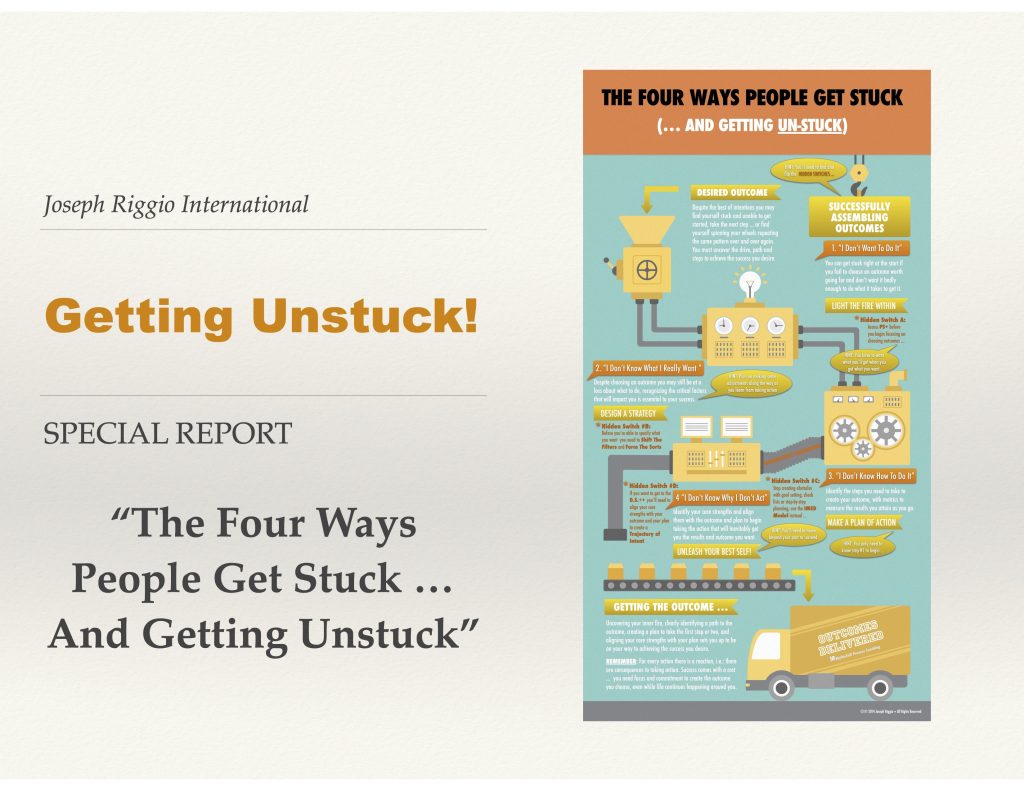
Get my Free Special Report “Getting Unstuck” … Click Here Now!

Filed Under: Blog, General, Life, Personal Transformation, Transformational Change & Performance, Uncategorized

Communication Mastery

Communication Mastery

by Joseph Riggio · Aug 21, 2022

Thinking is Communication … Communication is Thinking

I was speaking with a client this morning and it came up again …

THINKING IS COMMUNICATION … COMMUNICATION IS THINKING

It’s an idea that’s plagued me for half a decade now. It’s remarkable how clearly this makes sense to me today … how obvious it is to me.

Every once in a while I like to revisit the essence of what I do and why I do it, with and for my clients … i.e.: what value I bring to the work I do and am paid for with and by clients.

Here’s my latest update on that consideration, as of this Sunday afternoon, as I sit contemplating it here on 21 August 2022.

Introduction and History:

But let’s go back thirty years or so when I was first coming into the world of NLP, and it was introduced to be as a human communication technology. At that time the idea was that NLP was a way of considering communication and its implications in human interaction. Alongside the idea or interpersonal communication, it was also presented to me that NLP was an intrapersonal human communication technology too.

In the world of NLP the way we process language (the “Linguistic” part of NLP, “Neurolinguistic Programming”) was the critical consideration, especially the nature of syntactical processing, or the sequencing of the internal representations we use to think. In NLP terms this is the V-A-K-O/G representational systems comprised of V-visual, A-auditory, K-kinesthetic, O-olfactory, and G-gustatory, also know as a 4-tuple, where O & G collapse into an overlaid, singular representational form.

Beyond the primacy of the representational systems processing, NLP also looks at linguistic processing, the nature of how language creates representations and meaning. So there are models within the NLP model that address how we process language, like the Meta-Model which looks at the processes of Generalizing, Distorting and Deleting information in linguistic representations, or Meta-Programs which look at how we preference and evaluate language on a continuum of opposites to make sense of and create meaning from linguistic representations.

Then I think forward from that early indoctrination in the NLP model to my years of studying with Roye Fraser, including his training me in the model of work he developed, the Generative Imprint model. The Generative Imprint model is a meta-application of the NLP model that uses a unique positive orientation based in the excitatory bias, using a wholeform structure of perception and communication.

As I think about the years of apprenticing with Roye what stands out most is his use of hypnotic language to create wholeform interactions. Roye’s use of language was exquisite and aimed at what he referred to as the “symbolic, iconic representation” of the Generative Imprint, or a way a person knew themselves to be whole and complete, where they experienced a pervasive sense of wellbeing. This was his forte, and his raison d’etre too.

In the early years of working with Roye I came up with my own application of the Generative Imprint model I called the Mythogenic Self Process (the “myth-making” self process), which I later modified and shortened to the MythoSelf Process. The naming of the MythoSelf Process for my model has remained consistent now for almost 25 years, although the model has been through many revisions and refinements.

It took many years for me to clarify the essence of these models, NLP, the Generative Imprint model and my own MythoSelf Process model. As I was doing this I continued to explore and study other models as well, some philosophic, some psychologic, some an overlay like phenomenology and phenomenography, some others like linguistic and mathematical models, and a deep dive into brain-, neuro- and cognitive- sciences..

However, only after I seriously dove into the exploration and study of cybernetic systems in modeling human cognition and communication was it that all the pieces began to come together. This was the beginning of a profound understanding of the structure of wholeform thinking and communication I had mastered, under Roye’s tutelage and with his intense mentoring.

The Development of SSCT | Sensory-Systems Control Theory

Once I got that deep cybernetic patterns of human perception and cognition I could clearly see the connections between sensorial awareness and symbolic representation that form the basis of what we refer to as thought, and from thought, mind.

It became obvious to me that we transform our direct sensory experiences into symbols of representation so rapidly that there is no temporal gap for all intents and purposes between the two, i.e.: sensations instantaneously are translated into symbols in our conscious cognitive experience. This process is so instantaneous and absolute that reality as we know it is comprised of the symbolic representations we derive from sensory experience, and not based on the actual sensory experience itself.

This led me to develop the theory of human cybernetic cognition that progresses from sensory experience to perception, from perception to sense-making, from sense-making to meaning-making, from meaning-making to decision-making, and from decision-making to action-taking (behavioral response). I refer to this sequential process as the “Ladder of Perception.”

Most of the Ladder of Perception occurs outside of conscious awareness in the feed-forward system from sensation to response. With training the cognitive processing from perception to decision-making can be made conscious in hindsight, looking back from action-taking/response through each of the preceding steps of the Ladder of Perception model.

With advanced training and diligent practice the processing of the steps of the Ladder of Perception can become available consciously as they are happening, and with further advanced training before they happen in the cognitive sequence. When the process that will happen in the cognitive sequence can be considered before it has occurred and created a feed-forward effect in the system adumbration of the unfolding situation becomes possible.

When you can adumbrate the situation you are experiencing, what will most likely happen based on what has happened and is happening is revealed and can be acted upon before it happens as it will if the system is allowed to continue unfolding on the path it is currently taking.

Adumbrating gives you the opening and opportunity to intervene in a system before the event you want to alter has occurred, reshaping the context and framework to allow a different and most desirable outcome to become possible than is possible in the way the current context and framework are organized and being held.

The SSCT | Sensory-System Control Theory is a model that suggests that behavior is shaped at the level of sensation, and by changing the nature of perception behavior can be shaped and will follow. When we can and do choose what and how we are perceiving in the contexts we engage in we can shape the behaviors we need to express that will create the outcomes we desire. Obversely we cannot shape behavior by trying to change our behavior directly, since all behavior is an outgrowth of perception, and if the perceptions remain unchanged our behaviors will always revert to those in alignment with our perceptions.

Sensorial Awareness as Symbolic Representation

Ultimately we want to be able to choose the outcomes we create by our behaviors, because while we cannot necessarily control the contexts we find ourselves in, we do have control over what and how we are perceiving within and in relation to the contexts that contain us.

When we choose our perceptual position we can then manifest and enact the behaviors most likely to produce the outcomes we desire. Choosing our perceptual position requires us to become aware of the symbolic representations we are responding to in the context. By noticing the symbolic forms we are responding to, we can choose to shift our perceptual position until we generate the symbolic form that will and does allow us to manifest and express the most useful behavior in regard to creating the most desirable outcome.

One of the most potent ways to shift the symbolic representation is to shift the filters we are using for our primary way of attending to what we’re experiencing at the sensorial level of awareness.

This can include changing the primary filter, say from visual to vestibular, or auditory to proprioceptive, as well as changing what we noticing for within a given representational system and how we’re noticing for that information sensorially prior to the transform from perception to sense-making (NOTE: in the MythoSelf Process model in addition to the V-A-K-O/G 4-tuple we extend it to a 7-tuple of primary representational systems, V-A-K-O-G- and Vs-vestibular and P-proprioceptive).

Then as we progress through the Ladder of Perception sequencing we can force the sorting pattern of information that would best support our manifestation and expression of the behavioral response most likely to create the outcome we desire. When we shift the filters and force the sorts in this way we begin to reset the processing pattern we use in relation to this situation and the creating the outcomes we desire. Within the MythoSelf Process model this is called “creative expression.”

Creative expression can be partially or fully realized, and is or is not, by the facility that you have with shifting the filters and forcing the sorts to create the behavioral manifestation and expression that most aligns with your ability to create the outcomes you desire. The more elegant the pattern of behavior, the more we can say that you are realizing the fullness of you most profound, potent and powerful creative expression.

When you a fully realizing your creative expression in the behaviors you manifest and express you are living in the most aligned way possible with your innate sense of self, and aligning with that in regard to your external performance. In this way you have begun to create the outcomes you desire by being most who you are, and reducing the friction and compromise in the system. Ultimately when you have refining this pattern and made it the default way you take action the system comes to rest, there is no urgency, stress, anxiety or conflict you experience in taking action in this way.

We can say that when the system is at rest, and you are expressing yourself in the most elegant way possible you are in a state of flow, or what we call your State of Perfection.

By applying the SSCT | Sensory-System Control Theory to notice what happens at the sensorial level of awareness, and in the translation to symbolic representation prior to taking action, we can refine the perceptual position to bring the system to rest.

When you have patterned in the requisite perception training to notice the perceptual position you are holding and its effect on the Ladder of Perception sequencing, and you are capable of choosing the position you adopt and hold to bring the system to rest, you are accessing the reference point of your State of Perfection.

Since the process requires you to attend to your sensorial awareness in a pre-representational way, it is useful to think of this as a somatic intention that occurs in direct sensorial experience had in the body-mind, before the translation to symbolic representation. Only after you have processed the sensorial experience somatically can you accurately identify the accuracy of the symbolic form to the sensorial reality. This transformation from sensation to symbol is a semantic transformation, turning direct sensorial experience into meanings that can ignite conscious decision-making leading to deliberate action-taking, i.e.: in response to an intentional outcome.

THINKING IS COMMUNICATION … COMMUNICATION IS THINKING

So we’ve now come full circle …

We are virtually always acting on the symbolic representations of reality we create from our sensorial experiences. The manipulation of symbolic representation is what we call thinking. Thinking in this way, as symbolic manipulation, operates as a communication process in terms of the use, interactions, applications, and manipulations of symbols, e.g.: words … i.e.: thinking is communication.

In addition to words, symbols can also be communicated in any sensory form we are capable of processing, e.g.: the modalities of the 7-tuple. We are capable of, and do, process symbolic form internally as intra-systemic cognition (processing of information that is self-generated – our own internal thoughts) and inter-systemic cognition (the processing of information that is externally present to us). We can also make a case for inter-subjective cognition as being processed in the space we share with others in simultaneity.

However, what I’ve come to treat as most significant is the communication process itself. I have seen that when you learn to communicate with an exquisite level of clarity and precision internally and inter-personally your ability to express elite levels of performance follows inevitably.

What I mean by elite levels of performance is the ability to consistently maximize positive consequences and minimize negative consequences in the manifestation of your desired outcomes. When you are expressing elite levels of performance, most typically from a flow state or your State of Perfection, you create the outcomes you desire with the minimal cost of time, energy, and resources, including your personal goodwill. We refer to this way of performing as “effortless” in the sense that you proceed through the process of perception, decision-making, action-taking, and adapting that cycle iteratively based on the feedback you get from taking action without any undue urgency, stress, anxiety or conflict.

From the outside looking in, the outcomes you produce when you are operating in alignment with your State of Perfection being and remaining intact appears effortless, and you experience it as being effortless as well, .

When you communicate with others you are expressing your thinking, and they experience your thinking as a process or their own thinking … i.e.: communication is thinking.

Therefore as I consider where I bring the highest value to my clients I realize over and over again it resides in the way I help them recognize the quality of their communication, with themselves and with others, and to refine it to higher levels of quality.

People who work with me begin to recognize the inconsistencies in their thinking and communication processes and begin to experience significant changes in their life as they improve their ability to think and communicate exquisitely.

If you’re serious about wanting to experience the state of flow, effortless performance and the kind of exquisite thinking and communication I’m referring to here let’s find a time to chat.

In the meantime I’d love to read your thoughts and open a channel to exchange our observations and considerations as you have them too.

Best,

Joseph Riggio, Ph.D.
Sarasota, FL

Filed Under: Blog, Cognitive Science, Elite Performance, General, Human Systems, Language & Linguistics, NLP, NLP & Hypnosis, Personal Transformation, Transformational Change & Performance, Transformational Communication, Uncategorized

1000 Days of Training …

1000 Days of Training …

by Joseph Riggio · Jan 26, 2022

My journey to becoming a Master NLP™ Trainer … and, the Architect & Designer of the MythoSelf Process and SomaSemantics

“Uchi-deshi” … that’s probably a meaningless phrase to you, unless you are a dedicated martial artist, and have hung around the martial arts world for some time, especially the Japanese arts, like Judo or Aikido.

The phrase, Uchi-deshi, closely translated into English would be “inside student,” referring to a dedicated student of the martial arts who lives in the dojo, commits to a full-time practice in the art they are studying, and takes on responsibilities to the dojo’s master teacher and to service in the upkeep and care of the dojo too.

What’s amazing is that these students not only work in the dojo, cleaning, doing minor chores, maintenance, acting as an assistant to the master, and often taking on some of the teaching role for other more junior students as well … they often pay for the privilege of being an Uchi-deshi, and must be able to support themselves financially and independently while in such an apprentice relationship.

I bring this all up because it’s the closest I can come to the apprentice model I experienced with Roye, my mentor and master, while studying the arts of NLP and Roye’s “Generative Imprint” model with him. For seven years I spent the better part of 40 weeks a year attending training programs with Roye, or assisting him when he was working with clients, and often picking him up at the airport or running to the bank to take care of something for him. It was a grueling schedule because my cost for this much training was in the range of $100K/year, plus travel and housing (there wasn’t any live in dojo to stay in, so lots of hotel rooms in addition to the few times I stayed on a sofa in Roye’s home), so I had to work full time, while also studying 8+ hours a day when I wasn’t actually in the consulting or training room with Roye.

Truth is … I wouldn’t trade day of those seven years for seven extra years of life.

There’s just no way I could be who I am today without having spent those seven years apprenticing in the manner in which I did … it was indeed grueling, often uncomfortable and discouraging, and there were many days I thought would be my last, but it was a privilege every day for those seven years.

I remember a particular moment about three months after meeting Roye for the first time, I had asked him to help me with something and he promised he would. I was confident that if Roye promised me that he could help me get something I wanted from training with him I would get it, but after weeks and weeks of waiting, and asking for it over and over, it seemed I wasn’t getting any closer to having it. So I waited some more.

This went on for months, and finally I decided if he wasn’t going to help me I would just get on with it and figure it out for myself, in fact I decided I was done with Roye, and after I completed the commitment to getting my NLP™ Master Facilitator certification with him I was out of there. So I kept at it, showing up, doing the homework, reading prodigiously in NLP, linguistics, philosophy, psychology and cognitive science, averaging a least a book a week, and in some weeks three books. I spend hours every day writing and reviewing my notes too. And, Roye would hand out what he referred to as “hypno-hymnals,” hypnotic scripts that he work on personalizing for me, with me, going back and forth using fax machines to share what I’d written and then incorporating his hand written notes in the margins back into the script that he’d send me back. I must have done this with hundreds of pages of these ‘hymnals’ over just that first year with Roye.

Suddenly, on a Sunday afternoon or a three-day workshop with Roye, sitting in the circle with him, I asked my question again, after Roye ran his typical routine of going around to everyone in the room and asking, “What do you want?” focusing us to think about why we were there that day, and what we wanted from it. When it came to me, I once again asked for the same thing I’d been asking for over the past few months, not expecting anything different than what I’d already gotten in regard to this request … nothing!

Roye did nothing to disappoint me either, because he simply acknowledged my request as he had every other time I made it, and then moved on to the next person. As expected there wasn’t any lightening from the heavens, nor some internal seismic event, just another day in the “hypnotorium” … Roye’s term for the space he set up to doing training in with his students and clients. Yet, sometime later that day, after lunch, Roye was working with a client in front of the room and did something that made what I’d been asking for over the many months since I began studying with him become crystalline clear and obvious … and, I swear to this day he subtly glanced in my direction to see if I’d picked it up. I was dazed and in awe, one of the very few times in my life I was truly speechless, because I realized in that moment that he’d shown me that very thing probably hundreds of times since I’d first asked!

Roye wasn’t holding back at all … I was just incapable of getting what he was offering until I’d seen it again and again, and again. When I finally saw it, it was as though dark scales blinding me had dropped from my eyes, and for the first time I could see the world clearly. Not only did I see what Roye had done, exactly and precisely what I had been asking him to demonstrate for me, but a thousand other things he’d been doing over those same months I’d been waiting for this moment became clear to me as well.

That was the beginning of my humbling. I have to admit prior to that moment I pretty much acted like an arrogant asshole, thinking I knew much more than I did, feeling somehow better than my peers who were so slow in picking this stuff up from my short-sighted observations. In that moment of revelation I realized how little I knew, and for the first time grasped some idea of how deep the rabbit hole I climbed into when I entered the hypnotorium went … a lot further down than I could see from where I was standing was about the only thing I was sure of that day.

Well, obviously, since I’m telling you this story, I didn’t quit, in fact that’s when I doubled down and committed to being available for every weekend, every workshop and anything that Roye would open up to me. I also began making time to join training with Richard Bandler whenever I could, and other famous (to me) NLP™ Trainers like John Grinder and Robert Dilts … I went everywhere and saw everyone, including some of the most famous hypnotists I could catch up with whenever possible. Not a week went by where I wasn’t reading two or three books simultaneously and spending hours on bulletin boards in the early Internet days. I was in … hook, line and sinker, a fish out of water, determined to master the art of swimming … even if that meant upstream and against the current until I got it.

As I said already, that was the start of a seven year apprenticeship with Roye, one I’m eternally grateful to him making available to me … even though I believed I earned every opportunity given to me, with my sweat, blood and tears offered up as payment in full. That was in the late 1980s, and my the early 1990s I was working full time as an NLP™ Trainer and Consulting, working with sales teams internationally, and eventually working my way up to the C-Suite doing leadership development workshops and coaching senior executives for multinational corporate clients.

There was a famous SNL (Saturday Night Live) skit in the early days of that television show, where the comedian Garrett Morris played the baseball player Chico Escuela. In that skit Chico would say, “Baseball been berry, berry good to me.” mimicking the real live MLB player, Sammy Sosa’s Dominican accent. It was a funny skit that stuck with me, and I often think in the privacy of my own mind, “NLP been berry, berry good to me.”

I liken my journey so far to a kid who began playing sandlot baseball, one of millions, who makes it onto a Little League team, maybe one of ten to make that transition from the sandlot successfully. And, then moving along getting on a high school team and then a college team, leaving behind may as many as 10,000 of the kids who all began throwing baseball around with their friends, or if they were lucky enough, playing catch with a father who showed them how throw a baseball properly. Finally, one of a 1000 of those college players makes it through the minor leagues and into MLB, getting drafted by a team who give them a shot, and if they are good enough they then get the honor of entering baseball’s Hall of Fame, maybe one of a million or more.

I’m one of those lucky guys who’s been given the opportunity to do what so many others who picked up a book and read about hypnosis or NLP or coaching, and then found someone to take a class with, and maybe finished a certification program of some kind and even started a part-time practice, hoped to achieve. I’ve traveled around the world training some of the very top, elite performers in every field of excellence, and I’ve been paid very well to do it … enjoying what I so often refer to as a magical life. I know it all began when I stumbled across an ad to go to a single 3-day training on the old Blue Dell Farm, in Pemberton, NJ, where Roye had set up his hypnotorium, and I made that first phone call to find up more about it.

Ever since then I’ve been saying that life has been “… berry, berry good to me.”

All the best,

Joseph Riggio, Ph.D.
Architect & Designer of the MythoSelf Process and SomaSemantics

P.S. – I’ve trained just a handful of folks in my version of taking on apprentices like Roye invited me to be with him, at least two of them picked up their roots and moved to live close to where I was living at the time to have that kind of access, another couple I can think of just came to anything and everything I was doing until they absorbed enough of what was going on to claim mastery themselves, and at least one of these folks lived with me as a housemate for a while literally pestering me in daily conversations and dialogue, and picking up everything … almost by osmosis you could say.

I don’t really have a formal program for Uchi-deshi, nor can you come and live me, but I am opening a very limited and small window for anyone who thinks they might want to explore engaging in an intimate mentoring relationship to master the art of transformational change with me. I have “graduated” the last of the group I’d been working with in this way, and I’m ready to work with a few more folks who are up to the commitment to becoming one of the best there’s ever been … because not only do I think of the folks who have studied with me this way, but their reputations now precede them as the master’s they’ve become (if you are interested I’m happy to set it up for you to speak with a few of them to help you decide after we speak and agree that it might make sense for you to drink the potion Alice found, and enter the warren for a while …

Just go here to arrange an appointment … https://live.vcita.com/site/josephriggio/online-scheduling?service=k1zlmegpqkoykvri

NOTE: This link will only be available for a limited time, so if you’re interested schedule a time now. I reserve the right to cancel this opportunity at any time without notice, but I trust if the student is ready …


Filed Under: Blog, Coaches & Consultants, Coaching, General, Mentoring, MythoSelf Process Training, NLP, NLP & Hypnosis, Transformational Change & Performance

Living Mythically

Living Mythically

by Joseph Riggio · Jan 18, 2021

Living Mythically … Taking Control Of Your Story

From the beginning of my professional practice I referred to what I do with clients as “a piece of work” and suggest to my clients do their work. There’s a bit of danger phrasing thing in this way, in that “work” is often heard and thought of as negative, something that’s hard or difficult, or as something in opposition to fun and play, something that’s not enjoyable. And, yet I think that to be a very small minded and limited point of view, that only applied to work you should never be doing in the first place.

My “work” is aiming my clients to live and perform in their lives mythically. By living mythically I mean taking control of their autobiographical narrative, or writing the scripts they live by, their own life story. There’s nothing I find more playful, enjoyable and worthwhile than doing this work, yet it can be challenging and sometimes downright daunting, and even then it remains completely playful, engaging and fun for me to do.

Establishing A New Profession …

Another way I speak of what I do professionally in my practice with clients is that I am a “Clinical Mythologist.” I guide my clients mythologically to discover the stories they have been living from, the story they are living, and the story they are living into. Once we uncover these stories we take it further to begin to take control of the narrative these stories create collectively … the continuity of past, present and future as a singular way of understanding who you are fundamentally. This is an “ontological/ aesthetic” way of knowing yourself … as a being experience life sensually, contained in the iconic, symbolic representations you form about yourself and your life. One way we do this is in the form of language, the language we use with and about ourselves, and the language we use to describe reality as we know it, including others and our relationships with them.

A “piece of work” then refers to uncovering an aspect of revealing the autobiographical narrative someone is living from, and the affect of that narrative in their life as a mythic form. Of course this also means we’re revealing them to themselves. The revelations we uncover are both ill-formed and well-formed.

Ill-Formed Or Well-Formed Personal Mythology?

Ill-formed myths are fundamentally distortions of reality, not real in some way. Ill-formed myths disconnect you from your life, especially in regard to your purpose, passion and power, and away from living playfully. The ill-formedness creates cognitive dissonance, meaning that when you are operating from ill-formedness what you experience doesn’t make sense, the pieces don’t fit and you cannot form a coherent narrative, or mythic form through time.

Ill-formedness in your personal mythology … the autobiographical narrative your living from that describes reality as you know it and the way you relate to it … leads to what I call mythological distress and ultimately mythological crisis … the story your living doesn’t fit you.

Eventually, an ill-formed personal mythology will lead to ill-formed behaviors, that cannot and will not create the outcomes you desired, or produce the life you intend to be living, the relationships you want to be having, the accomplishments you want to be realizing.

Well-formed myths on the other hand are those that match you intrinsically, the arise from deep within you, before any traumas or comprises of yourself were experienced or occurred. A well-formed personal mythology contains and describes reality as you know it to be as free of distortions as you are capable of achieving. This view of reality leads to coherence that led to a a natural sense of awe and wonder, and a way of being in the world that is playful, childlike but not childish.

Wellformedness in your personal mythology opens you to the possibility of living a life of joy and splendor, experiencing yourself and others in enchanted and enchanting ways … you begin to experience the epiphany or what it means to be fully human and fully alive … life becomes meaningful play, filled with purpose, passion and power without struggle, effort or compromise.

Taking Control Of Your Story, And Your Life

What I’ve found in working with thousands of clients individually, in groups and within organizations and institutions has been that doing the work of living mythologically requires simultaneously becoming aware of your autobiographical narrative and taking control of it. The way this happens begins with choosing to be the author of the scripts you are living from, and rejecting the scripts that others have imposed upon you … often without any conscious awareness that that has happened, or that the script you are running is not your own.

The “writing” of your story, and the scripts you run, rests on the ways in which you perceive and make sense of the experiences you have, the meaning you apply to those experiences, and the decisions you make that lead to the action you take … and, this of course leads to the outcomes your create, as well as those you don’t.

As one of the huge benefits of “doing your work” of uncovering, revealing and taking control of your personal mythology you’ll free yourself from the ways you found yourself stuck in the past … procrastinating, hesitating to act, acting poorly, running in circles and finding yourself trying everything and anything you can think of to move forward, and yet still finding your stuck either not moving or moving and winding up where you began.

I’ve worked often and intensely with clients helping them to get unstuck in many ways and places in their lives, including extremely often in the ways they relate to others in their personal and professional relationships. When you reset your personal mythology it frees you from conflict, resentment, envy, shame, guilt and all the other things that so many people struggle with … without ever needing to wade through the suffering of revisiting those emotional sinkholes.

I find another thing that comes up almost as often can be the way that you relate to your sense of discovering real purpose and meaning in your life and career. Knowing you personal mythology makes how what you do professionally evident to you, the meaning it has in your life, and in relation to others too. Passion come from knowing why you are doing what you do, regardless whether we’re talking about actions you take personally for yourself and with others, or professionally. One of the most powerful things this does for you will be a natural reset of your relationship with money … earning it, accumulating it, spending it and sharing it as well.

It’s also extremely interesting to observe how my clients experience a positive change in their health, physically, mentally, emotionally and even spiritually, when the take back control of their autobiographical narrative. When you choose to be the author of the stories of your life … what they are, what they mean, and how they organize you to experience your life as it unfolds and you move forward through it … everything becomes clear to you and you have choices about it all, including how those experiences affect your health and wellbeing.

You cannot not live in relation to your life’s story, the autobiographical narrative that shapes and forms you, your experiences, your relationships and the life you are living. Either you choose to take control of your personal mythology, the story you are living, or you are controlled by it.

What’s Next …

As I shared with you at the beginning I love “doing my work” … shaping the story I’m living and sharing my client’s stories, because by keeping my attention here I can help you “do your work” too, and become the author of your life. Let’s get together sometime and tell some stories, eh?

Joseph Riggio, Ph.D.
Architect & Designer of the MythoSelf Process and SomaSemantics

Sarasota, Florida

P.S. – WHEN YOU’RE READY … you can always set up a time to arrange a complimentary call with me when you’re ready to begin again … YES, Joseph I’m Ready, let’s get together to explore my personal mythology and the life story I’m living.

P.P.S. – Get my book “Experiencing the Hero’s Journey” and go a bit deeper into the journey of your story by reading a bit about mine … in it I reveal the deep structure of ill-formedness, well-formedness and how to discover your own personal mythology and story.

Filed Under: Blog, Business Performance, Coaching, Elite Performance, General, Life, Mentoring, Mythology, Personal Transformation, Transformational Change & Performance, Uncategorized

Outlaw Thinking: Part 3

Outlaw Thinking: Part 3

by Joseph Riggio · Nov 9, 2020

grok

grok/ɡräk/Learn to pronounceverbINFORMAL•US

  1. understand (something) intuitively or by empathy. “because of all the commercials, children grok things immediately”
    • empathize or communicate sympathetically; establish a rapport. “nestling earth couple would like to find water brothers to grok with in peace”

Grok/ˈɡrɒk/ is a neologism coined by American writer Robert A. Heinlein for his 1961 science fiction novel Stranger in a Strange Land. While the Oxford English Dictionary summarizes the meaning of grok as “to understand intuitively or by empathy, to establish rapport with” and “to empathize or communicate sympathetically (with); also, to experience enjoyment”, Heinlein’s concept is far more nuanced, with critic Istvan Csicsery-Ronay Jr. observing that “the book’s major theme can be seen as an extended definition of the term”.

(https://en.wikipedia.org/wiki/Grok)

“Grok means to understand so thoroughly that the observer becomes a part of the observed—to merge, blend, intermarry, lose identity in group experience. It means almost everything that we mean by religion, philosophy, and science—and it means as little to us (because we are from Earth) as color means to a blind man.”

It’s what I do … I grok.

I am a Master Grokker.

I grok professionally with and for others.

SO …

I , Joseph Riggio, grok the MythoSelf Process, and within that universe of understanding, the underlying developmental modeling principals that the building of worldviews, and the narratives that form and inform them, ultimately rests upon.

Now, if you’ll stick with me for a short bit longer I’ll get to how and why this may be of critical important to you too.

Hackers also grok, as in “I hack reality, because I grok it.”

The word was later woven into hacker culture, appearing in the earliest editions of the Jargon File from the early 80s, which was later edited and republished by famous programmer Eric S. Raymond under the title The New Hacker’s Dictionary.

Hackers Dictionary

The primary definition given there is consistent with Heinlein’s, but the more religious and mystical connotations have been dropped:

  1. To understand. Connotes intimate and exhaustive knowledge. When you claim to ‘grok’ some knowledge or technique, you are asserting that you have not merely learned it in a detached instrumental way but that it has become part of you, part of your identity. For example, to say that you “know” LISP is simply to assert that you can code in it if necessary — but to say you “grok” LISP is to claim that you have deeply entered the world-view and spirit of the language, with the implication that it has transformed your view of programming. Contrast zen, which is similar supernal understanding experienced as a single brief flash.

Here’s an especially interesting bit for me:

When you claim to ‘grok’ some knowledge or technique, you are asserting that you have not merely learned it in a detached instrumental way but that it has become part of you, part of your identity.

I am quite literally asserting that after thirty plus years of immersing myself in the work I do, i.e.: the MythoSelf Process, and all the bits and pieces that it contains and it built up from and in relation to, I grok this stuff like nobody’s business!

NOW onto why this is all important, maybe critical, for and to you …

I’ve been laying out a premise for what I’ve playfully been calling Outlaw Thinking in my last couple of posts.

The essence of the idea is that A) I think (and therefore communicate) differently … other than as folks normally associate what thinking is or how it should be done, i.e.: in a straight linear way, from point A to point B, as efficiently and directly as possible … and, B) I help others to think and communicate like an outlaw too, meaning that I help them build new and more complex worldviews and narratives, that give them unique perspectives, options, choices and opportunities, because they develop significant adaptability in the way they think and communicate.

Okay here that is again …

B) I help others to think and communicate like an outlaw too, meaning that I help them build new and more complex worldviews and narratives, that give them unique perspectives, options, choices and opportunities, because they develop significant adaptability in the way they think and communicate.

SIMPLY … I train people to grok their world, their work, their own lives, and the other folks they engage and interact with … and I also train folks to do this work I do with others, so they can help their clients grok too.

Now you have what you need to decide if this is important, or even critical, to where you find yourself in your life today.

If getting to this kind of thinking and communication in your life and work means something to you, you’re in the right place … YOU’VE FOUND IT!

OUTLAW THINKING REVISITED:

So what do I do again, and why is it important, or critical, for you:

Applying the MythoSelf Process model with my clients helps them to unwind sticky, or wicked, problems and situations in their lives, relationships, work and businesses.

“Grokking” the MythoSelf Process model gives me a kind of genius superpower … because it makes it obvious what level of thinking someone is operating from, and where the limitation in their cognitive process exists, and then points the way to resolve that so that my clients can literally upgrade their mind.

The “genius” in the model is available to anyone who groks it, and that’s ultimately the effect of working with someone deeply versed in the MythoSelf Process.

All perspectives, or worldviews, rest on narratives that describe what is real for the individual, or organization, that is living within and in relation to the narrative … the stories they tell about themselves, others and the world as we know it to be.

The MythoSelf Process model uncovers the existing narrative, as well as the “primal narrative” — the origin narrative that contains the uncorrupted and uncompromised form of the individual or organization, before any attempts where made to reshape them to fit into what society wants them to become.

The primal narrative is the pure mythic form of the individual or organization, and provides access to a teleological trajectory the pulls them into the most desirable future possible for them. In some models of transformational work this would be referred to as becoming authentic, or operating authentically.

The advantage of accessing the primal narrative, or mythic form, that working within the MythoSelf Process provides any user, is that decision making becomes unclouded, and action taking become virtually automatic in relation to creating the outcomes you intend … the effect is that taking effective action, and creating results, feels effortless.

Solving wicked problems is especially important to what we’re discussing here, what I’ve call Outlaw Thinking.

The MythoSelf Process allows you to process complexity that gives rise to wicked problems, and develop effective strategies that unravel the complex issues that have tentacles in multiple directions, having multiple consequences that are overlapped, intertwined and potentially costly if you fail to resolve them, and when they are resolved well are highly rewarding.

Doing this requires operating from a different mind and elevating your performance in relation to the world we now live in today.

The deep challenges we face include:

  • A brain that evolved somewhere between 500,000 and 50,000 years ago, not in the complex and interrelated global world we now move in
  • Cultural learning and impositions designed hundreds of years ago, imposing explicit laws and implicit rules that order our lives today, that no longer effectively represent the world we are living in now

Only by upgrading your worldview, i.e.: effectively upgrading your mind, can you hope to effectively deal with the actual levels of complexity and circumstances we live in relation to on a daily basis today.

The MythoSelf Process is a method for working with someone who will guide you through the specific things you need to do to shift how you are experiencing yourself and your life, usually in relation to a specific situation or circumstance you are currently facing, that then generalized the upgraded pattern of thinking throughout your life.

Beyond the MythoSelf Process work with a facilitator or trainer of the Process, there is an opportunity to learn more about the foundational principals that form and inform the Process.

These principals used with the MythoSelf Process model are built on a developmental model of cognitive maturity, and will dramatically shift the way you think and the way you communicate (because quite literally communication is thinking — as you raise the level of your cognitive maturity communication, and language use in particular, become a controlling mechanism for thought).

If you’re ready to take the next steps in exploring how you can make this kind of leap in advancing yourself, your thinking and your communication have a look here now:

Mastering Cognitive Maturity

Best,

Joseph Riggio, Ph.D.
Architect & Designer of the MythoSelf Process and SomaSemantics

Developer of A.C.T. | Adaptive Cognitive Training and the Cognitive Maturity Model

P.S.: If you’re interested in working with me in one of my small coaching groups or 1:1, there’s no need to wait any longer, reach out to me directly at: joseph@josephriggio.com, and we’ll come back to you about how to find out more about taking the next steps to do that …

Filed Under: Blog, Business Performance, Coaches & Consultants, Coaching, Cognitive Science, Elite Performance, General, Human Systems, Language & Linguistics, Life, Mentoring, Mind Games, Mythology, MythoSelf Process Training, Uncategorized

Mission: OUTLAW THINKING! -Part 1

Mission: OUTLAW THINKING! -Part 1

by Joseph Riggio · Nov 7, 2020

We are certainly living in interesting times … (the foundation)

The most obvious aspect of this seems to be the speed at which things are happening and changing, as well as the level of complexity we are forced to deal with in our daily lives … in our relationships, or work, our heath, in politics and the economy, and in terms of the cultural values that we are most familiar with that are we can no longer expect to remain “as is” or stable for very long.

Why is this important?

Putting it as simply as possible, the mind you are currently using to think with isn’t going to get you the outcomes it could have just ten years ago, and will likely be totally outdated before the next ten are over

We’re seeing signs of this everyday. Consider for a moment people who you know who made it through most or all of their working careers never using or needing to use a smart phone or computer, or even a “dumb” mobile phone for that matter. That is becoming harder to do with every passing year, and will likely be virtually impossible for a vast majority of people in the next ten years.

Professions where being computer savvy wasn’t even a consideration, for example for many craftsmen ten years ago, is now becoming a necessity from communicating with customers to ordering materials, in addition to dozens of other professional uses that show up day to day. These examples are just the proverbial tip of the iceberg however.

Imagine for a moment a roofer who simply needs to point a laser measuring device at the edge of a roof as he or she walks along the perimeter, and the AI software he or she is using doing all the calculations of materials and labor, preparing all the materials purchase orders, work schedules, and cost estimates for the customer by the time the contractor has “walked the building.”

Now imagine a year from then when the contractor simply responds with a drone “fly over” the customer’s home, has all the information taken care of, and the customer receives the project estimate in real time with the contractor. That’s all possible today.

These kinds of considerations change things at many levels, including what the “work” of a roofing contractor becomes, and whether roofing contractors even exist in the near future, or if the home owner simply uses the drone-based AI system to do what a contractor would do today running the project themselves via the integrated software systems connected to materials suppliers and labor pools from their computer or smart phone.

Once again, this is at least theoretically possible right now … let’s call it “Uber Workforce” for kicks, imagining that it wouldn’t be too difficult for Uber to expand it’s operation to provide this kind of service as a mobile phone app. This will become the “new normal” very soon … for many, much soon than they are prepared for or will like when it happens.

So the question becomes, how do you deal with this kind of fast changing world using your current sense of normal and the kind of thinking you’ve been conditioned to believe will suffice in getting the outcomes in a world that no longer conforms to what’s been normal for decades, and in many cases, centuries.?

I’m all about this mission now … i.e.: helping those who “GET IT” and are ready to update their thinking, to radically update what they think about thinking so they can upgrade and install a whole new mind.

And, I get for most folks that leads to a second question, how … how do I make the adjustments and update my mind so I can deal with what’s already happened, and what’s going to continue happening that will requires ways and types of thinking I don’t currently have access to, but will very quickly become the new normal?

I’ve literally been thinking about these questions and how to answer them for decades. I’ve been building models and working with individual and corporate clients internationally to train them to become more effective in they ways they think and communicate.

My clients know they can count on me to help them navigate complexity, the sticky and wicked problems they face and must deal with that exceed ordinary ways of thinking and approaching “problem solving” as most professionals, including most consultants, do it today.

The folks who hire me count on me to think outside the box, and to bring my “outlaw thinking” to the problems they face. In it’s simplest form I bring a counterintuitive approach that turns problems on their head, and I look at them through a lens of possibility making them into windows of opportunity.

More specifically I’m looking at my clients problems from a completely different, higher order of thinking and level of complexity then they are presently capable of themselves. At the higher orders of thinking, and levels of complexity, more information becomes available, and the patterns that connect various sources of information within the context become obvious, because you begin to deal with what’s in front of you and obvious, as well as the underlying and hidden interconnections.

When I take into account the higher order of thinking that’s possible what’s emergent in the systems I’m dealing with also becomes obvious to me. Once I’ve done the calculus to analyze the data in the system, both what’s evident and emergent, I am able to make higher quality decisions about what action to take. This includes calculating the potential positive and negative consequences of the action, and factoring it into best and worse case scenarios, and then preparing for either as the actual outcome.

This is a cybernetic process of thinking that is iterative, recursive and systemic, generating self-referencing and self-organizing update loops. Working this way is the basis of generative learning, and this is what I train my clients to do when they hire me, or attend training with me. I refer to this kind of modeling as “wholeform learning” where the entirety of system, including connections through space and time, is considered in the functional analysis leading to a strategy to be implemented and refined through time as more data emerges and becomes present.

Almost always the greatest complexity in the systems I deal with, and train my clients to deal with, involve others as actors and agents within them. These actors and agents bring agendas of their own, and the ability to recognize the interactivity of these agendas in creating the outcomes achieved, even when the agenda are competing or conflicting, is where a kind of generative magic emerges from approaching the resolution of problems and the realization of solutions in the way I train my clients to do.

To recognize the overt agendas that people bring is easy and most people can do that innately. Recognizing hidden agendas and the secondary gains that remain unspoken and largely unseen requires very specialized thinking. This means significantly upgrading the order of thinking you apply to the analysis of any system you’re operating within and/or in relation to, if you want to achieve your outcomes effectively and effortlessly.

I’ll be back again soon with Part 2 of this mission statement, if you’re ready to learn a bit more now check this out today:

Mastering Cognitive Maturity

(As always, feel free to leave me your comments below, I love reading them and responding too.)

Best,

Joseph Riggio, Ph.D.
Architect & Designer of the MythoSelf Process and SomaSemantics

Developer of A.C.T. | Adaptive Cognitive Training and the Cognitive Maturity Model

P.S.: If you’re interested in working with me in one of my small coaching groups or 1:1 reach out to me directly at joseph@josephriggio.com and we’ll come back to you about how to find out more about taking the next steps to do that …

Filed Under: Blog, General, Human Systems, Mentoring, Uncategorized

Next Page »

© 2025 ABTI | Joseph Riggio International · Rainmaker Platform

Privacy Policy

  • Services
  • Log In