
Silent Brain Learning
 NOTE: Read this article and watch the video first …
[The Enormous Power of the Unconscious Brain]
It’s a great article, but the journalist has it all wrong IMO. In fact he completely contradicts himself …
Silence is Golden
In the video you see the comparison between the journalist’s brain and the world-champ’s brain (that’s right the 10 year old is a world champion cup stacker … what have you done lately???).
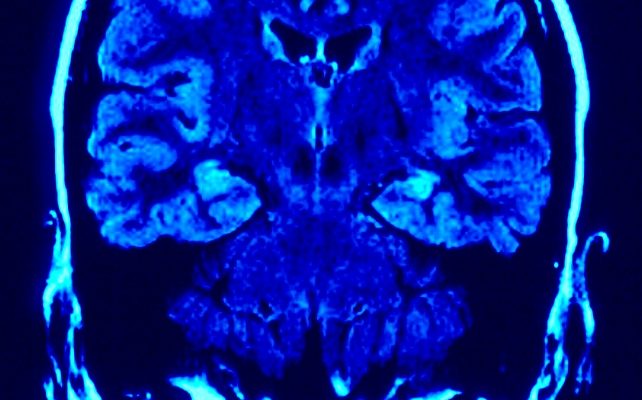
In that video the journalist’s brain is lit up like a Christmas tree .. whle the champ’s brain is virtually silent. Yet the journalist claims he’s wired in the programming to his cortical processing to run the patterns he’s running without processing them.
That’s fundamentally absurd!!! (Go ahead, read the paragraph above again.)
The argument I’m making is that what the champ did was to get his brain out of the way (okay, not his whole brain, but the part we “think” with normally … or at least consciously … the cortical brain (the neocortex).
His brain is silent because it’s not working … and even the little blips we see have little to nothing to do with what his hands are doing.
That’s not about training the cortical processing, or learning to submerge the conscious processing function.
The champ used his neocortex to train his cerebellum to take over … i.e.: his Silent Brain!
Why Performance Mastery Is “Silent”
Performance is a function of the ability to act in response and relation to the stream of data flowing in the system that you’re operating in to create your intended outcome.
The more accurately you perceive and interpret the data present in the system, the more accurately you can adumbrate what’s coming next … and, make adjustment to your responses.
Ultimately, your performance is a function of behavior, i.e.: the actions you take and don’t take in response to the way you percieve and interpret the data in the system. The more closely your actions align with the simplest, most direct path with the least resistence between where you are in the present moment and what you intend as your outcome, the more elgant, efficient and effective your performance will be … let’s call this the “Path of Perfection.”
When you can act consistently and reliably along the Path of Perfection, you will gained mastery in that behavioral performance … whether that’s mastery in sports, communication, business … or some other domain of action.
This kind of performance, i.e.: mastery, is a function of processing done beyond the reach of cortical processing … or at least solely by cortical processing.
The primary driver of mastery at the behavioral level of performance is processed in the cerebellum.
This is the seat of the silent processing we see in the video of the champ’s brain …
He’s not showing activity in the neocortex, because he’s off-loaded the processing to the cerebellum and gotten his cortical processing out of the way of his faster, more elegant cerebellar processing.
Blind But Not Dumb
The cerebellum may be blind, but it’s not dumb.
Cerebellar processing operates differently from cortical processing because it’s non-representational.
We see this when the champ puts on the blindfold and still runs the behavioral performance as well as when he’s not blindfolded. Although he’s not getting any visual input his motor facilities still function as accurately in the task he’s trained them to do.
He’s using a combination of kinesthetic input and spatial mapping to function at that level of performance. This is the magic of training the vestibular and proprioceptive systems to take over for the more common sensory system processing task, e.g.: looking at the cups, his hands and what he’s doing with them.
The silence of the cerebellum is it’s trick. The cerebellar processing pathways are more efficient because they are closer to the direct sensory data. The cortex almost immediately transforms direct sensory data into representations, abstractions and intellectualizations … at least one step removed from the actual data itself.
One of the most obvious examples, especially if you have yet to master something at the level of the world cup stacking champion (5 seconds for that whole routine, again and again, even blindfolded) … is the transformation of direct emotional experience into an intellectualization. Anger, joy, grief, ecstacy … all have an actual body experience, a felt sense … but the way the average person experiences their emotions has as much or more to do with the associations they make with the way they label their experience.
Cerebellar Training & Learning
The basis of virtually all the work I do is framed in relation to moving unnecessary cortical processing out of the way of performance.
This is not saying there is no place for corical processing, of course our neocortex is one of our most amazing evolutionary gifts … but, all things at the right time and in the right place … preferencing cortical processing over all other kinds of “thinking” or kinds of neurological processing.
The real “trick” is knowing how to get the cortex out of the way, freeing it to do what it does best … i.e.: make connections in time and space that don’t yet exist … creating future memories.
To do that the behavioral part of performance must be off-loaded whenever possible to the more efficient cerebellum.
When the cerebellum is in charge of responding there is a direct line to taking action, that cortical processing must run through multiple channels to get to first, creating a slower, more cumbersome response.
For some people (especially those who remain untrained) in getting through the levels and complexity of cortial processing they run out of steam before they get to action, i.e.: they find themselves unable to take action or constantly hesitating and procrastinating when immediate action would have served them (and, possibly others) best.
Knowing how to organize yourself to take action is the key to mastery.
In otherwords, if you want to attain mastery you must develop the ability to train and learn at the cerebellar level of response.
When you’re ready give me a call …
(You’ll find my contact details here: Joseph Riggio DotCom)
Joseph Riggio, Ph.D.
New Hope, PA
PS – The most effective way “cerebellar training” I’ve ever put together is my “Foolish Wisdom” group coaching program. I’m running a program in New Hope, PA in a couple of weeks on Saturday & Sunday, 16/17 April 2016.
Check out the Foolish Wisdom Workshop details here:
https://www.amiando.com/HSNIUBF.html