This website or its third-party tools use cookies which are necessary to its functioning and required to improve your experience. By clicking the consent button, you agree to allow the site to use, collect and/or store cookies.
Please click the consent button to view this website.
I accept
Deny cookies Go Back
  • Skip to primary navigation
  • Skip to main content

ABTI | Joseph Riggio International

  • Home
  • Meet Joseph
    • To Sicily And Back … A Love Story
    • JSR Short Bio & CV
    • Abbreviated CV Timeline
  • BLOG :: “Blognostra”
  • Contact
You are here: Home / Archives for Blog

Blog

The Really Big Ones …

The Really Big Ones …

by Joseph Riggio · Dec 13, 2018

Important Decisions …

You only make a few really important decisions in your whole life, the ones that are life changing.

Most people think they make important decisions every year, or month, or week … or even every day. Some really self obsessed folks think they make really important decisions every hour!

The reality is that most decisions have a very limited half-life, i.e.: the amount of time that decision lingers until you can make another decision that changes whatever happened as a result of the previous decision.

The simple reality is that virtually all decisions have a half-life of some kind, meaning they can be changed or even completely reversed as though they never happened at all.

Even getting a tattoo isn’t a permanent decision, but for now removing a finger would be, although even that decision leaves you with prosthetic options.

So when you think about it the only really big decisions, the important ones, are the ones that ripple out in space and time, affecting you in ways that are hard to comprehend completely when you make them. 

These decisions almost always have an affect beyond you and where you are standing in the moment. These kinds of decisions affect others, and usually your relationships with them. They may even affect dozens, hundreds, thousands, millions or billions of people, depending on who you are and the position you occupy when you’re making them.

But for most of us, the really big decisions, the most important ones linger most of all in our own lives, and we need to have a way to understand what they will mean to use before we commit to them.

I know a bit about making these kinds of decisions, because I have lived in the unique space of not only making my own … some remarkably successful ones and others that still linger in my life in ways that force me to relive them with some degree of regret, but I digress … I have also been privy to the decision making of clients whom I’ve stood beside when they were making some of the really big, important decisions in their lives.

Very few folks have the privilege of standing alongside someone as they make a truly critical, crucial decision in their life, and have that person turn to them and ask for advice or an opinion, one that is likely to have some weight in the decision that’s about to be made … possibly one that will change the course of a life. Yet, I have stood there, next to someone more than once, who was about to make what felt to them a life and death decision, and in a few cases was just that. And, in a few cases sometimes making that decision for more than just themselves.

I don’t think there is any more sobering experience I’ve had than those times someone has turned to me in a critical moment about making a crucial decision in their life, one that would change the course of their life and possibly the lives of many others, and asked for my advice or opinion knowing that they’d consider almost as valuable as their own personal counsel.

What You Must Know Before Making A Really Big, Important Decision:

What I’ve learned from standing in that unique space next to someone is that all decisions have consequences that extend beyond the moment you are making them in the here and now.

When you are making really big, important decisions you need to know they will have lingering consequences, and you cannot know all of them when you are making the decision.

This means you will have to learn to accept the risk of making really big, important decisions and the consequences they bring, even the unknown and unexpected consequences of the decision, or be at the mercy of having those decisions made for you by default.

The really big, important decisions don’t go away, they don’t fade and become meaningless in your life. Even when you refuse to make a big and important decision it will linger, and it will grown the stench of a rotting corpse, becoming more foul and difficult to deal with as you wait.

The most successful and fulfilled people I know share three common traits:

  1. First a kind of paradoxical one … they make all the decisions they can immediately and don’t make any decision that they aren’t ready to make until the waiting for that decision is full
  2. They include the counsel of another or others in their most important decision-making, and
  3. They own whatever decisions they make completely, especially when they don’t turn out well 

All three of these are present at all times for the really big, important decisions that the most successful and fulfilled people I know make for themselves and others, because often these folks are making decisions that deeply impact the lives of others as well as their own.

What’s most curious to me though is how most less successful and fulfilled people do exactly the opposite …

  1. They rush into decisions that could have waited and that they are in no position to make, while waiting on the decisions that need to be made and that they can make in the moment …
  2. They often or even always make their biggest and most important decisions based solely on their own counsel, neither thinking nor knowing how to engage another in helping them work through them, or not having someone in their life they can and do trust to stand in that space with and for them …. and
  3. They refuse to own the decisions they make or the consequences that come with them, always looking to blame someone else for what happened and what went wrong after the fact, it’s never their fault in their own minds, so they never get to learn from their mistakes and are doomed to making the same ones over and over again.

Now you might be reading these lists and wondering why they are so different … opposite from one another in fact.

My experience suggest that the most successful and fulfilled folks accept that life is uncertain and full of risk. They know that some risks can be avoided or mediated, and others are meaningless despite being present. These folks also know that those risks that cannot be avoided, mediated and are of great importance must be faced despite the fear they feel, and the do just that … they face what must be done directly and then they act, but only when they can and must, with the advice of trusted counsel, and the accept whatever will happen as a result of their own making.

The less successful and fulfilled people act from fear to relieve themselves of it, never really having learned to stand in it and accept that some things must be faced and cannot be avoided or mediated. They let their fear force them to make decisions they are incapable of making from how they are and where they stand in the moment, they insist on making them on their own or despite counsel otherwise from others, and in no way do they accept the full weight and responsibility of making their own decisions, because they feel forced into them by their fear and look to find a scapegoat they can blame for whatever tragic outcomes may come as a result of their own faulty approach.

I’ve seen dozens of examples of both … extremely successful and fulfilled folks who make truly high-quality decisions, and much less successful or fulfilled people who cannot seem to get out of their own way to make even moderately big or important decisions well.


What Are The Really Big and Important Decisions You’re Likely To Make?

Okay, I’m not going to give you a list, instead I’m going to give you principles you can use to make your own list.

The first principle is this:

  • Any decision you make that has lingering consequences through space and time that cannot be reversed immediately after you make it and take action on it is a big and really important decision.

Decisions of this kind include many critical health choices that you may find yourself forced to make in a moment of crisis, including who you choose to assist you and what options you take to address the crisis, whether your own or for another. Any decision that would alter the course of your life, or the life of another irrevocably is a big, important decision such as the decision to have a child, to give up a child or, to foster or adopt a child. From the first moment after you make these decisions and act upon them they immediately build momentum and compound to become big and important decisions in your life and that of others. There are also decisions to not do something that is time critical that are big and important decisions, like taking action to prevent harm to yourself or another, from something as simple as putting on a seat belt, or deciding not to drive in a severe storm if you don’t absolutely have to for something even more critical than avoiding a situation you don’t need to be in that puts you and others at risk. Make all these decisions with great care, and with the advice and input of counsel whenever you can.

These kinds of decisions also include any decision you make to harm yourself or another with grave consequence, for example anything that would cause the loss of a limb, an organ or a life. This could be from intentional self inflicted trauma, or unintentionally inflicted trauma like driving while drunk and permanently injuring yourself or another. These decisions also include setting down any path that leads to an escalation of events that cause this kind of trauma, from something as simple as not getting enough exercise or eating poorly, to taking drugs that lead to a crippling addiction, or engaging in activities with others that result in inevitable and devastating consequences like gambling beyond your means and building inescapable debt with people that must be paid, or following urges like sexual desire to places that can only end in grief for yourself and those you indulge yourself with as well. Avoid decisions of this kind at all costs if you are able.

The second principle is:

  • Any decision that requires you to make extraordinary effort to remove yourself from, change the outcome or direction of where it’s going, or how it will affect others after you make it is a big and important decision too.

Okay so we’re probably not talking about life and death here, so we a little removed from that intensity of risk and the decision making associated with it. However, these decisions do have lingering consequences and need to be made with utmost care whenever possible. An example of this kind of decision is entering into any kind of committed contract … from marriage to a professional engagement where you’ve pledged something from your time to a specific outcome you must produce or suffer the consequences if you fail to do what you’ve committed to and promised. It might also be a decision not to do something that would set you up for failure that you can avoid by saying no now. As with any big and important decision you’ll make, these kinds of decisions often require more than just simple counsel, but often professional counsel from experts like an attorney or accountant who can see the long term ramifications of your decision in way you could not on your own.

It might also be a professional decision regarding a business you own or run where you really do need the counsel of others with greater expertise and more qualified than you to make the proper decision. And, minimally you’ll want to have a trusted adviser, a personal “consigliere” of sorts in your corner for these kinds of decisions. This person can assist you in thinking through your decision, and while whatever decision you make will be your own, and as such you must own it completely, your consigliere can not only help you consider it in ways you might not on your own or from a view you that you wouldn’t take on your own, they may also be useful or even instrumental in carrying it out, or presenting it on your behalf as you spokesperson. This last bit is a masterful ‘trick’ of many elite performers creating a means of later modifying what has been said with a grace not otherwise possible.

The third and final principle for now is this one:

  • Almost all truly big and important decisions involve other people, usually people who hold a significant place in your life.

When it comes down to it the really big and most important things in your life will be about the people you care for, care about and love.

This is a key distinction about big and important decisions, it’s almost always about the people in your life.

Who you marry, the way you raise your children, the friends you make and keep company with, who you hire or work for, or work with … all these kinds of decisions involve other people. They can be and often are big, important decisions.

The think to know and remember about these decisions are that you are building a bank or good will or ill will, and you will do both in your lifetime. There is no pleasing everyone, and any attempt to do so will cause more harm than good, so get over trying. You want to know yourself and trust yourself to know when to say ‘yes’ and when to say ‘no’ to others regardless of how they will feel in the moment.

The ability to know when to say ‘yes’ and when to say ‘no’ to another person is a critical life skill you must develop if you want to live a successful and fulfilled life.

Saying ‘no’ as soon as possible is the surest way to minimize bad feelings and any ill will you will create with others. In fact becoming know as someone who says ‘no’ often and quickly gives you a tremendous freedom to do so, and makes those times when you say ‘yes’ far more meaningful.

Saying ‘yes’ is a commitment of yourself to another, and if you want to live a successful and fulfilled life you must practice living your commitments, the promises you make to others. No one hears the promise made to them by another as a casual comment, they will always take your promises seriously, until you prove to them that they cannot … then they will never take your promises seriously again. So better to say ‘no’ now, than to promise something you find later you cannot or will not follow through with and deliver.

As with all other big and important decisions the decisions in your life involving other people are often, if not always, made better by the trusted counsel of another. We are too charged around others to see them fully for who and what they are, and there is no guarantee that in this case two heads will truly be any better than one, but it does raise your odds of getting it right and your chance to make the best decision more likely.

This is especially true when the decisions involving someone is for you highly emotionally charged … either positively or negatively, love and hate are not often the best ground for making the best decisions. Yet, regardless of the counsel of others you must especially be willing to own your decisions made on the ground of love or hate.

Tread this ground with the utmost respect and humility, for here you will look back and see the biggest and most important decisions of your life.

The bank you make in the space of your relationships with others is the one you will draw from more and more as your own life force and will dwindles. You will find that you want to sit quietly with a trusted friend you’ve invested much with rather than move on to the next thing to do, the next great accomplishment in your life, when this time comes for you. Yet, will find yourself drinking alone, staring at an empty chair if you are not making these investments into the bank of life and relationships now. In these times of your life family and friends will be seen as your greatest treasure, so fill the treasure chest now with what’s most meaningful and not the trinkets many believe to be the stuff of great fortune.

As always I am humbled to have walked in this space with others who have and do trust me as one of their trusted advisers whom they look to for counsel when life shows up with these really big and important decisions, and for a few I have had the honor of standing alongside them as their personal consigliere when life showed up most critically, this is an almost unimaginable responsibility and privilege. Yet, as I scan the heavens and look to my own future, I see that these seeds I have sown have born the greatest fruit and my treasure chest is full, thank you for allowing me such grace …

Buona Fortuna and Abundanza,

Joseph
Filed Under: Blog, General, Human Systems, Life, Story, Uncategorized

Profane Coaching:101

Profane Coaching:101

by Joseph Riggio · Dec 1, 2018

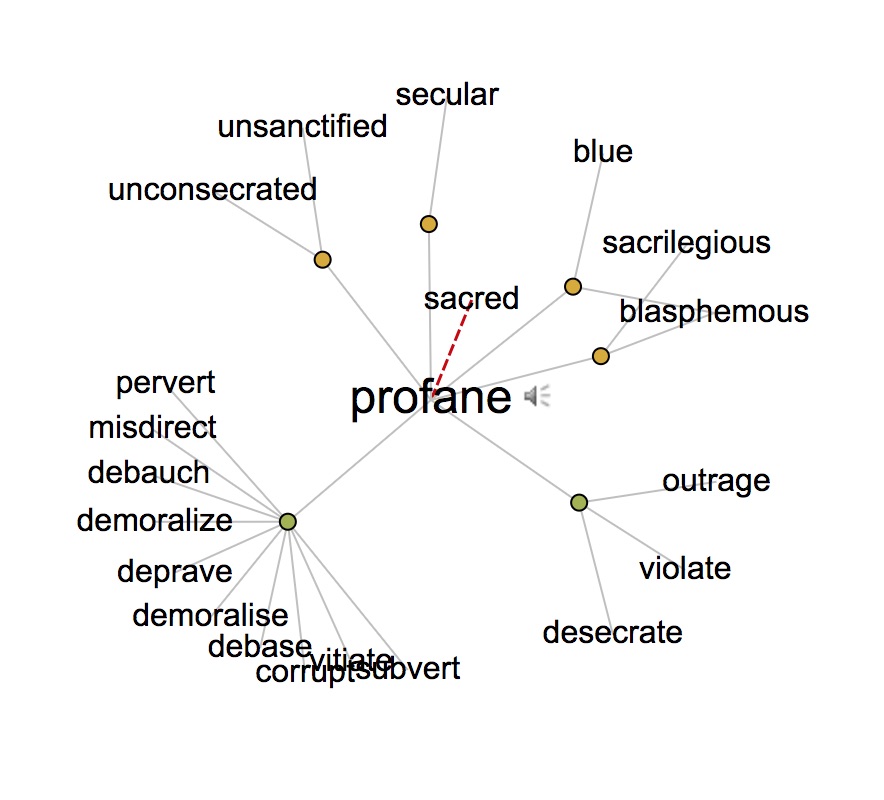
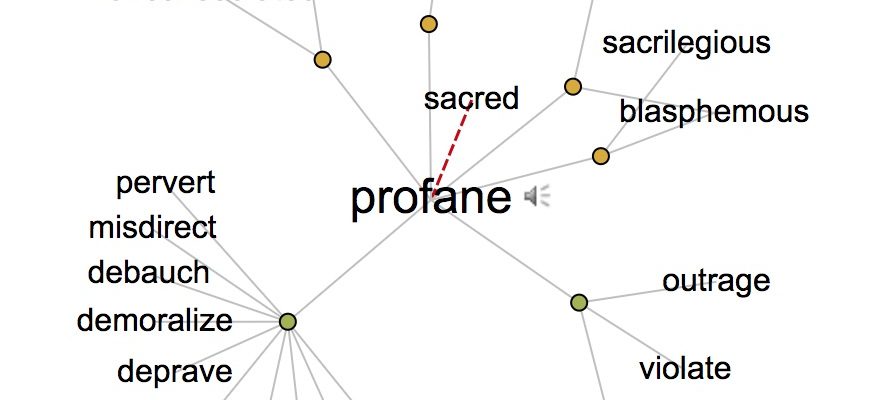
pro·fane – prəˈfān, verb: grossly irreverent toward what is held to be sacred.

Coaching often tries to present itself in one of two ways by many of the major practitioners of the craft …

  1. Socratic – very mild, gentle and nurturing, as the ultimate helping intervention that never interferes with the personal process of the individual being coached by adding anything or offering anything to them that they haven’t presented first themselves.
  2. Serious – very precise, impactful and professional, as a way to awaken and access higher levels of performance and especially interpersonal performance for executives, entrepreneurs, professionals and anyone seeking to lead others in any way.

Okay, let’s agree … those are two ways to consider coaching, and perfectly valid ones at that. Let’s also agree that it wouldn’t be too hard to find training or mentoring as a coach following one of those two paths either.

Now let’s set both of those ways of presenting coaching aside completely and look at the whole thing from another perspective entirely …

For three decades I’ve been developing an approach to working with clients that almost completely disregards the conventional thinking about coaching, and how it’s to be done with clients.

For instance here’s some of what I don’t often do …

  • Let my clients tell me about their problems/issues/challenges, I don’t need or want to know what’s wrong as the place we begin working together
  • Listen to them tell their story for too long, since it’s not the story they want to be living anyway
  • Keep my observations, opinions, and experience to myself, instead I apply all three liberally
  • Ask a lot of useless questions to establish rapport, just to allow my clients to feel they’ve been heard
  • Speak with deference and delicateness to protect my client’s sensitivity, or their shame, guilt or otherwise protected emotions
  • Treat my clients as equals in the coaching process, after all they come to me because I’m an expert not an equal
  • Mollycoddle clients or parse language, because it might offend or upset them to hear the truth
  • Try to remain professional at all times, meaning never showing emotion or revealing myself to them

That’s the short list.

It’s what makes my approach to coaching a bit “profane” so to speak (the other thing is the way I freely and joyfully use “colorful” language that may be more common coming from a stevedore than a coach or consultant – I have family in the stevedore business, so you can believe me, their language is remarkably colorful).

Here’s the bottomline right up front … my approach to coaching is a bit different, it starts out differently, it happens different, and it usually ends different too … with my clients wondering why they hell they came to see me in the first place (not because they didn’t get what they came for, but because they can’t remember what interfered with having it in the first place, or not having its all along).

My approach begins here …

WHADDA YA WANT?

It’s the simplest question in the world and one that ain’t always easy to answer.

It’s also the question you’ll get from any waitress in any NJ diner as she places a cup of strong, hot coffee down in front of you too.

The difference between me and your waitress is that she expects you to know what you want when she asks the question. If you don’t you’ll get an eye roll, and the next thing you’ll hear is, “You want me to give you a little more time honey?” as she walks away not to be seen again for the next thirty minutes (next time you’ll be ready with your order when she puts the coffee down, right?). She’s also more patient and kind than I am too.

I start already knowing that you don’t know what you want … even if you think you do. At least that’s true like 98.725 percent of the time (I just made that number up of course, but it’s probably remarkably accurate).

BUT … I also know that in answering the question, “WHADDA YA WANT?” that you have to access what it is you really want from getting what you think you want (that’s the truly secret sauce in the mix, and why I don’t listen too much to what clients have to say to me when I’m working with them).

Hey, I’m not trying to train you to be a Profane Coach here, I’m just laying out the structure a bit, so if you’re a little confused by that statement it’s okay, maybe someday we’ll meet up and it will make a lot more sense to you then.

What I’m actually paying attention to is how you are when you are answering the question.

How you are is what it’s all about!

What I mean by that is that there’s something we all access when we think about what we want, it’s the way we expect to be when we have it. This way of being is essential as well to what it take to get it, but it’s simply not available in the way of being that’s associated with longing for something that isn’t present.

You can only access what you really want when you aren’t longing to have it and thinking about how it’s missing.

Once again, this is that secret sauce I was mentioning, and to tell you the truth, most people need a little kick in the pants to let go of what holds them back from getting it.

That’s also in part what makes my approach to do the work we’d be aiming at together “profane” in the first place, I take off the kid gloves. We’ll be digging into places that are likely to be uncomfortable, but nonetheless essential to get to so we can get past whatever limits you today from having what you really want.

Let’s just put our cards on the table … what makes more way of working with clients profane is that I’m going to be intentionally provocative about pushing the buttons that normally unsettle the clients I’m working with to get to what’s beneath whatever they find unsettling.

It’s a really fascinating thing to create a context that’s simultaneously both unsettling and safe … another profane idea … that it’s possible to be both intentionally unsettling, provocative and disturbing in a coaching setting, and create a space that’s undeniably safe to explore the themes we’ll be discussing within.

What’s so powerful here is that the “secret sauce” reveals the underlying code that you use to access yourself at your best, when you are beyond being plagued by any limitations that prevent you from achieving what you intend and deeply desire.

The “Profane” Somatic Code

This “code” is somatically organized, held in the way you use your body at the micro-muscular level, literally the way your body prepares to respond before it even does.

Many somatic approaches address the idea that they way you use your body profoundly influences how you think, how you respond and what you do. Most of these somatic approaches look at the more gross movements and postural adjustments that we make and how these are affecting us in other ways beyond the question of the movements themslves.

At the core of the “profane” approach I use is going to movements that are so small that they are almost imperceptible … almost. Truth be told, these micro-muscular movements are in fact imperceptible from the outside, but they can be reverse engineered by the movements that emerge from them.

Once you know how the human body works you can figure out what has to happen for whatever you’re experiencing, or observing, at the level of micro-muscular pre-movements to happen. For arguments sake we could be pointing to individual muscle fiber twitches.

There’s another presumption in approaching coaching profanely, that the semantic structure, i.e.: the structure of meaning we create from what we perceive and the sense-making that arises from it, arise from the somatic ground of how we are within ourselves … literally the way we are in our bodies.

This is a profane concept to all those folks who hold the mental processes above or superior to body-based processes. Yet, within the consideration of the profane approach I’m outlining here what arises first in the body is considered at least equal to, and often superior to, what we become aware in mind … and, always ahead of the language we use to describe it.

This is a really big deal …

By being “profane” with you, you’ll get to what you won’t on your own, because you’d avoid it otherwise … either intentionally or unintentionally … but, with the right kind of provocation, the right kind of push, you’ll go where you normally won’t on your own.

This way of coaching isn’t for everyone … either coaches or clients, but it may be something you’d want to explore as a coach to add into your snatchel of tricks, or as a client to get past whatever it’s been that you keep bumping up against and ordinary “pedestrian” respectful approaches can’t bypass.

I’d love to hear from you with you’re thoughts about being “profane” as someone who works with clients … or, as someone who’d consider working with a “profane” coach.

All the best,

Joseph Riggio, Ph.D.
Architect & Designer of the MythoSelf Process, SomaSemantics and Generative Flow

Filed Under: Blog, Coaching, Transformational Change & Performance, Uncategorized

This Ain’t No Zen!

This Ain’t No Zen!

by Joseph Riggio · Jun 27, 2018

If it ain’t Zen, WTF is the MythoSelf Process then???


Essentially the MythoSelf Process is the “the ability to freely play and take action” it’s about “being childlike and creative in the way you experience, approach and show up in the world” … but, it ain’t Zen, or any other frackin’ thing either … we’ll come back to all this, but first we need to lay some groundwork.


Sometimes folks who come to experience the MythoSelf Process or to learn “how to do it” meaning that they want to become proficient in running the process with others as well as for themselves, assume that the MythoSelf Process is “like” Zen or something.

Here’s the first rule of the MythoSelf Process (NO! The first rule of MythoSelf is NOT: “You do not talk about MythoSelf.”):

The first rule of MythoSelf is: “THIS IS NOT THAT.”

Let’s start there things are themselves, i.e: what they are, no more, no less and not “LIKE” something other than themselves, regardless of what we’re referring or pointing to, things are just themselves … objects, people, places, events, ideas, and yes, the MythoSelf Process is just the MythoSelf Process … it ain’t Zen (or any other bloody thing you can imagine in the distortions of your mind “it’s LIKE” … ‘cause it ain’t!).

Okay, so then what “IS” the MythoSelf Process???

The MythoSelf Process is dynamic, i.e.: it’s a process:

proc·ess

ˈpräˌses,ˈprōˌses

noun

  1. a series of actions or steps taken in order to achieve a particular end.”military operations could jeopardize the peace process”synonyms: procedure, operation, action, activity, exercise, affair, business, job, task, undertaking”investigation is a long process”

The MythoSelf Process “happens” (NOTE: it’s never “DONE” to someone, it “HAPPENS” with someone or a group of people).

The MythoSelf Process reveals what we call the “source code” that a person uses to know themselves to be alive. It uses an “if/then” algorithm, “if THIS, then THAT” … if “this” is present then I am alive.

This is the essence of awakening, becoming aware that you are alive, you are present, this is happening right here, right now … and you are able to remain present to it as it unfolds and is coming into being, moment by moment by moment responding to what “IS” …

”Like THIS …”

We often say, “Like THIS …” as a way of referencing what is present that acknowledges the presence of being alive to the individual experiencing the “this” of their own internal awareness.

Unlike many other approaches to “awakening” the MythoSelf Process bases the way to awakening in the experience of the body, the somatic experience, or how you notice yourself being in your body in this moment right here, right now.

Ultimately with training and experience you become able to track this experience almost unconsciously, but fully competently, making adjustments and compensating to be at your best at all times … or at the very least to know when you are not, and give yourself permission to get back to yourself before you make any major commitments or take any major action. (We usually recommend, “WHEN IN DOUBT, DON’T!”)

Signals in the System

The skill I’m referring to above is a subtle awareness to notice for the way you are in your body, or how your body is responding in the moment to what we call “The Signals in the System” or all the stuff that’s happening right here, right now, including all the stuff that’s happening internally for you … your thoughts, how you feel, where you are tense or relaxed, what urges you’re feeling, all those internal signals are part of the totality of what we call the signals in the system.

What you need to get for now is that the signals in the system we’re mostly concerned with are the ones that mostly go unnoticed, e.g.: what’s not being said, or the breeze that’s blowing as you’re thinking about how to invest the inheritance you just found out about from your great uncle George, or whatever. Signals in the system points to that stuff in the background, that’s there not just imagined or projected magically, but so often is left out of the calculation of what’s going on and how that’s affecting you and how you’re responding to what’s happening.

Okay, that might sound like a lot to keep track of, we know. Here are a couple of things that might help you relax about all the possible signals in the system that you could be noticing for:

  1. You don’t need to do anything about the signals in the system, just let them be for now
  2. You don’t need to even pay any particular attention to the signals in the system, as long as you know they are there even when you are not paying attention to them

What you do want to do about the signals in the system is pay attention to the ones you do notice!

If something stands out from the background to you, regardless of what it may be or how insignificant it may seem, just agree with yourself to notice it … trust us, there’s a reason you noticed it, there’s a reason your system responded to it. Now immediately check how you are in yourself, what are you doing in your body?

The easiest way to learn to check what’s going on within yourself, what you’re doing with your body, is to check for where you are holding any kind of tension. For now try to relax that tension and notice what happens as a result. You’re not trying to make a change in terms of what you notice, other than relaxing wherever you find tension in your body. Then, just notice what you notice. If it’s nothing, let it be. If you find you’ve changed the way your thinking, or what you’re thinking about, or how you’re feeling … or, if a sudden seemingly random thought pops up in mind … pay attention to that and consider what it means to you in terms of adjusting how you’ll respond to whatever is going on as a result of noticing what came up for you.

Eventually, with practice and some discipline, you’ll begin to “notice for” the signals in the system automatically, and the “distance” between the incoming signals as well as you internal signals, and your response will be virtually nonexistent, essentially you’ll begin to respond instantly and highly effectively with regard to moving in the direction of the outcomes you intend.

Taking Action … Playfully

So this brings us full circle.

When you are able to be present to what’s happening in the moment … right here, right now … you’ll find you’re able to respond to things in a way the feels like playing, as well as instantly and effectively, regardless of the context or circumstance.

This is the beginning of freedom, i.e: the freedom to take action.

Most people experience times where they are hesitant, or get caught and freeze, or maybe they wish they had responded differently after the fact.

Yet, when we watch children at play, while they may not like the outcome they seldom if ever go back and think, “I wish I had done that differently.” or get stuck in their play unable to act at all. They simply act out of their innate nature.

This is the idea of what we mean by becoming “childlike” … having access to your innate, natural way of taking action freely.

When you “arrive” at the point where you are both able to track the signals in the system in regard to your intended outcomes and you also have the ability to respond creatively, as though you are at play, you are free in a way very few adults will ever experience.

This is essentially what the MythoSelf Process leads to … “the ability to freely play and take action” it’s about “being childlike and creative in the way you experience, approach and show up in the world.” …

So, when someone asks, “Is the MythoSelf Process like Zen.” I get how they can be confused … but, regardless of where there may be similarities, THIS ISN’T THAT.”

If you are interested in learning more about the MythoSelf Process I’ve got a short video I made here: MythoSelf Professional Training

All the best,

Joseph Riggio, Ph.D.

Architect & Designer of the MythoSelf Process and SomaSemantics

P.S.: If you’re also interested in getting trained in the MythoSelf Process yourself you can also get that information here as well: MythoSelf Professional Training

Filed Under: Blog, Elite Performance, General, Human Systems, Transformational Change & Performance, Uncategorized

L’Chaim …

L’Chaim …

by Joseph Riggio · Mar 22, 2018

“To Life …”


This morning I was inexplicably brought back to a memory of sitting on a small bench overlooking the bridge that crossed the pond at the Blue Dell Farm in Pemberton, NJ during a break, while at an NLP training with Roye Fraser. I’d gone there to study NLP with him, and discovered he was weaving a magical score with something he called “The Generative Imprint” using NLP to deliver and train in this model of transformational change he’d been developing for about a decade at that time.

This was an unusual way to teach NLP, not by a series of exercises to teach either concepts or techniques, like representational systems or swish patterns, but in what he called “wholeform” (something I’d come to appreciate more as I delved into the work of the quantum physicist David Bohm).

We’d all sit in the “Hypnotorium” Roye’s name for the room we worked in with him, that was a converted mechanics garage on the property he owned there in Pemberton. Roye would begin talking about something, then he’d ask us all “What do you want?” and someone would say or do something that would catch his attention and he’d “bring them up” … meaning he’d bring them to the front of the room and begin working with them. Not demonstrating a concept or technique, but using concepts and techniques to create profound transformational change with whomever he’d brought up tot he front.

Then we’d be instructed to “Go do the exercise.” … and, everyone in the room would be like, “What exercise?!!???” (even though the exercise was clearly spelled out on a flip chart with steps to take to do whatever it was that we’d be working on at that moment) … because, we’d just seen a seamless flow of concept and technique customized to the exacting needs of an individual that no one there at the time could hope to replicate. So we’d walk off, spellbound, to do our best to “Do the exercise.”

It was in the Hypnotorium with Roye that the phrase, “L’Chaim” uttered in a deep, resonant, voice with a ting of a South African accent, usually proceeded or followed by a deep, roaring burst of laughter, became etched in my mind.

“L’Chaim!” … TO LIFE!

The work Roye did was about “LIFE!” … discovering the wonder and joy of being alive … fully, completely and with abandon.

I took this on in my years of apprenticing with Roye, dedicating myself to helping others find for themselves “the wonder and joy of being alive … fully, completely and with abandon.”

“L’Chaim!”

Many times since those early years I myself uttered that phrase after completing a piece of work with someone … often to Jewish clients I’ve had who I hoped would recognize my toasting their new awakening to themselves, sometimes to gentiles like myself who I hoped would recognize the intention if not the literary meaning of the phrase.

A way I’ll often end a piece of work, or a training session, or even many of my posts is with the bastardized Italian-American, “Buona Fortuna and Abundanza!” … which I state as a prayer and a blessing, i.e.: “May you have good fortune and abundance in your life.” (there is no word “abundanza” in Italian, the Italian word is “abbondanza” meaning “plenty”).

Another phrase I picked up from Roye was his colorful way of sending folks off, “Go forth and fructify.” … said with a glint in his eye and a conspiratorial tone to his voice.

fruc·ti·fy

ˈfrəktəˌfī/

verbformal

verb: fructify; 3rd person present: fructifies; past tense: fructified; past participle: fructified; gerund or present participle: fructifying

1. make (something) fruitful or productive.

◦ bear fruit or become productive.

Origin:

Middle English: from Old French fructifier, from Latin fructificare, from fructus ‘fruit.’

You may think, “Ahhh, this Roye fellow was a very playful sort!” … and you my friend would be correct. But, you’d be missing the deadly serious side of him. He was playful only in respect to achieving the outcome, i.e.: to lead his clients to living their lives … fully, completely and with abandon.

More than anything that’s what I got from my years with Roye, first to, “ live my life fully, completely and with abandon” and then to commit to this as the first principal of the work I learned with him as I share it with others.

After some years I began to bring my own approach to this work to life, the MythoSelf Process. This model was born from drawing on some distinctions that came from my own personal history and the study of other intellectual and transformational giants … folks like the renowned mythologist Joseph Campbell, and the masterful somatic practitioner Moshe Feldenkrais, and seeing how our life stories are carried within us in word and deed.

I began to develop a unique way of working with folks using both transformational stories and subtle somatic interventions to shift the fundamental position of perception and decision making of the clients I work with today. This way of approaching transformational change that leads to breakthrough performance emerged from that early work I began learning with Roye in the Hypnotorium.

Roye taught me to attend to gross and subtle “idiosyncratic movement” aligned with “ideomatic phrases” … individualized ways people express something that is not easily captured in language and is highly unique to them personally. From this early training I began to notice something more about what I today refer to as “micro-muscular response” and “dynamic patterns of movement” … the basis of the Soma-Semantics model I’ve been developing and refining for the past thirty years.

In my observations with clients over tens of thousands of hours of doing work with them in training rooms, groups and one-to-one private work, I’ve noticed how deep values that guide perception, decision making and behavioral responses are reflected in the way the body configuration adjusts to reflect the mind of the individuals I’m working with irrefutably and absolutely.

As a person accesses these values, that are the basis of their personal identity, i.e.: what’s most meaningful to them before any conscious awareness or processing take place, they automatically and irrevocably make somatic adjustments that are the physical manifestations of what they are accessing.

The resulting somatic pattern generates a state change, or a way of being, that is consistent with the values and identity position they have been accessing.

This is a physical declaration of themselves, like a bold pronouncement, “I AM THIS!” … or at a more fundamental level of awareness that is barely conscious for them most of the time, “I AM!”

This then becomes the basis, or the ground, from which all the work that proceeds is built upon.

From this most fundamental, unspoken declaration of “I AM!” we work to extract the narrative form in story and in idiom, often expressed in paradoxical form, e.g.: “supple steel” … “calm intensity” … this is the semantic expression of the Soma-Semantic pair.

When these are firmly inhabited they individual who possesses them has the basis for accessing how they know themselves to be alive in the most fundamental and primal way possible (NOTE: to get here takes a bit of expertise and tradecraft).

This has now become the starting point … beginning the journey that follows, remaining always grounded in and tethered to the fundamental distinction of being alive …
fully, completely and with abandon …
—
“L’Chaim!”
.

It’s not always so easy for clients who haven’t yet experienced the wholeform way of learning that is the basis for the MythoSelf Process and the Soma-Semantics model to see the value of investing in getting to this fundamental position from which to live their life.

Far too often folks are consumed with the urgency of the immediate …

– resolving some crisis that has arisen

– paying the bills

– sending the children off to school

– getting the next promotion, contract or client

– growing their business or practice

– caring for an elderly parent

– insuring their own future or legacy …

whatever is staring them in the face in the moment.

Yet, doing all these things, even extraordinarily well, will not bring you peace or peace of mind. These things will not satisfy the deep existential and ontological longings you have to know and live your purpose, and to fully manifest and express all you are capable of being.

And, despite the deep, compelling call of the adventure Jospeh Campbell speaks of in the Hero’s Journey … i.e.: to become fully human and realize yourself in all your magnificent splendor … most folks will pursue the urgent and trivial at the cost of the significant and substantial.

But, I persist because I have seen the difference that establishing the fundamental awareness and access to this way of being makes in every other moment of one’s life.

Instead of trying to “get somewhere” the basis of the work I do with clients is to have them stop where they are and experience themselves in this moment … fully, completely and with abandon.

This is difficult, I know.

To simply slow down enough to face yourself and come to the complex realization of where you are, how you and who you are in this moment … before rushing off to the next thing, or just proceeding to get on with your life.

However, all the accomplishments, achievements and accumulation of wealth and material success in your life will never satisfy you if you are missing this fundamental grounding in being fully , completely and with abandon present to yourself and your life as it is … right here, right now.

Then you can make the essential and substantive decisions you need to that will both satisfy your existential and ontological longings, giving your life meaning, purpose and direction … and, also ”get on with it”, knowing that where you are aiming yourself is a destination worth arriving at in the end.

Not having this one distinction in place keeps virtually everyone stuck without the hesitation, concern, worry, anxiety or fear that stops them from being able to “get on with it” … and create the life they desire and dream of for themselves, and those they care about and love.

Even when all the other pieces are seemingly in place, ignoring this crucial foundation for everything else will leave you at the top of having climbed the wrong ladder, and possibly with no way of getting back down to start over or the time left to do it if you could.

In fact, the greatest challenge is having enough success to dig in and fortify the position you’ve established, even when you sense that the peak you’re standing on isn’t one that serves you or those you truly care about and love.

Here’s the good news …

I’ve worked with enough folks, from 5 – 95, to know that remembering the deep call to life … your source code to living fully, completely and with abandon … is available to you regardless of where you find yourself standing today.

You may have to give up some of what you have, to get what you truly and deeply want, but the reward is worth the sacrifice every time.

The realization of yourself, and the potency of action that comes with that release, will allow you to build the significance and substance you desire in your life, both on your own and with others.

If you are ready there is a way …

“L’Chaim!” … it’s still ringing in my ears after all this time.

With grace and humility,

Joseph Riggio, Ph.D.
Architect & Designer of the MythoSelf Process and SomaSemantics

(On a snowy morning from) Parsippany, NJ

P.S.: If you’re interested in exploring experience Foolish Wisdom with me live in Lambertville, NJ, 2-days Live, Saturday & Sunday, 31 March/1 April (or join me for just one day on Saturday, 31 March).

Find out more: Foolish Wisdom
Let me know what you think otherwise in the comments below or by sending me a private message …

BUONA FORTUNA AND ABUNDAZA!

Filed Under: Blog, General, Human Systems, Life, Mentoring, Story, Transformational Change & Performance, Uncategorized

Thinking Small

Thinking Small

by Joseph Riggio · Mar 16, 2018

“I bury the bone so deep that the dogs have to scratch for it.”*

I admit it, I’ve always had a hard time thinking small. Some folks are great at it though. They use small words and a just a few of them to express magnificent and expansive ideas. Not me.

I tend to be wordy. My sentences run on … and, sometimes on. And, if there’s not a big word to express what I’m thinking and trying to say, I just make one up on the fly. I’m like that. I think that “free speech” means what it says, and I should be free to speak even that which hasn’t existed before I spake it.

In fact that’s the heart of the matter. As fish swim in water, we, i.e.: humans, homo sapiens sapiens, swim in language. Words. And, more words. Life is filled with wordiness for humans.

All that so far is okay. It’s okay to think small. It’s okay to be wordy. It’s okay that humans swim in language.

It’s the “belief” thing that gets us every time though. The idea that the words we read, and the words we hear, and the words we write, and the words we speak are “true” … or, represent what’s “real” … when in fact words are words and nothing more.

The words aren’t the thing they point to at all. The word “love” isn’t “love” any more than it’s a fish. But, that doesn’t mean that words aren’t powerful, they are indeed. Words bring worlds into being.

G. Spencer Brown, in his book, ”Laws of Form” speaks of universes coming into being when “… a space is severed or taken apart.”

The theme of this book is that a universe comes into being when a space is severed or taken apart. The skin of a living organism cuts off an outside from an inside. So does the circumference of a circle in a plane. By tracing the way we represent such a severance, we can begin to reconstruct, with an accuracy and coverage that appear almost uncanny, the basic forms underlying linguistic, mathematical, physical, and biological science, and can begin to see how the familiar laws of our own experience follow inexorably from the original act of severance. The act is itself already remembered, even if unconsciously, as our first attempt to distinguish different things in a world where, in the first place, the boundaries can be drawn anywhere we please. (page v)

Now, imagine if you will, that language severs the wholeform of reality by imagining it’s “parts” as independent and distinguishable by virtue of the idea that they can be labeled, i.e.: named, bringing into being a new universe each time a new word, specifically a noun, is uttered or written, contained within the universe that remains unnamed and residing next to all the universes that have been named, including all those things named, and labeled by the names given them, which don’t exist.

Which brings us to the point of my rambling.

For many years I’ve striven to present what I do as simply and naively as possible. Alas, as I’ve said though, I am not a man of small thinking, or for that matter small words.

I believe my fault lies in thinking in wholeform, i.e.: I have trouble perceiving the boundaries that sever spaces into separate universes. This leads to expansiveness in all ways, including the wordiness of which I am at fault. For what it’s worth I think the British polymath I’ve quoted above, G. Spencer Brown got this idea stuck in his head (or at least his writing) too, despite his writing about the opposite.

”In this sense, in respect to its own information, the universe must expand to escape the telescopes through which we, who are it, are trying to capture it, which is us.” – G. Spencer Brown, Laws of Form

Stay just a little bit longer

(Musical Interlude)

Oh, won’t you stay just a little bit longer

Please, please, please, say you will

Say you will

(Jackson Browne – “The Load Out – Stay” from the album Running on Empty)

Okay, back to the main point or as Professor Rodríguez from my first doctoral program was found of saying, “Keep the main thing, the main thing!”

As simply put as I can put it, what I do is lead people back to a wholeform consideration of the universe to help them get their heads right.

Literally for years I’ve been trying to simplify what I do, in terms of form, i.e.: how I do what I do … or the pragmatics of it. This led me down many paths and alleys.

As a result of this journeying I’ve developed many programs, and mini-programs, and models, and techniques … all in the service of this one thing, looking for the holy grail of transformational change, the philosopher’s stone or alchemist’s prima materia of the Change Artist.

(AUTHOR’S NOTE: For what it’s worth I think I may have stumbled upon it, but as Lao-Tau says in the Tao Te Ching,

Tao (The Way) that can be spoken of is not the Constant Tao’ The name that can be named is not a Constant Name.

Nameless, is the origin of Heaven and Earth;

The named is the Mother of all things.

Thus, the constant void enables one to observe the true essence. The constant being enables one to see the outward manifestations.

These two come paired from the same origin. But when the essence is manifested, It has a different name.

This same origin is called “The Profound Mystery.”

As profound the mystery as It can be, It is the Gate to the essence of all life.

http://www.with.org/tao_te_ching_en.pdf)

However, as a result, I’ve become as the ouroboros, swallowing whole the circle of infinity, and realizing in the process neither an end or a beginning. And, so I come back to the start of all things.

The beginning and the end are the wholeform, from which all separate universes are cleaved, but despite the severing remain whole nonetheless.

This was always the essence of the MythoSelf Process model and work.

BUT … to do this, as the sacred work I perceive it to be, i.e. leading a person back to themselves uncorrupted and complete, requires losing all other intentions or distortions along the way.

There can be no intention beyond arriving at the wholeform, having removed all the distinctions that create separate universes, and in turn separating ourselves from ourself.

So, “mea culpa, mea culpa, mea máxima culpa” I got both distracted and became disingenuous about the nature of the work at hand.

The MythoSelf Process work was never “about” something other than itself, i.e.: encountering the wholeform that is the *all and everything.

So my apologies for any suggesting otherwise. In other words that I may have misled you to think this was “about” something, e.g.: being happy, or getting wealthy, or having great relationships, or any other damn thing beyond the main thing, which of course is everything.

But, for whatever it’s worth, I’m back at the core of the work, but with a vengeance, having spent far to much time searching in vain for what it was not.

I guess I said it long ago, but had not the ears to hear myself …

“This is NOT that!”

With a few folks who have stuck around and become trainers and master trainers of the work, as well as some folks who are otherwise masterful in their own ways within the scope of the work, I will be offering both “MythoSelf Experience” 3-day programs and a full year-long MythoSelf Professional Training presented over three four-day modules in a few places in the upcoming months.

If you’d like to get on my list about these opportunities either drop me a note in the comments below, send me an email at joseph-AT-josephriggio.com, or PM me on Facebook (https://www.facebook.com/josephriggio) if you prefer.

I’d love to read your comments about where you are with my unfortunate wordiness below …

Best,

Joseph Riggio, Ph.D.
Architect & Designer of the MythoSelf Process and SomaSemantics

P.S. – In the meantime if you’d like to experience the MythoSelf work with me directly in a small group setting I’m offering a “Foolish Wisdom” workshop this month in Lambertville, NJ, you can find the information here:

Foolish Wisdom in Lambertville, NJ – MARCH 2018


Filed Under: Blog, Coaching, General, Life, Mentoring, Mythology, Transformational Change & Performance, Uncategorized, Upcoming Events, Workshops

The Skeleton Key To Transformational Performance

The Skeleton Key To Transformational Performance

by Joseph Riggio · Jan 17, 2018

Why We Focus On Neurocognitive Developmental Training As The Basis Of Instigating Transformational Change And Peformance Breakthrough

At each stage of human existence the adult is off on his quest to his Holy Grail, the way of life he sees by which to live.
– Clare W. Graves


Because people get stuck when the worldview they are using doesn’t accommodate the outcomes they intend … they need a way to get out of their “stuck state.”

Neurocognitive Developmental Training provides the skeleton key that unlocks the mystery of success.

This is the essential and most rewarding reason “WHY” it makes sense to get Neurocognitive Developmental Training (NDT) … but, once you dive down the rabbit hole you’ll find so much more that will be valuable to you too.

Neurocognitive Developmental Training is all about building “(Human) Adaptive Intelligence” – i.e.: the ability to adapt your thinking to the situations and contexts you encounter and are engaged in at any given time.

When you put your attention on it, you’ll likely recognize that what I’m calling (Human) Adaptive Intelligence, or (H)AI, is an innate trait of almost everyone you’ve met and know, including yourself. However, you may also simultaneously recognize how most folks avoid “adapting” their way of thinking, or probably more frequently reach the limits of their capacity to adapt rather quickly.

So, why is it, if we all seem to possess the ability to use adaptive thinking, that we don’t more naturally, frequently, and easily do it?

I’d argue it’s because it makes us uncomfortable to operate outside of, or beyond, our most familiar ways of operating, in this case thinking and acting.

This is the clearly identified and documented psychological “Cognitive Dissonance Theory” …

attitude change cognitive dissonance cartoon
Cognitive Dissonance: https://www.simplypsychology.org/cognitive-dissonance.html


Essentially this theory states that people will avoid whatever is unfamiliar, and when they cannot make sense of the unfamiliar create a rational reason to explain what is unfamiliar within the boundaries of their current Model of the World, i.e.: their way of perceiving and making sense of the world around them, including their current beliefs and values.

Simply stated, Cognitive Dissonance Theory, suggests that people would rather live with discomfort and/or dissatisfaction, and continue to fail at succeeding in the ways the claim to most desire, than have to change their beliefs and values to match the situational and/or contextual evidence they confront, i.e.:

Therefore, unless AND until someone shifts the Model of the World they are operating from, they will keep repeating the same challenges they have confronted in the past, and fail to make the changes in their life would allow them to succeed, but cause them instead to continue failing in the same way that they always have in the past.– Joseph Riggio, Ph.D.

This presents people with a huge limitation in getting what they want, yet people will still avoid updating their Model of the World even when they recognize and know that’s what’s required of them to get what they want, and to find satisfaction and peace in their lives, all because the discomfort of making that change seems to them in the moment more disquieting and unreachable than not having the satisfaction and peace of getting what they deeply desire feels like to them now.

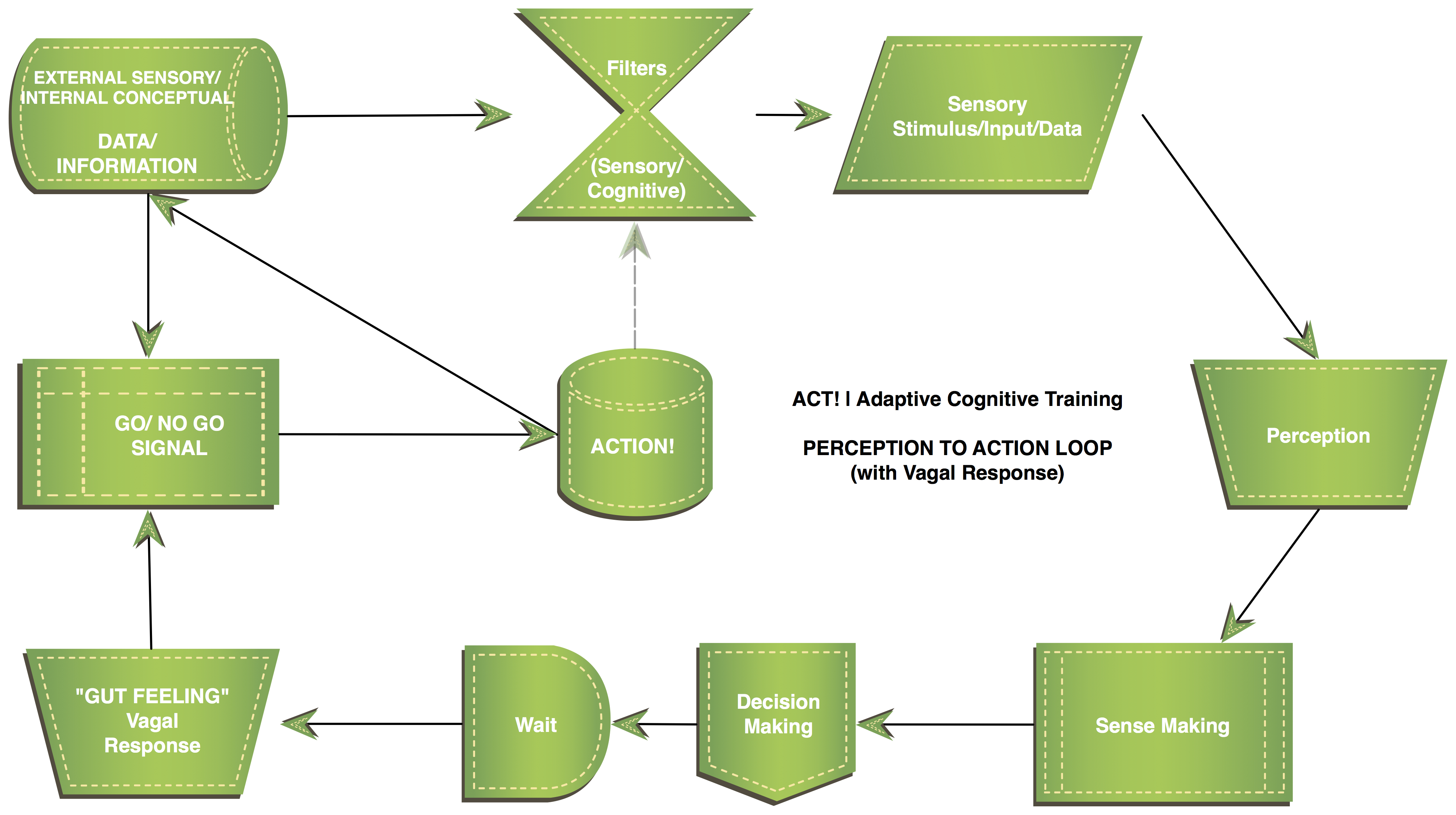
Ultimately most of us operate off of well established patterns of neurochemically and neurophysiologically ingrained behavior. These patterns arise in us as “GO” or “NO GO” signals.

Our “GO/NO GO” signals are actually organized somatically as well as psychologically, originating for the most part as shifts in our vestibular and proprioceptive systems, literally we “feel” in or out of balance, and like we’re stuck or motivated to take action.

This is deeply connected to the idea of  your “gut response” … that feeling in the pit of your stomach when you know something is wrong and it makes you a bit queasy or nauseous, or when something is very right and you feel a tingling warmth about it in your belly.

Most people have learned to override this primitive, instinctual system designed to serve as both an “early warning system” as well as a “alert system to opportunity” by processing the “signals in the system,” i.e: the data that’s present, rationally or logically instead.

So they lose out on the benefit of learning how to trust this ancient system of response that is designed to protect and serve them.

We now know, through recent neuroscientific research, that the “vagal pathway” a system of nerves that is dominated by the vagus nerve that runs from brain to the digestive organs, controls much of what we have historically thought of informally and colloquially as our “gut response” … that innate way of knowing what is bad or good for us, before we even have time to think about it.

Here’s a short list of some of the ways the vagal pathway is involved in our health and sense of wellbeing (http://upliftconnect.com/12-ways-unlock-powers-vagus-nerve/):

Vagus nerve dysfunction can result in a whole host of problems including obesity, bradycardia (abnormally slow heartbeat), difficulty swallowing, gastrointestinal diseases, fainting, mood disorders, B12 deficiency, chronic inflammation, impaired cough, and seizures.

Meanwhile, the vagus nerve stimulation has been shown to improve conditions such as:

  • Anxiety disorder
  • Heart disease
  • Tinnitus
  • Obesity
  • Alcohol addiction
  • Migraines
  • Alzheimer’s
  • Leaky gut
  • Bad blood circulation
  • Mood disorder
  • Cancer

So you can see that we’re looking at a very significant part of our nervous system as it affects us.

What I’ve found in my work with people is that the “GO/NO GO” signal we experience is also part of the vagal response system, and that it links to our vestibular (sense of balance) and proprioceptive (sense of self/movement) systems, the very thing that gives us the feelings of either being stuck or being motivated to take action.

As far as I can tell from my work with thousands of clients this function of the vagal response system is deeply intertwined with the Neurocognitive Developmental Level you are operating from as well. Literally, where in your brain you preference when you are noticing information in the environment, making sense of what you notice, making decisions based on what you perceive, and taking action based on the decisions you make.

Using my unique Neurocognitive Developmental Training technology, ACT! | Adaptive Cognitive Training, you can literally update your vagal response to be more resilient and effective in aligning your “GO/NO GO” signals to the actual signals in the system and the outcomes you want to achieve.

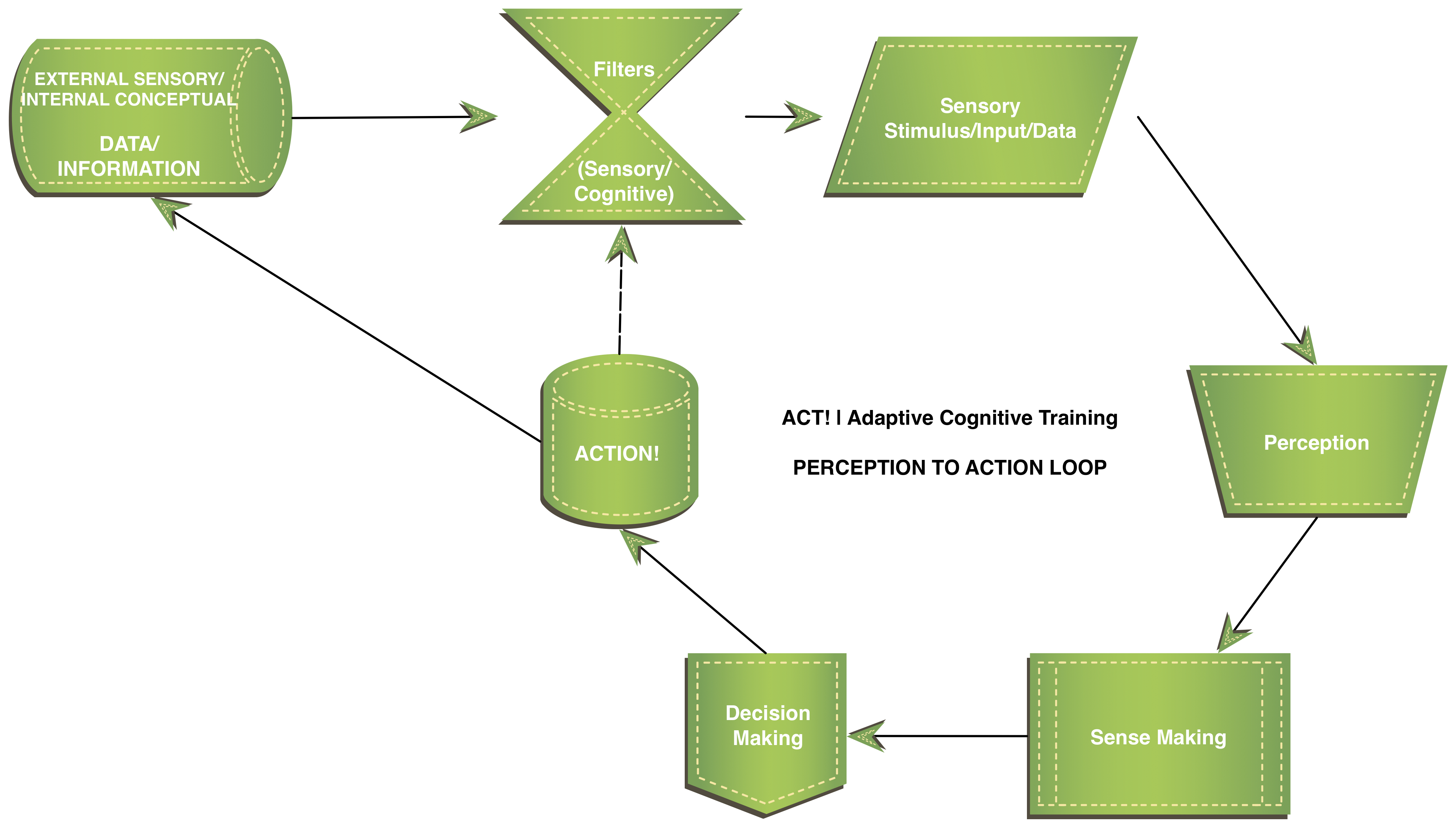
In the ACT! | Adaptive Cognitive Training model, I refer to the chain of processes from Sensory Perception to Sense Making to Decision Making to Action Taking, as the “Perception to Action Loop” in part because it’s both iterative and recursive, updating as it “loops” on itself.

Here’s a look at one way of graphically representing this system:

[File Download: ACT-PerceptiontoActionLoop]

If we add the ‘GO/NO GO” signaling process that operates through the vagal pathway the model might look like this …

[File Download: ACT-PerceptiontoActionVagalLoop]


In part, updating the Neurocognitive Developmental Level you’re operating from by default updates what you’re noticing for and how you notice for it in the environment – what I call your Perceptual Filters, and the way you make sense of information – what I call your “Sorting Patterns” … this has the effect of changing the decisions you make and the action you take, because you are noticing different information and making sense of it differently as well.

A simple example of this would be whether you are noticing for risk or opportunity, the sequence in which you do that (assuming you can notice for risk and opportunity), and the way you balance how you make sense of both in relationship to one another.

Someone who notices first for risk will tend to be “risk adverse” and protective of themselves and the relative safety of their current situation.

Someone who notices first for opportunity will tend to be “risk willing” and seek to leverage themselves and the possibilities in the current situation.

Now which one is the better choice is totally situational and contextual …

For example making a decision to walk through a dark alley late at night in an unfamiliar neighborhood to cut ten minutes off the time it would take to get to your hotel if you walked the long way might suggest that the more useful strategy is to first access the risk and act with some degree of risk aversion.

An alternative example might be making a decision to run an advertisement for your business that has an upside of 1000% return on the investment and only represents .01% of the revenue that a product or service currently generates suggests that the more useful strategy might be to first access the opportunity and act with some degree of risk willingness.

Understanding that you are not stuck to one fixed way of thinking about the world, or using one fixed, default pattern of response is the first step in freeing yourself to experience a major update to your worldview and the model of the world you operate from, as well as the ability to reap massive rewards associated with significantly increasing your level of adaptability.

When you engage in Neurocognitive Developmental Training you begin this process of loosening the lock hold that your current worldview has on you, and releases you from the limitations of the model of the world you are operating from now in those situations and contexts where it simply doesn’t serve you best.

Neurocognitive Developmental Training really gives you a smoother and more elegant access to the full range of (Human) Adaptive Intelligence, than you currently have now, and opens up your ability to access all of the Neurocognitive Developmental Levels that are innately available to you, even if you have difficulty accessing them now, or simply don’t access them at all yet.

“When man is finally able to see himself and the world around him with clear cognition, he finds a picture far more pleasant. Visible in unmistakable clarity and devastating detail is man’s failure to be what he might be and his misuse of his world.
This revelation causes him to leap out in search of a way of life and system of values which will enable him to be more than he has been. He seeks a foundation of self-respect, which will have value system rooted in knowledge and cosmic reality where he expresses himself so that all others, all beings can continue to exist.
His values now are of a different order from those at previous levels: They arise not from selfish interest but from the recognition of the magnificence of existence and the desire that it shall continue to be.”
– Clare W. Graves


Joseph Riggio, Ph.D.
Architect & Designer of the MythoSelf Process and SomaSemantics
Stockton, NJ in the Delaware River Valley

P.S. – You can also read more about ACT! | Adaptive Cognitive Training, the Perception to Action Loop, and Neurocognitive Developmental Levels here: Transformational Performance Breakthrough

Filed Under: Blog, Coaching, Cognitive Science, Elite Performance, General, Human Systems, Life, Transformational Change & Performance, Uncategorized

Claiming Your Right To Be … Become The Buddha

Claiming Your Right To Be … Become The Buddha

by Joseph Riggio · Jan 10, 2018

Taking A (Semantic) Stand …

What Would It Take To Get You To Put A Stake In The Ground, And Claim That Space As Your Own?”


[“I am Diogenes.”]
One version of the story about the Buddha sitting under the Bodhi Tree seeking the complete unfolding of consciousness tells of his last challenge by the gods before his enlightenment. Just prior to realizing his final enlightenment the gods, represented by the demon Mara had him send his most beautiful daughters, sometimes thought of as “Lust” and “Desire,” to seduce the future Buddha, but he was unmoved by them, so they departed.

Then Mara sent his monstrous army into the fray, and again Siddhartha Gautama, the future Buddha, sat unmoving and untouched. They launched their weapons, arrows and spears darkened the sky they flew in such profusion, but as they reached the future Buddha they fell around him having turned inflight into a shower of flowers. 

Finally Mara himself stood against the future Buddha, and he proclaimed his right to the seat of enlightenment by the virtue of his spiritual accomplishments, and his armies of demons and monsters all stood with him acknowledging his accomplishments as well. With this Mara asked, “My army speaks for me, who will speak for you?” and the future Buddha seemingly unmoving but for the single gesture of reaching down with two fingers of his right hand touched the earth, and in that moment claimed his right to be and the space he sat upon, and he was enlightened.

This single, final gesture of the future Buddha is captured in the “earth witness” mudra, where the left hand rests palm up upon the knee of the folded and crossed left leg, while the right hand reaches down to touch the earth and claim witness for one’s right to be. This simple expression of one’s being is the ultimate representation of steadfastness, and the silent exclamation, “I AM!”

I’ve always found this part of the story profoundly moving …

I yearn for Siddhartha Gautama’s steadfast stillness, his willingness to simply be … needing nor wanting anything more. Even when the irresistible temptations of mana … power, prestige, authority are thrust upon him he resists, or when irresistible beauty, lust and desire threaten to seduce him he never falters … remaining silent and unmoving.

As I’ve shared before I’m a “good” Roman Catholic boy by indoctrination if not actualization, and as a good student I’ve learned my lessons well. This moment of the Buddha’s reminds me as well of the moment the devil tries to seduce Jesus in the cave with temptation of worldly gain and power, even trying to trick him with simplicity by offering simple bread and water for his cavernous hunger and blistering thirst … to which Jesus replies, “Man shall not live by bread alone, but by every word that proceeds. out of the mouth of God.” rebuking Satan and his temptations.

These mythic forms of claiming one’s space, one’s right to be, have always been compelling for me.

For almost my entire adult life I have sought to incorporate and assimilate this simple understanding for myself, one’s right to be” – and to explore it and share it with others who share my fascination with this thing that I think is the ultimate expression of what it is to be human … our ability to claim our right to simply be, without adornment or even proof beyond our being itself.

The right to be shows up for me most in the idea of what I call one’s mythic form … the deep, often pre-conscious autobiographical narrative that defines and drives us. This narrative, unlike most stories that are told pre-exists in form and precedes language … it’s more somatic than it is semantic.

It’s been thirty years this year that I will have committed myself to unearthing the mystery of mythic form as I conceive of it. What I’ve convinced myself of in these three decades dedicated to the realization of, what it means to simply be, is that it is held and contained in what drives us to action, and comes to expression in our acts … on our own, with and in relation to others.

This beingness, if you will, is the source of our personal power, it is the seat of our personal performance, and yet it remains elusive at best for most of us.

So we seek to come to terms with our being, what we perceive rumbling unceasingly beneath the surface, driving us, seeking expression, willing us to become .. and, we know it only through what we can call our ‘worldview’ … the totality of the way we know the world around us and ourselves in relation to it … our private realities.

These realities are what I think of as mythic form, the massive, imposing, singularity of the autobiographic narrative that precedes language, and at the same time dominates everything thing we think and speak. Our mythic form is unmistakable in our actions, in deed and in word. And, can seem to us “a given,” fixed in space and time, an irreversible, unchangeable aspect of ourselves … ”who” we know ourselves to be.

Yet this simply isn’t true, we become what we claim to be, much more fully than what we’ve known we were. This then is your key to freedom, your key to become fully human, as the renowned scholar and mythologist Joseph Campbell suggested.

This ability to claim our future being is all about what it is to be human, and it requires us to drive a stake into the ground as surely as the Buddha showed us in his simple act of claiming his right to be be by touch the earth with the two fingers of his right hand. In his moment of defiance Siddhartha Gautama was the stake in the ground.

So, as is my wont at the start of the new year I give voice to my stake in the ground, the spot I will sit upon for this revolution of the earth around the sun.

This year I lay claim to “MAD SKILLS” … the expression of virtuosity in action, in my deeds and words. And … I invite you to join me in claiming MAD SKILLS for yourself as well, beginning at the core, with the unfolding of the mythic form, the worldview that drives you.

This surely is at the heart of it all … the chain of causality that determines not just what we do, what we accomplish, realize and gain for ourselves and with others, but ultimately who we become … the worldview we hold, the seat of our perceptions, sense-making, decision-making, action-taking … the results and outcomes we achieve, and fail achieve … our pre-conscious, and ever-present, mythic form.

I share with you that at the very center of our ability to choose and decide who we are in this moment, and who we will become in the next, is our commitment to building ”MAD SKILLS” … virtuosity in our action-taking.

There is a paradox I invite you to explore with me this year … that our doing both proceeds from our being, and precedes it as well in our becoming.

My invitation to you is to enter the liminal space of exploration that exists just before and between our acts, to take control of who we are and who we are aiming to be as well.

This is the space that opens before the Gates of Perception that determine how we know the world around us, and our place in it …

Are you ready for the journey of your life?

Remember, this ship you are upon set sails but once for you … lay claim to who you will have been and who you have become before it docks for the last time …

Best,

Joseph Riggio,Ph.D.
Architect & Designer of the MythoSelf Process and SomaSemantics

P.S. – Click this link to find out more about the Gates of Perception and how you can dive in deeper … much, much deeper than you probably ever have now.

Filed Under: Blog, Life, Mythology, Story, Transformational Change & Performance, Uncategorized

« Previous Page
Next Page »

© 2025 ABTI | Joseph Riggio International · Rainmaker Platform

Privacy Policy

  • Services
  • Log In